


A break-even analysis tells you how much your business must sell before it stops losing money and starts earning it. You divide your fixed costs by what each sale contributes after variable costs, and the answer is your sales target in units or dollars. Below, we walk through the formulas, two worked examples (one for a product business, one for a service business), and the ways owners use the number to set prices and plan.
TL;DR
- The break-even point is where total costs and total revenue are equal: zero profit, zero loss.
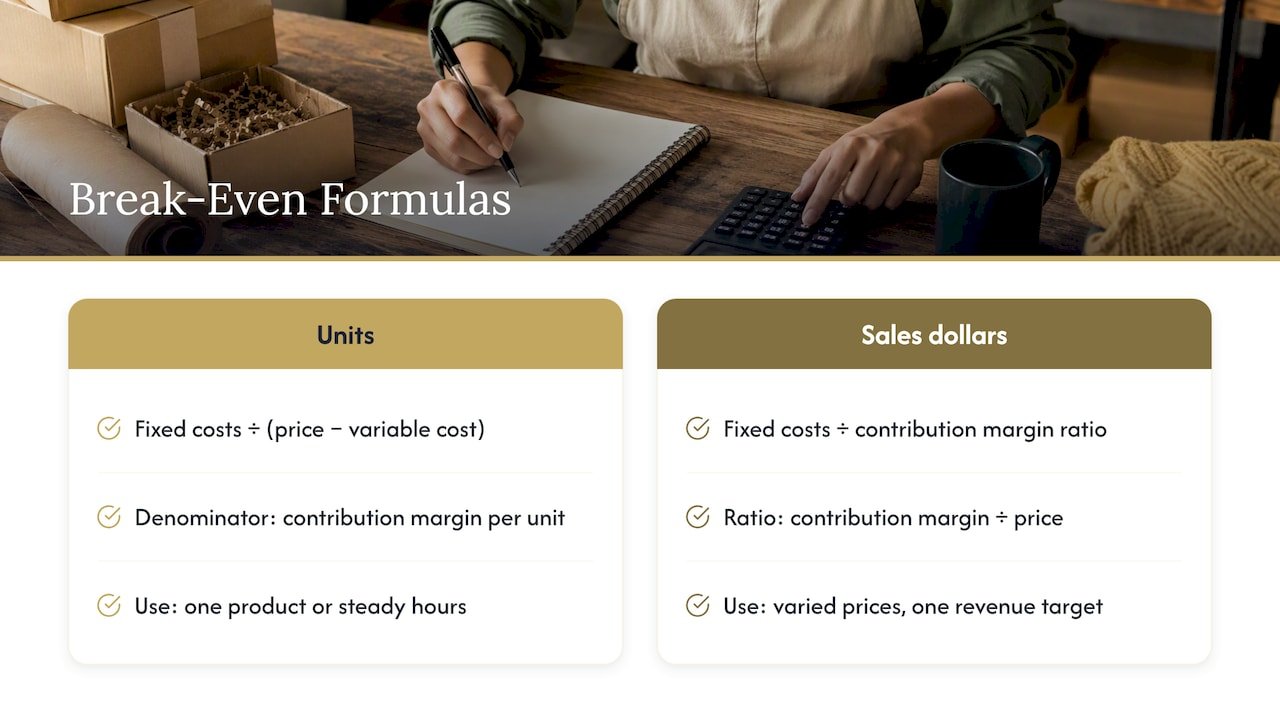
- In units: fixed costs ÷ (price − variable cost per unit). In dollars: fixed costs ÷ contribution margin ratio.
- Service businesses should count billable hours, not total hours, and include their own pay and benefits as costs.
- Re-run the numbers with different prices and costs to see how fragile your target is.
- Break-even is a short-term planning tool. It does not replace a budget or a forecast.
Table of Contents
- What break-even means for a small business
- Fixed and variable costs: sorting your expenses
- The break-even formulas
- Worked example: a product business
- Break-even for a service business or freelancer
- How owners use the result
- Where break-even analysis falls short
- Our perspective: a number you should revisit
- Get help building your break-even model
- A simple checklist for your first break-even analysis
- FAQ
- Sources
What break-even means for a small business
The U.S. Small Business Administration defines the break-even point as the level of production at which total costs and total revenue are equal. Below it, you lose money. Above it, you earn a profit.
That makes it one of the most useful numbers a new owner can know. It answers practical questions:
- How many customers, orders or billable hours do I need each month?
- Is my price high enough to cover what it costs me to deliver?
- How much can sales drop before I start losing money?
It matters most at three moments: before you launch, when you change a price, and when you take on a new fixed cost such as a lease, a hire or a software contract.
Fixed and variable costs: sorting your expenses
Every break-even calculation starts with sorting costs into two groups.
Fixed costs do not change with how much you sell. The SBA lists rent, insurance, salaries, property taxes, interest and depreciation as examples.
Variable costs rise and fall with volume: materials, packaging, shipping, payment processing fees, sales commissions, and hourly labor you pay only when work is done.
Some costs are a mix of both, such as a utility bill with a base charge plus usage, or a phone plan with overage fees. The SBA advises separating these semi-variable costs into their fixed and variable parts when you can.
A quick sorting table
| Expense | Usually fixed | Usually variable |
|---|---|---|
| Rent or lease | Yes | |
| Insurance | Yes | |
| Salaried staff | Yes | |
| Software subscriptions | Yes | |
| Raw materials or inventory | Yes | |
| Shipping and packaging | Yes | |
| Card processing fees | Yes | |
| Hourly contractors paid per job | Yes | |
| Sales commissions | Yes |
The sorting is only as good as your books. If expenses are miscategorized or months behind, the result will mislead you. Our guide to bookkeeping best practices for small business owners covers how to keep categories clean from the start.
The break-even formulas
There are two versions, and both come from the same logic.
Break-even in units
Fixed costs ÷ (selling price per unit − variable cost per unit)
The bottom part of that fraction is the contribution margin: what each sale contributes toward paying fixed costs once its own direct costs are covered.
Break-even in sales dollars
Fixed costs ÷ contribution margin ratio
The contribution margin ratio is the contribution margin divided by the selling price. The SBA describes both calculations on its break-even point page.
Use the unit version when you sell a single product or a consistent hour of work. Use the dollar version when you sell many items at different prices and need one revenue target.
Worked example: a product business
This is a hypothetical business, used only to show the math. Say you run a small coffee cart.
- Fixed costs: $6,000 per month (permits, cart lease, insurance, software, your salary)
- Average price per drink: $12 (a typical order including a pastry)
- Variable cost per order: $4.50 (ingredients, cups, card fees)
Step 1: contribution margin. $12 − $4.50 = $7.50 per order.
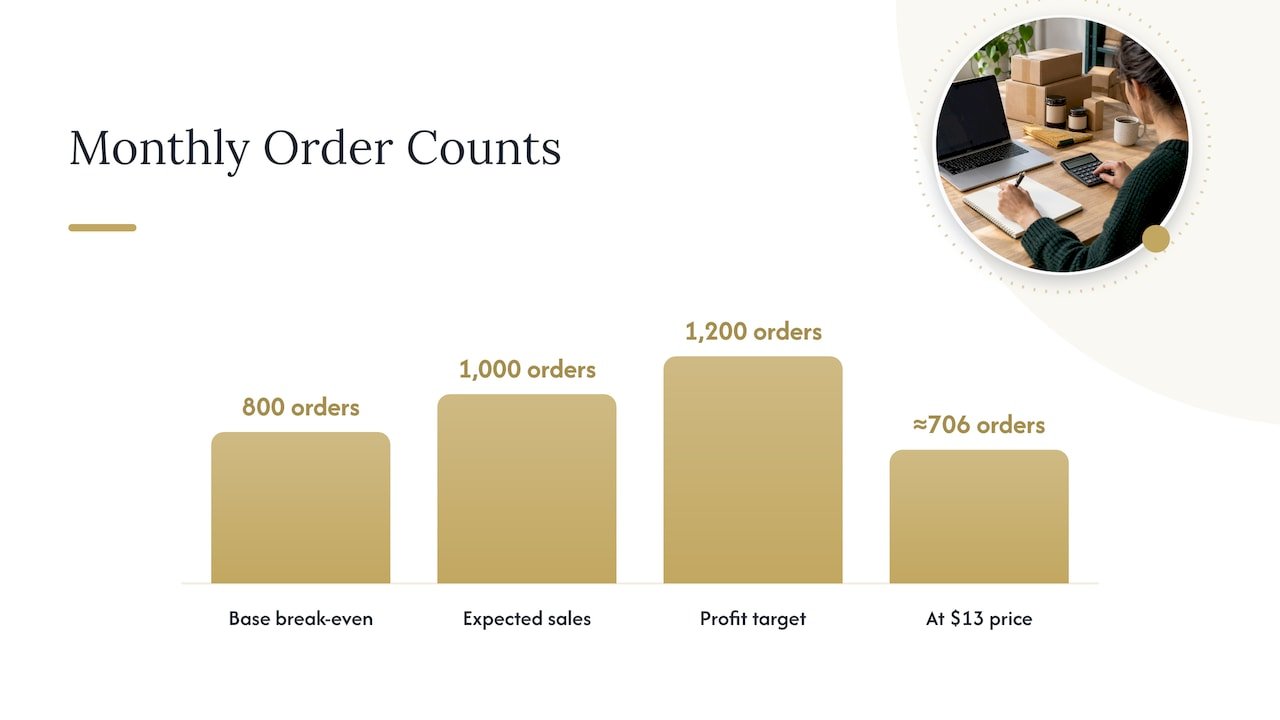
Step 2: break-even units. $6,000 ÷ $7.50 = 800 orders per month.
Step 3: break-even revenue. The contribution margin ratio is $7.50 ÷ $12 = 62.5%. Then $6,000 ÷ 0.625 = $9,600 per month. You get the same answer by multiplying 800 orders by $12.
Now put the number to work.
- Margin of safety. If you expect to sell 1,000 orders, you have 200 orders of cushion. Sales could fall 20% before you lose money.
- Profit target. To earn $3,000 a month, add it to fixed costs: ($6,000 + $3,000) ÷ $7.50 = 1,200 orders.
- Price change. Raise the price to $13 and the contribution margin becomes $8.50. Break-even drops to about 706 orders ($6,000 ÷ $8.50 = 705.9, rounded up).
The federation of small businesses in the UK notes that once you pass break-even, each additional unit adds its margin to profit. That is why the 801st order in the example is the first one that earns you anything.
Break-even for a service business or freelancer
If you sell time rather than products, the “unit” is a billable hour. The math is the same, but the inputs are harder to get right.
A University of Nebraska-Lincoln guide shows the trap clearly. With $30,000 in annual fixed costs and $15 in variable cost per hour, billing at $30 an hour means you need 2,000 billable hours just to break even. The guide points out that this is not a realistic model for one person. A full-time year is roughly 2,080 working hours, and nobody bills all of them.
Count billable hours, not working hours
Marketing, invoicing, proposals, bookkeeping and training all take time you cannot charge for. Time off matters too. Guidance from the University of Mary Washington’s Center for Economic Development says that total cost for a self-employed professional should include direct employment costs, such as health insurance and retirement contributions, plus business operating expenses, such as marketing and insurance. The Nebraska guide likewise says billable hours should be adjusted for non-billable tasks and for time away from work.
The same example with a better price
Using the Nebraska figures, raise the rate from $30 to $50 an hour and keep everything else the same:
- Contribution per hour: $50 − $15 = $35
- Break-even hours: $30,000 ÷ $35 = about 858 hours a year
If you can realistically bill 1,200 hours, that leaves roughly 342 hours of cushion. Bill 1,200 hours and everything past the 858th hour is profit, which is $11,970 before taxes ($35 × 342).
The lesson is that for freelancers and consultants, price is usually a bigger lever than hours. Our 90-day service pricing strategy shows how to test rate changes without scaring off clients, and our piece on accounting service pricing explains how flat-rate models work from the buyer’s side.
How owners use the result
Once you have the number, it feeds several decisions.
Setting prices. Small business owners use break-even results to set profitable prices and judge whether a product is viable. If your break-even volume is higher than the market could plausibly buy, the price or the cost structure has to change.
Testing a cost change. Before signing a larger lease or hiring someone, add the cost to your fixed total and see how many more sales you need. The same source notes that the analysis helps you evaluate the impact of cost changes or price increases on the sales you must make.
Judging risk. The margin of safety, the gap between expected sales and break-even, shows how much room you have if a slow season hits.
Planning cash. Break-even tells you the sales level, not when the cash arrives. Customers who pay in 30 or 60 days can leave you short even when you are above break-even on paper. Our guide to business financial planning and the one on setting a small business budget that works cover that side.
Where break-even analysis falls short
Break-even is a clean model, and clean models make assumptions.
- Fixed costs are not fixed forever. Yale School of Management’s primer notes that the analysis assumes fixed costs stay constant within a range of output. Over a longer period, many costs treated as fixed will step up, which can understate costs and overstate profit.
- It ignores the cost of capital. The same primer says the method is not meant for long-term strategic decisions, since it leaves out factors like what your money could earn elsewhere.
- One price, one mix. If you sell several products or give discounts, a single average price can hide a lot.
Test the assumptions
The fix is a simple sensitivity analysis. The USDA’s Natural Resources Conservation Service describes varying price, volume and cost inputs to see how the break-even point shifts. In practice, build a small table in a spreadsheet:
| Scenario | Price | Variable cost | Break-even orders |
|---|---|---|---|
| Base case | $12.00 | $4.50 | 800 |
| Ingredients up 10% | $12.00 | $4.95 | 850 |
| Price up $1 | $13.00 | $4.50 | 706 |
| Both | $13.00 | $4.95 | 746 |
If a small shift in one input pushes break-even far out of reach, you have found the number to watch.
Our perspective: a number you should revisit
Most owners we meet calculate break-even once, usually for a bank or a launch plan, and never touch it again. That is a missed opportunity. The figure only helps if it reflects the business you run today.
What we see in practice is that the weak point is rarely the formula. It is the inputs. Fixed costs are missing because an annual insurance premium or a software renewal was never spread across months. Variable costs are guessed because transactions have not been categorized. Owner pay is left out entirely, so the business seems to break even while the owner works for free.
That is why we treat break-even as a bookkeeping output first. With clean, current books, you can rebuild the analysis in minutes each quarter. We suggest re-running it whenever you change a price, add a fixed cost, or see a margin move for two months in a row. Ask whether the result still feels achievable, then decide what to change: price, costs, or the volume you plan to sell.
For freelancers especially, we would rather you raise a rate by a reasonable amount than work more hours to compensate for a number that was too low. More hours hits a ceiling. Price does not.
— Kelli
Get help building your break-even model
If you would rather not sort through a year of transactions on your own, we can help. Our team provides accounting and bookkeeping for small businesses, including customized financial reporting, budgets and forecasting, cash flow management and business consulting, either virtually or in person. We start by getting your books in order, then build the break-even view that fits how you actually sell. You can also book a consultation to talk through your numbers.
If you want to compare other ways of measuring profitability, see our overview of profit analysis tools for entrepreneurs. To learn where cost reductions typically come from, read about cost-saving accounting strategies.
A simple checklist for your first break-even analysis
- Pull the last 6 to 12 months of expenses from your books.
- Mark each expense as fixed, variable or mixed, and split the mixed ones.
- Add your own pay and benefits to fixed costs if they are not already there.
- Calculate your average price and variable cost per unit or per billable hour.
- Compute break-even in units and in dollars.
- Compare it to your realistic sales, and calculate the margin of safety.
- Run at least three what-if scenarios for price and cost.
- Put a reminder on your calendar to repeat it each quarter.
FAQ
Is breaking even the same as making a profit?
No. At break-even your total revenue equals your total costs, so profit is zero. According to the SBA, that point means zero profit and zero loss. Profit begins with the first sale above it.
Should I include my own salary in fixed costs?
Yes, if you want an honest answer. For self-employed professionals, the University of Mary Washington guide counts direct employment costs such as health insurance and retirement contributions in the total. Leaving out owner pay makes the target look easier than it is.
How often should I recalculate break-even?
Recalculate whenever your prices, major costs or product mix change, and review it at least quarterly. Fixed costs that seem stable can step up over time, a limit noted in Yale’s primer. A regular check keeps the target tied to the business you run now.
Does break-even analysis tell me what my business is worth?
No. It shows the sales you need to cover costs, not the value of the company. Questions like what a business with $500,000 or $1,000,000 in sales is worth depend on profit, assets, growth and the market, so they need a separate valuation. An accountant can walk you through that if you are buying, selling or seeking funding.
Sources
- Break-even point, U.S. Small Business Administration
- The Starting Point: Calculating Break-Even, University of Nebraska-Lincoln
- Basic Cost Approach to Pricing, University of Mary Washington Center for Economic Development
- A Primer on Breakeven Analysis, Yale School of Management
- Break-even and profit, Business Queensland
- Break-even analysis for small business, Federation of Small Businesses