


Financial risk reduction for small businesses is defined as the process of identifying, evaluating, and controlling threats to your company’s cash flow, assets, and long-term stability. The globally recognized standard for this process is ISO 31000, which outlines five steps: identify, analyze, evaluate, treat, and monitor. Small business owners who apply this framework systematically protect themselves from the most common financial shocks, including cash flow disruptions, client concentration, and uninsured losses. This guide walks you through each step, including the 13-week rolling cash flow forecast and four core treatment strategies, so you can build real financial safety for your business.
What financial risks do small businesses face?
Small business financial risk falls into four main categories: cash flow disruptions, client concentration, debt exposure, and uninsured losses. Each one can threaten your operations independently. Together, they can shut a business down fast.
Cash flow disruptions happen when income and expenses fall out of sync. A client pays late, a supplier demands upfront payment, or a slow season hits harder than expected. Client concentration means one customer accounts for a large share of your revenue. Losing that client creates an immediate crisis. Debt exposure covers loans, credit lines, and obligations that become unmanageable when revenue drops. Uninsured losses include property damage, liability claims, or data breaches that your current coverage does not address.

The most practical tool for identifying these risks is a risk register. A risk register is a simple document that lists every potential threat, its likelihood, its potential impact, and who owns it. You can build one in a spreadsheet. The goal is to get every risk out of your head and onto paper so you can act on it.
To build your risk register, pull from two sources:
- Internal data: your financial statements, accounts receivable aging reports, and past incidents. Learning how to read financial statements is the fastest way to spot patterns you might otherwise miss.
- External data: market trends, supplier news, and industry reports that signal emerging threats.
| Risk Category | Common Example | Data Source to Check |
|---|---|---|
| Cash flow disruption | Late client payments | Accounts receivable aging report |
| Client concentration | One client = 40%+ of revenue | Revenue breakdown by client |
| Debt exposure | Variable-rate loan payments rising | Loan agreements, interest rate trends |
| Uninsured loss | Cyberattack, property damage | Insurance policy review |
Pro Tip: Set a calendar reminder to update your risk register every quarter. Risks that seemed minor in January can become critical by October as market conditions shift.
How do you prioritize financial risks by impact and likelihood?
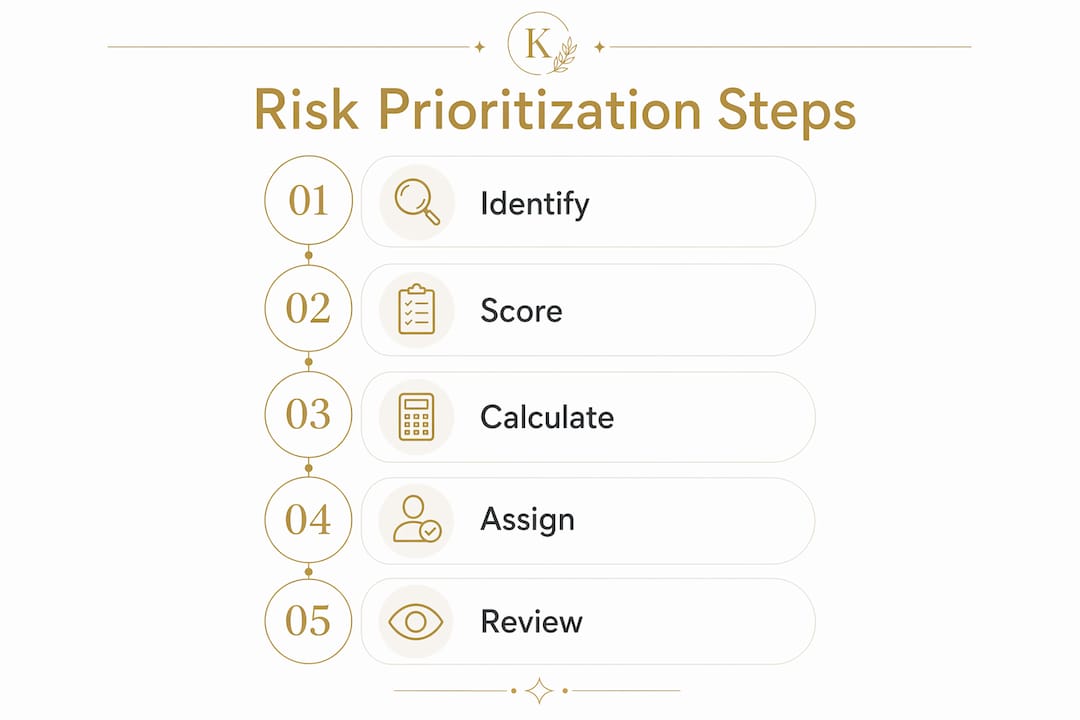
Not every risk deserves equal attention. The impact-vs-likelihood matrix is the standard tool for deciding where to focus first. It plots each risk on two axes: how severe the financial damage would be, and how probable the event is.
Prioritizing risks using this matrix focuses your limited time and money on the threats that matter most. High-impact, high-likelihood risks require immediate action. High-impact, low-likelihood risks need a contingency plan but not daily attention. Low-impact risks of any likelihood can be monitored passively.
| Risk Zone | Impact | Likelihood | Recommended Action |
|---|---|---|---|
| Critical | High | High | Act immediately, assign owner |
| Contingency | High | Low | Build a backup plan |
| Monitor | Low | High | Track quarterly |
| Accept | Low | Low | Document and revisit annually |
Pro Tip: Score each risk on a 1–5 scale for both impact and likelihood, then multiply the two scores. Any risk scoring 15 or above belongs in your critical zone.
After scoring, assign each risk to a specific person in your business. Unowned risks never get resolved. Revisit your scores quarterly because risk likelihood can shift seasonally or with economic changes. A risk you scored a 2 in march may be a 4 by september.
Step-by-step risk treatment strategies to lower financial exposure
ISO 31000 defines four treatment strategies for every identified risk: avoid, mitigate, transfer, and accept. Applying all four gives you the strongest protection. Relying on just one leaves gaps.
Avoid
Avoidance means stopping an activity that creates unacceptable risk. If a new product line requires debt you cannot service if sales disappoint, you avoid the risk by not launching it yet. If a particular client consistently pays 90 days late and disrupts your cash flow, you avoid the risk by ending that relationship or requiring prepayment.
Avoidance is not always possible, but it is always worth asking: “Can we simply not do this?”
Mitigate
Mitigation means reducing the probability or impact of a risk you cannot avoid. This is where most of your day-to-day risk management happens.
Key mitigation actions for small businesses include:
- Cash flow forecasting: A 13-week rolling cash flow forecast tracks every expected inflow and outflow across the next 90 days. It triggers a review automatically when your cash balance approaches a reserve threshold. Managing cash flow with bookkeeping is the most direct way to build this discipline into your routine.
- Invoice management: Send invoices immediately after delivery. Offer a small early-payment discount. Charge late fees consistently.
- Supplier vetting: Qualify backup suppliers before you need them. Single-source dependency is a supply chain risk that becomes a financial risk fast.
- Diversifying revenue: If one client represents more than 30% of your revenue, actively pursue new clients to reduce that concentration.
Transfer
Transfer means shifting the financial impact of a risk to a third party, most commonly through insurance. General liability, business interruption, professional liability, and cyber insurance all transfer specific risks. However, insurance transfers financial impact but does not prevent operational disruption or reputation damage. A business interruption claim pays out eventually. Your customers may not wait that long.
Accept
Acceptance means acknowledging a risk and choosing to absorb it rather than spend resources managing it. This works for low-impact risks where the cost of mitigation exceeds the potential loss. When you accept a risk, set aside a reserve fund to cover it if it materializes. Self-insuring small, predictable losses is a legitimate strategy when your cash reserves are healthy.
Pro Tip: Formal risk management programs can reduce insurance premiums by 10–20%. Document your controls and share them with your insurer at renewal time.
What tools help you monitor financial risks continuously?
Risk management is not a one-time setup. Quarterly updates to your risk register and rescoring of each risk are the minimum standard for staying current. The tools below make that process manageable.
The 13-week rolling cash flow forecast
This forecast covers 13 weeks of projected inflows and outflows, updated weekly. It shows you exactly when your cash balance will dip below your reserve threshold. At that point, you act: collect receivables faster, delay non-critical expenses, or draw on a credit line. Without this forecast, you find out about a cash crisis when it is already happening.
Key risk indicators
Key risk indicators (KRIs) are metrics that signal a risk is growing before it becomes a crisis. Track these three at minimum:
- Current ratio: current assets divided by current liabilities. A ratio below 1.0 means you cannot cover short-term obligations.
- Days Sales Outstanding (DSO): the average number of days clients take to pay. Rising DSO signals a cash flow problem forming.
- Cash runway: how many months of operating expenses your current cash covers. Below three months is a warning level.
Scenario planning
Scenario planning with three outlooks — best case, worst case, and “something interesting” — prepares you for environments you cannot predict. The “something interesting” scenario is the most valuable. It forces you to think through a specific, plausible disruption: losing your largest client, a supplier going out of business, or a regulatory change affecting your industry. Stress-testing your cash flow by simulating major revenue drops confirms whether your emergency reserves are actually sufficient.
Pro Tip: Run your worst-case scenario through your 13-week forecast. If the numbers show you running out of cash in week 8, you need a larger reserve or a faster access to credit before that scenario becomes real.
Common mistakes that increase financial risk for small businesses
The most damaging financial risk management mistake is mixing personal and business finances. Separating personal and business finances is fundamental to accurate risk assessment and reduces your personal liability exposure. When finances are commingled, you cannot see your true business cash position, and your personal assets become vulnerable to business creditors.
The second most common mistake is treating insurance as a complete risk management plan. Insurance alone is insufficient protection. It must be combined with avoidance, mitigation, and acceptance strategies to cover the gaps insurance cannot reach, including reputational damage and operational downtime.
Other critical mistakes include:
- Over-reliance on a single client or revenue stream. Stress-testing your revenue by modeling what happens if your top client leaves is the fastest way to see this vulnerability clearly.
- Skipping the contingency plan. A risk register without assigned owners and response plans is just a list of worries.
- Treating risk management as a one-time task. Conditions change. A plan built in january may be dangerously outdated by july.
When a risk does materialize, the response sequence is straightforward: activate your contingency plan, communicate with affected stakeholders immediately, and document what happened for your next risk register update. For additional guidance on building a resilient financial foundation, resources like the Charles Choate Creative blog cover business management topics including how digital presence affects financial stability.
“The businesses that survive financial shocks are not the ones that avoided all risk. They are the ones that planned for it, knew their numbers, and had a response ready before the crisis arrived.”
Key Takeaways
Reducing financial risk for small businesses requires a structured, ongoing process built on the ISO 31000 framework, consistent cash flow monitoring, and all four treatment strategies working together.
| Point | Details |
|---|---|
| Use a risk register | List every financial threat, score it by impact and likelihood, and assign an owner. |
| Apply all four treatments | Combine avoid, mitigate, transfer, and accept for the strongest protection. |
| Forecast cash flow weekly | A 13-week rolling forecast shows cash shortfalls before they become crises. |
| Separate finances completely | Keep personal and business accounts apart to protect assets and see true financial health. |
| Update risks quarterly | Rescore your risk register every quarter because conditions change throughout the year. |
What I’ve learned about financial risk that most guides won’t tell you
Most risk management articles hand you a framework and call it done. What they skip is the part that actually determines whether you survive a financial shock: the habit of looking at your numbers before something goes wrong.
I have worked with small business owners who had insurance, a business plan, and good intentions. What they did not have was a current picture of their cash position. When a major client left or a supplier raised prices overnight, they were making decisions blind. The 13-week rolling forecast is not glamorous. It is a spreadsheet you update every week. But it is the single tool that most consistently separates businesses that adapt from businesses that scramble.
The other thing I see consistently underestimated is client concentration. A business owner who is proud of a strong relationship with one large client is often sitting on the most dangerous risk in their portfolio. That relationship feels like security. It is actually exposure. Diversifying your revenue base is not a growth strategy. It is a survival strategy.
Risk management works best when it is built into your regular financial review, not treated as a separate annual exercise. Quarterly rescoring, monthly KRI checks, and a weekly cash flow update take less than two hours a month combined. That two hours is the most valuable time you spend on your business finances. For owners who want personalized financial strategies built around their specific risk profile, working with a financial professional makes that process faster and more accurate.
— Kelli
How Kelliworks supports your financial risk management
Financial risk management is only as strong as the financial data behind it. When your books are accurate, current, and organized, every risk decision you make is grounded in reality.

Kelliworks operates as a full-service virtual accounting department for small business owners. We handle bookkeeping, cash flow forecasting, and financial consulting so you always know where your business stands. Our team builds the financial visibility you need to identify risks early, apply the right treatment strategies, and keep your reserves where they need to be. If you are ready to put a real risk management foundation under your business, hiring a virtual accountant through Kelliworks is the most direct path to financial clarity and control. Schedule a free consultation to get started.
FAQ
What is financial risk management for small businesses?
Financial risk management is the process of identifying, evaluating, and controlling threats to your business’s cash flow and assets. The ISO 31000 framework defines five steps: identify, analyze, evaluate, treat, and monitor.
How do I start a financial risk assessment for my small business?
Build a risk register that lists every potential financial threat, scores each one by impact and likelihood, and assigns an owner. Pull data from your financial statements, accounts receivable reports, and market conditions.
What is a 13-week rolling cash flow forecast?
A 13-week rolling cash flow forecast tracks every expected inflow and outflow across the next 90 days, updated weekly. It triggers a review when your cash balance approaches your reserve threshold, giving you time to act before a shortfall hits.
Why is insurance not enough to manage financial risk?
Insurance transfers the financial impact of a loss but does not prevent operational disruption or reputational damage. Combining insurance with avoidance, mitigation, and acceptance strategies covers the gaps that insurance alone cannot reach.
How often should I update my risk management plan?
Update your risk register and rescore each risk at least quarterly. Risk likelihood shifts with seasonal changes, economic conditions, and business growth, so a plan built at the start of the year may be outdated within months.