


Financial goals planning is the process of setting, documenting, and executing clear financial objectives to drive business growth and stability. For small business owners, this practice is not optional. 76% of Americans have financial goals, but only 34% write them down. Among those who do write them down, 76% actually achieve their goals. That gap tells you everything about why documentation is the most underused tool in business finance.
The industry term for this practice is goal-based financial planning. It prioritizes your business and lifestyle objectives over short-term market performance. The role of financial goals planning goes beyond tracking numbers. It gives every budget decision, investment, and expense a clear purpose. Without that structure, most business owners react to problems instead of preventing them.
What are the key components of effective financial goals planning?
The SMART goals framework is the foundation of any effective financial planning process. SMART stands for Specific, Measurable, Achievable, Relevant, and Time-bound. Applying the SMART framework makes goals far more likely to succeed than vague intentions. A goal like “grow revenue” gives you nothing to act on. A goal like “increase monthly revenue by $5,000 within six months by adding two new service packages” gives you a target, a deadline, and a method.

Breaking large goals into milestones keeps progress visible and motivation high. A business owner targeting $100,000 in annual profit should set quarterly checkpoints at $25,000 each. Missing a quarterly milestone signals a problem early, when you still have time to adjust. Hitting one builds confidence and confirms the plan is working.
Prioritizing goals by time horizon matters just as much as setting them:
- Short-term goals (under 12 months): Build an emergency fund, pay down high-interest debt, or cover a specific equipment purchase.
- Medium-term goals (1–3 years): Hire a key employee, expand to a second location, or reach a revenue threshold.
- Long-term goals (3+ years): Fund retirement, acquire a competitor, or achieve full financial independence from the business.
Pro Tip: Write your goals in a shared document and review them with your accountant or financial consultant each quarter. Accountability to another person increases follow-through significantly.
How does financial goal setting improve business decision-making?
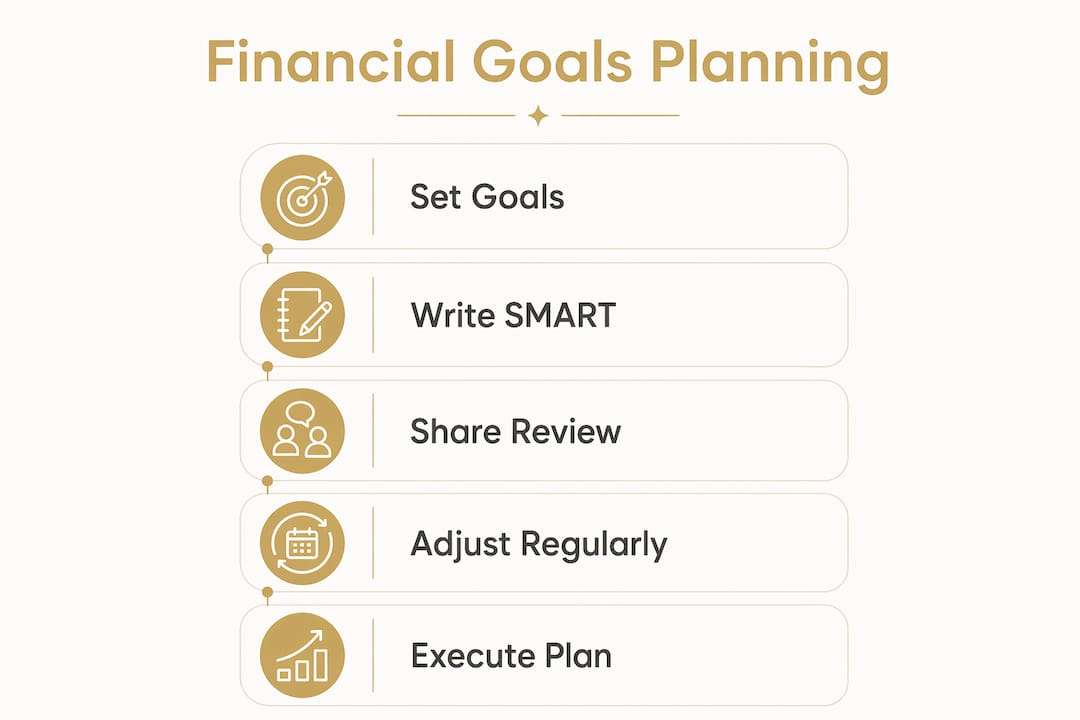
Goal-based financial planning anchors every business decision to a specific objective. Goal-driven strategies reduce decision fatigue and increase confidence during market volatility. When you know your six-month cash reserve goal, you stop second-guessing whether to take on a risky client or delay a purchase. The goal answers the question for you.
Budgeting becomes far more effective when it connects to clear goals. Two methods work well for small businesses:
- The 50/30/20 rule: Allocate 50% of revenue to operating costs, 30% to growth investments, and 20% to savings or debt reduction. Goal-setting paired with budgeting systems improves the likelihood of meeting financial targets.
- Zero-based budgeting: Assign every dollar a purpose at the start of each month. This method forces you to justify every expense against your current goals, not last year’s habits.
Cash flow management is the operational foundation that makes goals achievable. A business can be profitable on paper and still fail because cash arrives too slowly. Tracking receivables weekly and aligning payment terms with your cash flow goals prevents that gap from becoming a crisis. You can learn more about this through cash flow and bookkeeping practices built for small businesses.
Holistic financial planning coordinates investing, taxes, insurance, and cash flow to create long-term stability. Risk management belongs inside your financial plan, not outside it. A business owner who sets a goal to protect $200,000 in assets will naturally review their insurance coverage and liability exposure as part of that goal. Without the goal, that review never happens.
Pro Tip: When market conditions shift, do not abandon your goals. Adjust the timeline or the milestone amount, but keep the destination intact. Reactive decisions made during volatility almost always cost more than a measured plan adjustment.
What strategies keep financial goals planning effective as businesses evolve?
Financial plans are living documents. Experts recommend monthly check-ins and quarterly reviews to keep goals aligned with evolving business realities. A plan written in january may need significant revision by april if a major client leaves or a new opportunity appears. The review schedule is what separates a plan that works from one that collects dust.
Effective ongoing strategies include:
- Monthly check-ins: Review actual revenue and expenses against your targets. Identify variances early and adjust spending or sales activity before the gap widens.
- Quarterly milestone reviews: Assess progress on medium-term goals. Decide whether to accelerate, adjust, or replace goals that no longer fit your business direction.
- Annual full plan reset: Rebuild your goal hierarchy from scratch each year. Factor in tax strategy, debt payoff progress, insurance needs, and any major business changes.
“Financial planning is a continuous process, not a one-time event. The businesses that thrive are the ones that treat their financial plan as a working tool, not a filing cabinet document.” — Fidelity Financial Planning Guide
Setbacks are part of every business cycle. A goal-oriented owner responds to a slow quarter by reviewing the plan and identifying which levers to pull. An owner without a plan responds emotionally, often cutting the wrong costs or chasing the wrong revenue. Anchoring financial decisions in long-term goals builds the emotional discipline to stay steady when results are temporarily off track.
Structural financial decisions such as tax planning, debt management, and insurance reviews often have greater long-term impact than chasing investment returns. Building these reviews into your quarterly goal cycle means they happen consistently, not only when a crisis forces them.
How can small business owners integrate financial planning with professional services?
Professional accounting and consulting services turn financial goals from intentions into executed plans. Virtual accountants provide expert support to help small businesses align goals with accurate bookkeeping, tax strategy, and cost-saving measures. A virtual accounting department gives you the expertise of a full finance team without the overhead of full-time staff.
The table below shows how professional services map to specific goal-planning needs:
| Goal-planning need | Professional service that addresses it |
|---|---|
| Accurate revenue and expense tracking | Monthly bookkeeping and reconciliation |
| Tax liability reduction | Proactive tax planning and preparation |
| Goal progress measurement | Financial statement review and analysis |
| Cash flow forecasting | Bookkeeping with cash flow reporting |
| Cost reduction tied to growth goals | Cost-saving accounting strategies |
Working with a financial consultant helps you connect your goals to your actual numbers. Many business owners set goals in isolation from their financial statements. A consultant reads your profit and loss statement, balance sheet, and cash flow report alongside your goals to identify where the plan is realistic and where it needs revision. Understanding how to read financial statements is a foundational skill that makes every goal-planning conversation more productive.
The right time to seek expert help is before a problem becomes urgent. Business owners who engage professional support early set more accurate goals, avoid costly tax surprises, and build financial habits that compound over time. Personalized financial strategies tailored to your industry and revenue stage produce better outcomes than generic templates.
Key Takeaways
Effective financial goals planning requires written, SMART objectives reviewed regularly and supported by professional accounting to produce measurable, lasting business growth.
| Point | Details |
|---|---|
| Write goals down | Documented goals achieve a 76% success rate compared to unrecorded intentions. |
| Use the SMART framework | Specific, Measurable, Achievable, Relevant, Time-bound goals outperform vague targets. |
| Budget with purpose | Align every dollar to a goal using zero-based or 50/30/20 budgeting methods. |
| Review plans regularly | Monthly check-ins and quarterly reviews keep goals aligned with business reality. |
| Get professional support | Virtual accounting services connect your goals to accurate financial data and tax strategy. |
Why I believe most small business owners are one written plan away from a breakthrough
After working with small business owners across dozens of industries, the pattern is consistent. The owners who struggle financially are not less talented or less hardworking. They simply have not written their goals down and connected them to a real budget. They know what they want, but they have not built the structure that makes it achievable.
The biggest mistake I see is treating financial planning as a year-end activity. Owners scramble in december to understand what happened, instead of reviewing monthly and adjusting in real time. By the time they see the problem, the year is over and the opportunity to fix it is gone.
What actually works is simple: write three to five financial goals for the next 12 months, assign a dollar amount and a deadline to each one, and review them every month with someone who can hold you accountable. That accountability partner is often an accountant or financial consultant, not a business partner or spouse. The professional relationship creates the right kind of pressure.
Goal-based financial planning prioritizes your business and lifestyle goals over short-term performance. That shift in focus changes how you make decisions every single week. You stop chasing trends and start building toward something specific. The clarity that comes from a written plan is not just financial. It reduces stress, improves sleep, and makes the day-to-day work feel purposeful.
— Kelli
How Kelliworks supports your financial goals planning
Small business owners who work with Kelliworks get more than bookkeeping. They get a full virtual accounting department that connects their financial goals to real numbers, tax strategy, and monthly accountability.

Kelliworks offers tailored services including tax preparation, bookkeeping, and financial consulting, all designed to help you build and execute a financial plan that fits your business. Whether you are setting goals for the first time or refining a plan that has stalled, our team brings the expertise to make it work. Learn how virtual accounting services can support your planning process, or book a free consultation to talk through your specific goals with a professional who understands small business finance.
FAQ
What is the role of financial goals planning for small businesses?
Financial goals planning gives small business owners a clear, documented roadmap for every financial decision. It connects budgets, cash flow, and tax strategy to specific, time-bound objectives that drive measurable growth.
How does writing down financial goals improve results?
Written goals improve achievement rates significantly. Among people who document their financial goals, 76% achieve them, compared to far lower rates among those who do not write them down.
What is the SMART goals framework in financial planning?
SMART stands for Specific, Measurable, Achievable, Relevant, and Time-bound. Applying this structure to financial goals makes them far more likely to succeed than broad or vague intentions.
How often should small business owners review their financial plan?
Monthly check-ins and quarterly milestone reviews are the standard recommendation. Annual full resets allow owners to rebuild their goal hierarchy based on the prior year’s results and new business priorities.
When should a small business owner hire a financial professional?
The best time is before a financial problem becomes urgent. Professional support helps owners set accurate goals, avoid tax surprises, and build consistent financial habits that compound over time.



4 Responses