


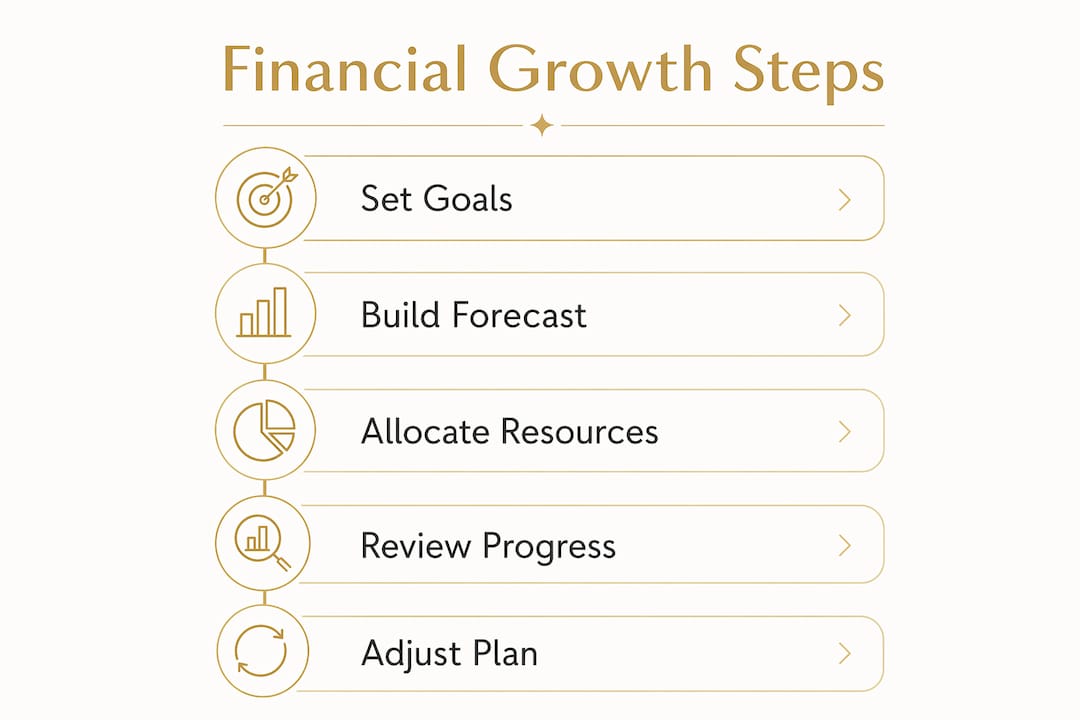
A financial growth strategy is defined as a structured plan that connects your revenue goals, cost structure, and investment decisions across a 3–5 year horizon, reviewed monthly to stay aligned with real business performance. The industry term for this practice is strategic financial planning, and it covers far more than a basic budget. For small business owners, entrepreneurs, and freelancers, building this kind of plan is the difference between reacting to financial surprises and making confident decisions before problems appear. This guide walks you through each step to create a financial growth strategy that actually works in 2026.
How to create a financial growth strategy with SMART goals
Clear goals are the foundation of any financial growth plan. Without them, you are managing money without direction. The SMART framework, which stands for Specific, Measurable, Achievable, Relevant, and Time-bound, gives your goals structure that you can actually track and act on.
A strong SMART financial goal looks like this: increase net revenue by 20% within 12 months by adding two new service packages and reducing client churn below 10%. That goal names the target, the method, and the deadline. SMART goal examples like boosting revenue 20% in one year or executing a 24-month hiring plan are considered best practice in 2026 because they force you to connect ambition to a specific plan.
Small business owners benefit from setting goals across two time horizons. Short-term goals cover 6–12 months and focus on cash flow, margin improvement, or a specific revenue milestone. Long-term goals cover 2–4 years and address expansion, hiring, or entering a new market. Separating these two horizons prevents you from sacrificing long-term stability for short-term wins.
Aligning financial goals with your overall business strategy is equally critical. If your business strategy is to grow through referrals, your financial goal should fund a referral program, not a paid advertising campaign. Misaligned goals waste money and slow growth. Kelliworks helps small business owners set aligned financial goals that reflect both their numbers and their vision.

Pro Tip: Review your goals every 90 days, not just annually. Markets shift, costs change, and a goal that made sense in january may need adjustment by april.
Why rolling forecasts outperform static annual budgets
Static annual budgets become outdated fast. Many small businesses find their annual budget obsolete by Q2 during growth phases because revenue and costs shift faster than a once-a-year plan can accommodate. A rolling 12-month forecast solves this by updating every month, so your plan always reflects current reality.
The table below shows the key differences between a static budget and a rolling forecast.
| Feature | Static annual budget | Rolling 12-month forecast |
|---|---|---|
| Update frequency | Once per year | Monthly |
| Reflects current data | Rarely after Q1 | Always |
| Handles growth volatility | Poorly | Well |
| Scenario planning | Limited | Built in |
| Decision-making speed | Slow | Fast |
Driver-based forecasting makes rolling forecasts even more reliable. Instead of guessing a top-line revenue number, you build your forecast from the inputs that actually drive revenue: client count, average transaction value, and purchase frequency. Driver-based forecasting using these three levers produces projections that are grounded in real business activity, not wishful thinking.
Scenario planning adds another layer of protection. Build three versions of your forecast: a base case using current trends, an optimistic case assuming a strong quarter, and a conservative case assuming a slowdown. Running all three gives you a clear picture of your financial range and prevents you from being blindsided by a bad month.
A well-built financial operating model connects your revenue drivers to your cost drivers and projects your profit and loss statement, balance sheet, and cash flow at the same time. That integration is what turns a forecast into a real decision-making tool.
Pro Tip: Pull in 24 months of historical data before building your first rolling forecast. Patterns in your own numbers are more reliable than industry benchmarks.
How to allocate resources and plan growth investments
Resource allocation is where financial strategy development gets concrete. You need to know exactly what your money is doing before you can decide where to put more of it.
Start by mapping your cost structure into three categories:
- Fixed costs: Rent, software subscriptions, salaries. These do not change with revenue volume.
- Variable costs: Payment processing fees, materials, contractor hours. These scale with output.
- Step-function costs: Costs that jump at specific capacity thresholds, like hiring a second employee or leasing additional office space.
Separating these three cost types clarifies exactly when you will hit a capacity limit and what it will cost to break through it. That clarity tells you when to hire, when to invest in equipment, and when to hold back.
Break-even analysis is the next tool every small business owner needs. For any growth investment, model the total cost, the expected revenue it generates, the contribution margin, and the exact payback period. Break-even analysis for growth investments prevents cash traps, which are situations where you spend money on growth but run out of cash before the revenue arrives.
Timing matters as much as the investment itself. Securing financing proactively, before you need it, consistently produces lower costs and better terms than scrambling for capital mid-crisis. If your forecast shows you will need a credit line in six months, apply now.
Operational readiness must match your financial plan. Staffing, technology, and processes need to scale in step with your financial growth plan. Hiring too late creates bottlenecks. Hiring too early burns cash. Your resource allocation plan should include specific revenue triggers that tell you exactly when to make each move.
For freelancers and solo operators, cost-saving strategies are just as important as revenue growth. Reducing unnecessary fixed costs frees up capital for investments that actually move the needle.
How do you track and adjust a financial growth strategy?
Tracking is where most small business owners fall short. They build a plan, then check it once a quarter and wonder why results do not match projections. Consistent monitoring, using the right metrics, is what keeps a financial strategy alive.
Build a KPI dashboard that tracks these metrics monthly:
- Gross margin: Revenue minus direct costs, expressed as a percentage. This tells you if your pricing and delivery costs are healthy.
- Net cash flow: Cash in minus cash out. Monthly cash flow forecasting that layers customer payment timing, vendor payouts, and capital expenditures prevents cash shortages during growth phases.
- Customer acquisition cost (CAC): What you spend to win one new client. Rising CAC signals that your marketing or sales process needs attention.
- Revenue per client: Tracks whether your existing clients are growing in value over time.
Monthly reviews catch problems early. Quarterly reviews are too infrequent during growth phases. Rolling forecasts updated monthly keep small businesses aligned with fast-changing realities. Set a fixed date each month, review actuals against your forecast, identify the gaps, and update the plan.
Scenario modeling is not just for planning. Use it during reviews to test how a 15% revenue drop or a sudden cost increase would affect your cash position. That kind of stress-testing builds confidence and prevents reactive decisions.
Reading your financial statements accurately is a prerequisite for effective monitoring. If you cannot interpret your profit and loss statement or balance sheet, you cannot spot the warning signs early enough to act.
Pro Tip: Assign ownership of each KPI to a specific person, even if that person is you. Metrics without owners do not get fixed.
Key takeaways
A financial growth strategy works when it combines clear SMART goals, monthly rolling forecasts, disciplined resource allocation, and consistent KPI monitoring reviewed on a fixed schedule.
| Point | Details |
|---|---|
| Use SMART goals | Set specific, time-bound financial targets that connect directly to your business strategy. |
| Replace static budgets | Switch to rolling 12-month forecasts updated monthly to stay aligned with real performance. |
| Map your cost structure | Separate fixed, variable, and step costs to identify capacity limits and hiring triggers. |
| Plan investments early | Model break-even and payback before committing capital, and secure financing before you need it. |
| Monitor monthly | Track gross margin, net cash flow, and CAC every month and update your forecast accordingly. |
What I have learned from watching small businesses plan for growth
The most common mistake I see is confusing growth with scaling. Growth and scaling are not the same thing. Growth means spending more to earn more. Scaling means growing revenue faster than costs. Most small business owners want to scale, but they plan as if they are just growing. That gap between intention and execution is where cash disappears.
The second pattern I notice is that business owners wait until they feel financially comfortable before they start planning. That is exactly backwards. Financial plans shift businesses from reactive to proactive management, and that shift is most valuable when things feel uncertain. The plan is not a prediction. It is a framework for making faster, better decisions when reality does not match your expectations.
Flexible forecasting is not a sign of weakness or indecision. It is the most honest thing you can do with your numbers. A business owner who updates their forecast every month and adjusts their plan accordingly is far more in control than one who defends a January budget in october. Embrace the revision. That is where the real financial strategy development happens.
If you are a freelancer or solo operator, do not assume this level of planning is only for larger businesses. The IT strategy principles that apply to SMBs in 2026 make clear that proactive planning at any size produces better outcomes than reactive management. The tools and frameworks are the same. The scale is just smaller.
— Kelli
Financial planning support from Kelliworks
Building a financial growth strategy takes time, clarity, and the right numbers in front of you. Kelliworks operates as a full-service virtual accounting department for small business owners, entrepreneurs, and freelancers who want expert support without the overhead of an in-house finance team.
Kelliworks provides bookkeeping, financial consulting, and tax preparation, all tailored to the specific needs of growing small businesses. Whether you need help building your first rolling forecast, mapping your cost structure, or setting up a KPI dashboard, the team brings the expertise to make it practical. Find out how a virtual accountant can support your financial growth planning, or explore personalized financial strategies built around your business goals.
FAQ
What is a financial growth strategy?
A financial growth strategy is a structured plan that sets measurable revenue and cost goals, builds flexible forecasts, and guides investment decisions across a 3–5 year horizon. It is reviewed monthly to stay aligned with actual business performance.
How do SMART goals apply to financial planning?
SMART goals give financial targets a specific outcome, a measurable metric, and a clear deadline. An example is increasing revenue by 20% within 12 months by adding two new service offerings.
How often should I update my financial forecast?
Small businesses in growth phases should update their rolling forecast every month. Monthly updates keep the plan aligned with real revenue and cost changes, which quarterly reviews miss.
What is the difference between growth and scaling?
Growth means revenue and costs increase together. Scaling means revenue grows faster than costs, producing higher margins over time. Deliberate financial planning is required to achieve scaling rather than just growth.
When should a small business start financial growth planning?
Financial growth planning should start before you feel ready. Proactive planning improves investment confidence and produces better financing terms than reactive planning during a cash shortfall.