


Freelance bookkeeping is the systematic practice of recording, categorizing, and reconciling every financial transaction in your business to maintain accurate records and support tax compliance. The industry term for this practice is “bookkeeping,” distinct from accounting, which interprets and analyzes those records. Understanding freelance bookkeeping basics explained in plain terms gives you control over your cash flow, your deductions, and your peace of mind. Freelancers who track income and expenses consistently avoid the scramble at tax time and make better decisions about pricing, spending, and growth. This guide covers the core components, the right tools, the most common mistakes, and how clean books connect directly to lower tax bills.
What are the essential components of freelance bookkeeping?
Freelance bookkeeping rests on five core tasks. Each one builds on the last, and skipping any one of them creates problems that compound over time.
- Income recording. Log every payment you receive, regardless of the platform. PayPal transfers, direct deposits, checks, and cash all count. The IRS requires you to report all income, and your books need to reflect that before you file Schedule C on your Form 1040.
- Expense categorization. Group every business purchase into a category: software subscriptions, home office, travel, professional development, or equipment. Proper categories determine which deductions you can claim and how much you owe.
- Receipt management. Save every receipt, digital or paper. A photo saved to a cloud folder works. The IRS can audit returns up to three years back, and missing receipts mean lost deductions.
- Bank and credit card reconciliation. Match your recorded transactions against your actual bank statements every month. Reconciliation catches duplicate entries, missed transactions, and bank errors before they distort your profit picture.
- Profit and loss tracking. Subtract total expenses from total income to get your net profit. This number drives your quarterly estimated tax payments on Form 1040-ES and tells you whether your business is actually growing.
Effective bookkeeping routines involve weekly transaction logging and monthly reconciliation to maintain clean, audit-ready books and reduce tax-time stress. That weekly habit takes less time than you think, and the monthly review keeps you from facing a mountain of unrecorded transactions in april.
Pro Tip: Open a dedicated business checking account the day you start freelancing. The “one-checkbook method” of using one business account and one business credit card for all transactions is the single most effective way to avoid bookkeeping errors and audit risk.

What tools and software can freelancers use for bookkeeping?
The right tool depends on your revenue and transaction volume, not on what sounds most professional. Overspending on software before you need it is a common and avoidable mistake.
Freelancers earning under $100,000 annually can manage their books effectively with simple tools and about 30 minutes of weekly bookkeeping time. That is a realistic commitment that fits into any schedule.
Here are the main categories of tools worth considering:
- Free cloud software. Wave offers free invoicing, income tracking, and expense categorization. It connects to bank accounts and generates basic financial reports. It works well for freelancers with straightforward finances.
- Low-cost subscription software. QuickBooks Self-Employed and FreshBooks both offer plans designed for freelancers. They automate expense categorization, track mileage, and generate profit and loss reports. Costs typically fall in the range of $15–$30 per month.
- Spreadsheets. A well-organized Google Sheets or Excel file works for freelancers with low transaction volume. You track income in one tab, expenses in another, and calculate net profit manually. The tradeoff is time: manual entry takes longer than automated imports.
- Receipt and mileage apps. Apps like Expensify handle receipt scanning and mileage logging. These pair well with any bookkeeping software to fill the gaps in expense tracking.
DIY bookkeeping typically costs $0–$30 per month in software. That compares to $200–$600 per month for a professional bookkeeper and $300–$1,500 or more annually for CPA tax preparation. Knowing those numbers helps you decide when to handle books yourself and when to hire help.
Pro Tip: Start with the simplest tool that covers your current needs. You can always upgrade to more powerful software as your income and transaction volume grow. Complexity added too early creates confusion, not clarity.
What are common bookkeeping mistakes freelancers make?
Most bookkeeping problems come from a small set of recurring errors. Recognizing them early saves you money and stress.
- Mixing personal and business finances. Running business expenses through a personal account makes it nearly impossible to separate deductible costs from personal spending. Open a dedicated business account from day one.
- Delaying bookkeeping until tax season. Waiting until april to record a full year of transactions guarantees errors, missed deductions, and hours of painful catch-up work. Common mistakes include delaying bookkeeping until tax season, and the fix is a simple weekly 30-minute habit.
- Misclassifying expenses. Putting a software subscription under “office supplies” instead of “software” does not seem serious until an audit reveals a pattern of errors. Use consistent categories from the start and refer to IRS Schedule C line items as your guide.
- Ignoring monthly reconciliation. Skipping reconciliation lets errors accumulate. A transaction recorded twice, or a bank fee you missed, distorts your profit number and your tax estimate.
- Neglecting small expenses and mileage. A $12 parking fee or a 15-mile client visit adds up across a year. The IRS standard mileage rate changes annually, and those deductions are real money left on the table when you do not track them.
Pro Tip: Schedule a recurring 30-minute block every Friday to log the week’s transactions. Pair it with a monthly calendar reminder for reconciliation. Consistency matters far more than perfection.
How does freelance bookkeeping support tax planning and compliance?
Clean books are the foundation of accurate tax filing. Without them, you cannot calculate what you owe, claim what you deserve, or defend yourself in an audit.
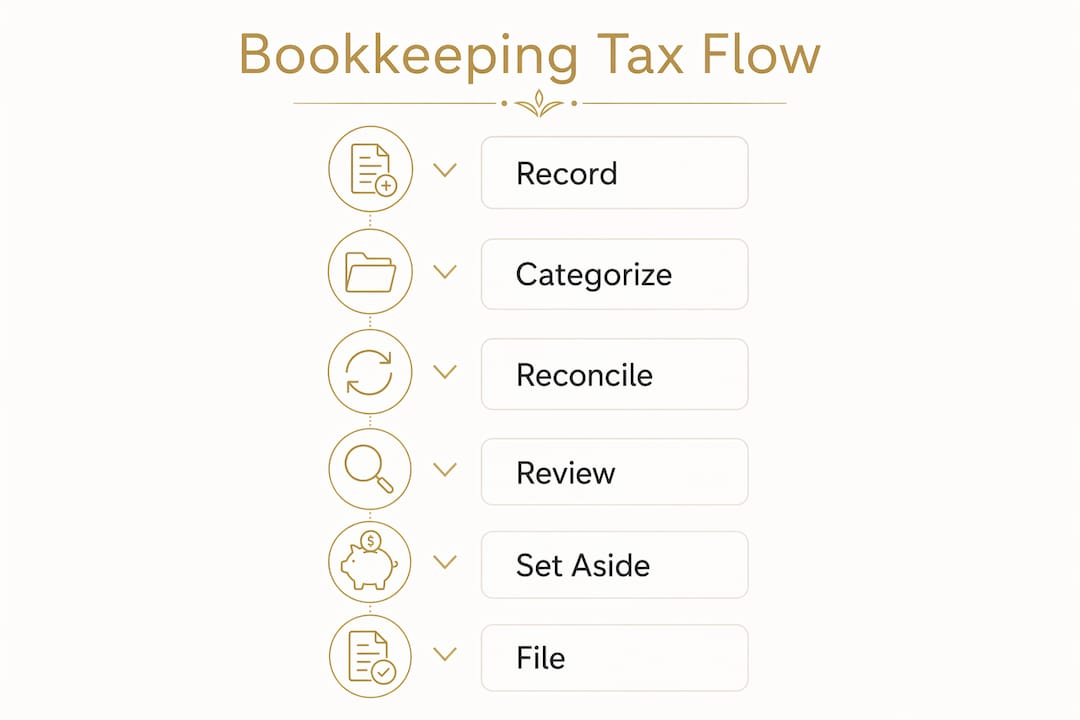
Accurate bookkeeping supports Form 1040-ES quarterly tax payments and deduction tracking throughout the year. Freelancers who miss quarterly estimated tax payments face IRS underpayment penalties, which add to your tax bill without any benefit.
The table below shows how each bookkeeping task connects to a specific tax outcome.
| Bookkeeping task | Tax outcome |
|---|---|
| Monthly profit and loss review | Accurate quarterly estimated tax calculation using Form 1040-ES |
| Expense categorization | Maximized deductions on Schedule C, reducing taxable income |
| Receipt storage | Audit-ready documentation for every claimed deduction |
| Bank reconciliation | Verified income figures that match 1099 forms from clients |
| Year-end financial summary | Faster, lower-cost CPA or tax software preparation |
Setting aside taxes throughout the year is a practical step that prevents a painful lump-sum payment in april. A common approach is to transfer 25%–30% of every payment you receive into a separate savings account designated for taxes. That account stays untouched until quarterly payment deadlines in april, june, september, and january.
Treating bookkeeping as a strategic tool rather than a chore gives you clearer financial insights and supports better business decisions. When you know your actual profit margin, you can price your services correctly, plan for slow months, and decide when to invest in growth. Understanding bookkeeping compliance standards also helps you stay prepared if your business expands into new markets or structures.
A consistent monthly close process, including bank feed reconciliation, invoice review, and tax set-asides, ensures audit readiness and simplifies tax filing. Freelancers who build this habit report significantly less stress during tax season and greater confidence in their financial numbers.
Key Takeaways
Freelance bookkeeping requires five consistent habits: income recording, expense categorization, receipt storage, monthly reconciliation, and profit tracking, all of which directly reduce your tax bill and audit risk.
| Point | Details |
|---|---|
| Separate accounts from day one | Use one dedicated business checking account and one business credit card to eliminate errors. |
| Match tools to your revenue | Freelancers under $100,000 annually can manage books with free or low-cost software in 30 minutes per week. |
| Weekly logging beats annual catch-up | Recording transactions weekly prevents the errors and missed deductions that come from tax-season scrambles. |
| Clean books lower your tax bill | Proper expense categorization on Schedule C maximizes deductions and supports accurate Form 1040-ES payments. |
| Monthly reconciliation is non-negotiable | Reconciling bank statements monthly keeps your profit numbers accurate and your books audit-ready. |
What I’ve learned from years of watching freelancers manage their books
Most freelancers come to bookkeeping with the wrong frame. They see it as paperwork, a necessary evil that exists only to satisfy the IRS. That framing makes it feel like a burden, so they delay it, dread it, and do it badly.
The freelancers I have worked with who build real financial confidence share one trait: they treat their books as a business dashboard, not a compliance checkbox. When you know your net profit for the month, you know whether to take on more clients or raise your rates. That is not accounting theory. That is practical business intelligence.
The other thing I see consistently is that complexity kills consistency. Freelancers who choose the most feature-rich software often abandon it within two months because the learning curve is too steep. Start with the simplest system that covers your current needs. A Google Sheet with two tabs beats a sophisticated platform you never open.
Separating personal and business finances is the single change that produces the fastest improvement. I have seen freelancers cut their bookkeeping time in half simply by opening a dedicated business account. Everything else gets easier from that point.
Scale your tools and support as your income grows. At $50,000 in annual revenue, a spreadsheet works. At $150,000, a professional bookkeeper pays for itself in time saved and deductions found. The goal is not to have the most sophisticated system. The goal is to have accurate books, consistently.
— Kelli
How Kelliworks supports your bookkeeping and financial health
Managing your own books is a solid starting point, but there comes a point where professional support pays for itself many times over.

Kelliworks operates as a full-service virtual accounting department built specifically for small business owners and freelancers. We handle bookkeeping, tax preparation, and financial consulting so you can focus on the work that actually grows your business. Our team brings the same level of attention to a solo freelancer’s books as to a growing small business, because both deserve accurate numbers and a clear financial picture. If you are ready to hand off the bookkeeping or want expert guidance on your tax preparation and compliance, Kelliworks is here to help. Reach out for a free consultation and find out what clean, professionally managed books can do for your bottom line.
FAQ
What is freelance bookkeeping?
Freelance bookkeeping is the practice of systematically recording, categorizing, and reconciling all financial transactions in a freelance business. It covers income tracking, expense categorization, receipt storage, and monthly bank reconciliation.
How much time does freelance bookkeeping take each week?
Freelancers earning under $100,000 annually typically need about 30 minutes per week to keep their books current. Monthly reconciliation adds another hour or two at the end of each month.
Do I need an accounting degree to manage my own books?
No degree or license is required to manage freelance bookkeeping. No legal requirement exists for a CPA or accounting credential to handle basic bookkeeping for your own business.
How does bookkeeping connect to quarterly taxes?
Accurate books give you the net profit figure you need to calculate quarterly estimated tax payments on Form 1040-ES. Without current books, you are guessing at what you owe, which leads to underpayment penalties.
When should a freelancer hire a professional bookkeeper?
Hire a professional when your transaction volume grows, your time is better spent on client work, or your finances become complex enough that errors cost more than the bookkeeper’s fee. Professional bookkeepers typically charge $200–$600 per month, which is often offset by the deductions they find and the time they save.