


To plan for business expansion financially, start by building a 12–24 month rolling cash-flow model that covers base, conservative, and optimistic scenarios, with a funded operating reserve of several months. Cash-flow problems, not lack of ideas, are the leading reason businesses fail, which makes runway sizing the single most important step before you commit to any expansion.
Here is your immediate action checklist:
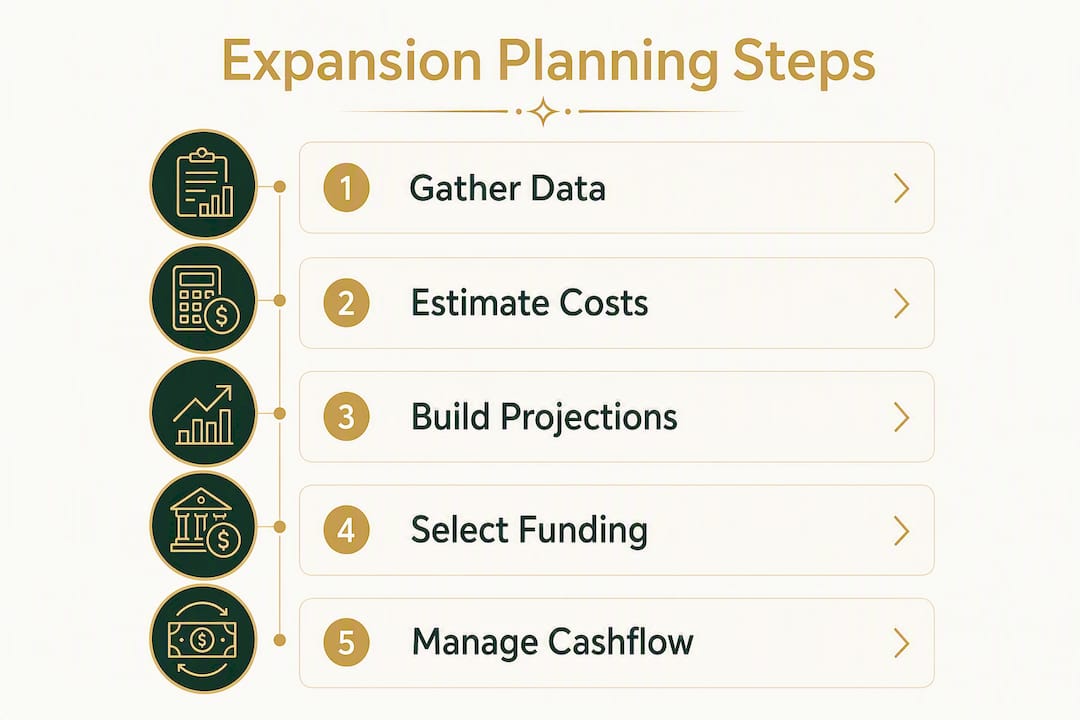
- Assess liquidity and margins — pull your recent months of P&L, balance sheet, and bank statements and calculate your current ratio, gross margin, and days sales outstanding (DSO).
- Estimate total capital need — add one-time capital expenditures (capex), incremental operating expenses (opex), working capital increases, and a contingency reserve appropriate to uncertainty.
- Build three-scenario projections — model base, optimistic, and conservative revenue and expense paths for 12–36 months.
- Identify funding sources — map each capital need to the right instrument: SBA loan, bank line of credit, equipment financing, or internal cash.
- Set an outsourcing trigger — decide in advance at what revenue level or complexity threshold you will engage a virtual accounting department or fractional CFO.
The SBA’s business plan templates and calculators give you a free starting framework for the financial section of your expansion plan. Kelliworks can take that framework further, turning it into a live model your lender, board, and operations team can all work from.
Pro Tip: Before you open a spreadsheet, download the SBA’s financial projection template and use it to structure your assumptions tab. Linking every expense line to a hiring or capacity trigger makes the model auditable and far easier to update as conditions change.
Table of Contents
- How do you audit your current financial position before expanding?
- What does it actually cost to expand? Estimating your capital requirement
- How do you build realistic financial projections for expansion?
- What are your best funding options for business expansion?
- How do you protect cash flow and runway while you expand?
- Tax and legal items that change your expansion budget
- What financial systems do you need before you scale?
- When should you bring in an outsourced accounting partner?
- Key Takeaways
- What most expansion plans get wrong
- Kelliworks gives you a full finance team without the full-time cost
- Useful sources and templates for building your expansion plan
How do you audit your current financial position before expanding?
Expansion planning built on inaccurate baseline numbers is the most common and most expensive mistake small business owners make. Before you model growth, you need a clean, reconciled picture of where the business stands today.
Gather these financial statements first:
- Last 12 months of P&L statements, broken out by revenue channel if possible
- Balance sheet as of the most recent month-end
- 12-month cash-flow statement (actual, not projected)
- Accounts receivable aging report (30/60/90/120+ day buckets)
- Accounts payable aging report
- Current debt schedule (outstanding balances, interest rates, maturity dates, covenants)
- Inventory report, if applicable
Once you have those documents, compute the following ratios. Each one tells you something specific about your capacity to fund growth.
| Metric | Source statement | What to look for |
|---|---|---|
| Gross margin | P&L | Below 40% in most service businesses signals pricing or cost pressure |
| Contribution margin | P&L | Covers fixed costs and funds expansion; track by product/service line |
| Current ratio | Balance sheet | Below 1.5 means limited short-term buffer for expansion spend |
| Quick ratio | Balance sheet | Below 1.0 signals potential liquidity risk without a credit line |
| Days Sales Outstanding (DSO) | AR aging + revenue | Above 60 days creates working capital pressure during growth |
| Days Payable Outstanding (DPO) | AP aging + COGS | Higher DPO preserves cash; renegotiating terms is a free financing source |
| Debt Service Coverage Ratio (DSCR) | P&L + debt schedule | Below 1.25 will concern most lenders; 1.5+ is preferred |
| Working capital requirement | Balance sheet | Working capital often increases ahead of revenue in many industries; rising revenue almost always increases this before cash comes in |
Pay particular attention to DSO. If your customers are paying you in 75 days but your vendors expect payment in 30, you are already running a structural cash gap. Expanding into new markets or product lines will widen that gap before it narrows.
Pro Tip: Reconcile your bank balance to your accounts receivable aging report before you build a single projection number. Unreconciled discrepancies of even a few thousand dollars will compound into material errors in a 24-month model. This step takes two hours and saves weeks of rework.
When preparing documents for lenders or investors, prioritize: a 3-year P&L, a 12–24 month cash-flow statement, your current balance sheet, your debt schedule, and a one-page business overview. Lenders focus first on cash-flow sufficiency and second on collateral, so the quality of your cash-flow data matters more than the strength of your assets.
What does it actually cost to expand? Estimating your capital requirement
Most owners underestimate expansion costs by 20–40% because they budget for the obvious line items and miss the working capital increase that growth demands. A reliable cost estimate separates expenses into four categories.
The four cost categories:
- One-time capex — equipment purchases, leasehold improvements, technology infrastructure, vehicles, and deposits.
- Incremental opex — new payroll (salaries, benefits, payroll taxes), additional rent, marketing spend, software subscriptions, and utilities tied to the new location or product line.
- Incremental working capital — the cash tied up in additional inventory, the receivables gap from new customers, and the timing difference between paying vendors and collecting from clients. Working capital often increases ahead of revenue in many industries, so budget for this before the first dollar of new revenue arrives.
- Contingency reserve — typically 10–25% of total project cost, depending on how well-defined the scope is. Construction and equipment projects with firm bids sit at 10–15%; new market entries with uncertain demand sit closer to 25%.
Sample worked example — adding a second service location:
- Leasehold improvements: $45,000 (contractor bid)
- Equipment and furniture: $18,000 (vendor quotes)
- First and last month’s rent deposit: $8,000
- Hiring and onboarding (2 staff, 60-day ramp): $22,000
- Marketing launch (local digital + signage): $12,000
- Incremental working capital (60-day AR gap on projected $30k/month revenue): $60,000
- Contingency at 15%: $24,750
- Total capital requirement: $189,750
That working capital line surprises most owners. It is not a cost in the traditional sense, but it is cash you need to have available before the new location reaches breakeven.
Spreadsheet template structure: Set up columns for Item, Category (capex/opex/working capital/contingency), Unit Cost, Quantity, Total, Timing (month), and Funding Source. This maps directly into your cash-flow model and makes it easy to show a lender exactly when each dollar goes out.

| Spend item | Category | Month 1 | Month 2 | Month 3 | Month 4–6 |
|---|---|---|---|---|---|
| Leasehold improvements | Capex | $45,000 | — | — | — |
| Equipment | Capex | $18,000 | — | — | — |
| Deposits | Capex | $8,000 | — | — | — |
| New staff payroll | Opex | — | — | — | — |
| Marketing launch | Opex | $8,000 | — | — | — |
| Working capital build | Working capital | — | — | — | — |
| Contingency reserve | Reserve | — | — | $24,750 | — |
This timeline view reveals that your peak cash need hits in Month 3, not Month 1. Knowing that in advance lets you structure financing draws accordingly rather than scrambling mid-project.
Pro Tip: Get at least two contractor or vendor quotes for every capex line item before finalizing your model. A single quote is an estimate; two quotes are a market check. The difference often runs 15–30% on construction and equipment.
For a deeper look at building a financial growth strategy that ties these cost categories to your broader business objectives, Kelliworks has published a practical guide worth bookmarking alongside your spreadsheet.
How do you build realistic financial projections for expansion?
Strategic financial planning aligns cash flow, capital allocation, and risk management across a 3–5 year horizon and is fundamentally different from an annual budget. A budget asks “what did we spend last year?” A projection asks “what will the business need to fund the plan, and when?”
Start with revenue drivers, not revenue totals. For each product line or location, define:
- Average transaction value (or monthly recurring revenue per client)
- Volume (units sold, clients served, or transactions per month)
- Conversion rate (leads to paying customers)
- Retention rate (for recurring revenue models)
- Ramp timeline (how many months before the new location or product reaches steady-state volume)
Multiply those inputs to build a monthly revenue line. Then model your expense ramps: new hires typically start 1–2 months before revenue arrives, fixed costs step up at specific capacity thresholds, and variable costs scale with volume. Map each expense to the month it hits cash, not the month it is incurred on an accrual basis.
Three-scenario structure:
- Base (most likely): Revenue ramp takes several months to reach most of the target; costs come in at budget.
- Optimistic (+15–20%): Ramp takes 4 months; marketing performs above expectations; no major delays.
- Conservative (−15–20%): Ramp takes 9–12 months; one key hire delayed 60 days; a major client reduces spend.
The conservative scenario is the one that tells you whether you need bridge financing. If it shows a cash deficit in Month 7, you need a credit facility in place before Month 4.
Sample projection assumptions tab:
| Assumption | Base | Optimistic | Conservative |
|---|---|---|---|
| New monthly revenue at steady state | $30,000 | — | — |
| Months to reach steady state | 6 | 4 | 10 |
| Monthly fixed cost increase | $18,000 | $18,000 | $18,000 |
| DSO (days) | 45 | — | 60 |
| Contingency draw | 50% | 0% | — |
Break-even calculation: Monthly fixed cost increase ÷ Gross margin % = Monthly revenue needed to cover new fixed costs. Using the base scenario: $18,000 ÷ 0.55 = monthly revenue to break even on the expansion. At a 6-month ramp to $30,000, the base scenario reaches breakeven in Month 7.
Pro Tip: Link your projection outputs directly to any loan covenant thresholds your lender sets, such as minimum DSCR or maximum debt-to-equity ratio. Build a small covenant-tracking tab in the model so you can see at a glance whether a revenue slip would trigger a covenant breach before it happens.
What are your best funding options for business expansion?
Different funding choices carry different cost structures and implications, and matching the instrument to the use-case is as important as securing the capital itself. Capex and long-term growth investments call for long-term financing; working capital gaps call for flexible, revolving instruments.
| Funding source | Best use | Typical cost | Time to close | Key tradeoff |
|---|---|---|---|---|
| Internal cash / retained earnings | Any; lowest risk | No interest cost | Immediate | Reduces operating reserve |
| SBA 7(a) loan | Capex + working capital | Prime plus a variable margin | 60–90 days | Documentation-heavy; slower |
| SBA 504 loan | Real estate and major equipment | Below-market fixed rate | 60–90 days | Requires 10% owner equity injection |
| Bank term loan | Capex | 6–10% (varies) | 30–60 days | Requires collateral and strong DSCR |
| Business line of credit | Working capital, bridge | Prime + 1–3% | 2–4 weeks | Variable rate; subject to annual renewal |
| Equipment financing | Equipment only | 5–12% | 1–3 weeks | Collateral is the equipment itself |
| Revenue-based financing | Working capital | Factor rate 1.1–1.5x | 1–5 days | High effective APR; fast but expensive |
| Invoice factoring | AR-heavy working capital gaps | 1–5% of invoice value | 1–2 weeks | Costs rise with volume; client notification |
| Equity (angel/investor) | Long-term growth capital | Ownership dilution | 3–12 months | Loss of control; governance expectations |
SBA loans in practice: The SBA 7(a) program is the most flexible option for small business expansion, covering capex, working capital, and even business acquisitions. The documentation requirement is real: expect to provide 3 years of business tax returns, 3 years of P&L statements, a current balance sheet, a cash-flow projection, and a written business plan. The SBA’s planning resources include templates that structure exactly this package.
Funding selection checklist:
- Does the capital need last more than 12 months? Use long-term debt or equity, not a line of credit.
- Is the need tied to a specific asset? Equipment financing or SBA 504 is usually cheaper than a general term loan.
- Do you need flexibility to draw and repay repeatedly? A revolving line of credit fits; a term loan does not.
- Are you willing to give up equity? Only if the capital need is large, the growth opportunity is high-conviction, and you have exhausted debt options.
- What is your DSCR after adding the new debt service? If it falls below 1.25, most lenders will decline.
Lender package priorities:
- 3-year P&L (audited or CPA-reviewed preferred)
- 12–24 month cash-flow projection with assumptions memo
- Current balance sheet
- Capex schedule with vendor quotes
- Personal financial statement (required for most SBA and bank loans)
Price every financing option into your model before you commit. An SBA loan with typical rates and terms adds a monthly debt service amount that must be modeled. That figure needs to appear in your cash-flow projection, not as a footnote.
How do you protect cash flow and runway while you expand?
Expansion is the period when cash flow is most vulnerable. Revenue from the new initiative is still ramping while costs are already running at full speed. The businesses that survive this period are the ones that manage cash with weekly discipline, not monthly reviews.
Set up a 13-week rolling cash forecast. This is different from your monthly projection. A 13-week rolling cash forecast forces you to track every cash inflow and outflow at the transaction level, week by week, and roll it forward each week. It reveals short-term liquidity cliffs that monthly reporting misses entirely. Update it every Monday morning.
Operational levers to free cash quickly:
- Tighten receivables: move to net-15 or net-30 terms for new customers; send invoices the day work is complete.
- Renegotiate payables: ask key vendors for net-60 terms or early-pay discounts you can selectively use.
- Reduce inventory to the minimum viable level before the expansion launch date.
- Use short-term or month-to-month leases for equipment and space during the ramp period where possible.
- Stage vendor payments to match cash inflows rather than paying all invoices on receipt.
Weekly and monthly KPIs to track:
- Cash burn rate (net cash out per week)
- Runway in months (cash on hand ÷ monthly burn)
- DSO (target: below 45 days)
- DPO (target: above 30 days without damaging supplier relationships)
- Gross margin by product or location (watch for margin compression as volume scales)
Good bookkeeping practices make this level of weekly visibility possible. Without clean, current books, the 13-week forecast is guesswork.
Pro Tip: Establish a committed revolving line of credit before your runway gets tight, not after. Banks lend to businesses that do not need the money. If you wait until cash is thin, your options narrow to expensive alternatives. Apply for the line when your financials are strong and treat it as insurance, not operating capital.
Tax and legal items that change your expansion budget
Tax and legal costs are the most consistently underestimated line items in expansion budgets. They rarely appear in the initial plan and almost always show up as surprises during execution.
Tax and payroll items to budget for:
- Payroll taxes: Employer share of FICA (Social Security and Medicare) runs 7.65% of gross wages. Add state unemployment insurance (SUTA), which varies by state and experience rating.
- New-state sales tax nexus: Hiring employees or opening a location in a new state typically creates sales tax nexus. Budget for registration, software configuration, and ongoing filing costs.
- Employer health benefits: If expansion triggers ACA employer mandate thresholds (50+ full-time equivalent employees), budget for health insurance contributions.
- Payroll setup costs: New state payroll registrations, payroll software upgrades, and HR compliance reviews.
- Tax filing frequency changes: Higher revenue often triggers more frequent estimated tax payments or sales tax filing schedules.
Permits, licensing, and compliance timeline:
- Research state and local business license requirements for the new location or activity at least 90 days before launch.
- File for any required occupational licenses (contractor, food service, healthcare, financial services) and budget 4–12 weeks for approval.
- Register for state income tax withholding in every new state where you have employees.
- Confirm zoning compliance for any new physical location before signing a lease.
- Budget permit and compliance costs into your contingency reserve, not as a separate line item, so they do not create a false sense of precision.
When expansion crosses state lines or changes your entity’s revenue profile materially, a brief consultation with a tax advisor about entity structure is worth scheduling. The right structure can affect your effective tax rate, liability exposure, and the cost of future capital raises. For early-stage tax planning guidance, Kelliworks has a practical resource that covers the key decision points.
This article provides general information, not legal or tax advice. Confirm current rules with a qualified tax professional or the relevant state authority before making structural or filing decisions.
What financial systems do you need before you scale?
Most small businesses reach expansion with accounting systems built for a simpler operation. QuickBooks Online or a basic spreadsheet works fine at $500k in annual revenue. At $2M across two locations with 15 employees, it starts to break down. Small businesses frequently outgrow basic accounting systems during expansion, and the cost of that gap shows up in delayed reporting, missed tax deadlines, and cash surprises.
Systems and controls to implement or upgrade before expanding:
- Cloud-based accounting software with multi-location or multi-entity capability (QuickBooks Online Advanced, Xero, or NetSuite for more complex operations)
- Integrated payroll processing connected to your accounting system
- Accounts receivable automation (automated invoice delivery, payment reminders, online payment portal)
- Purchase order controls and an expense approval policy
- A documented month-end close checklist with assigned owners and deadlines
Monthly reporting the business should produce:
- P&L by location or product line (not just consolidated)
- Cash flow actual vs. forecast (variance explained in writing)
- AR aging report with collection actions noted
- Project or job profitability report (if applicable)
- Headcount and payroll cost report
On the hiring side, the right sequence matters. Most businesses expanding from $1M to $3M need a senior bookkeeper or staff accountant before they need a controller. A controller becomes necessary when you have multiple entities, complex revenue recognition, or lender reporting requirements. A fractional CFO or outsourced virtual accounting department is often the most cost-effective path between those two stages.
Avoid over-investing in an ERP system too early. A full ERP implementation (SAP, Oracle, Microsoft Dynamics) is appropriate for businesses with $10M+ in revenue and complex inventory or manufacturing operations. For most small business expansions, a well-configured QuickBooks Online Advanced or Xero setup with integrated payroll and AR automation covers the need at a fraction of the cost.
When should you bring in an outsourced accounting partner?
Engaging experienced advisory or fractional CFO support is valuable when expansion introduces multi-state operations, tight runway, or complex capital raises. The question is not whether to get outside help, but when and in what scope.
Clear engagement triggers:
- Annual revenue crosses $500k–$1M and monthly reporting is consistently late or inaccurate.
- You are opening operations in a second state and need payroll registration, sales tax nexus analysis, and multi-state filing.
- You are preparing a lender package for an SBA loan or bank financing and need CPA-reviewed financials.
- Monthly cash flow is unpredictable and you cannot explain variances from forecast.
- You are spending more than 10 hours per month on bookkeeping, payroll, or tax prep yourself.
Service scope to outsource:
- Bookkeeping: Weekly transaction coding, bank reconciliation, and month-end close.
- Rolling forecasts: Monthly update of the 13-week cash forecast and 12-month projection.
- Management reporting: P&L by location, cash-flow vs. forecast, and KPI dashboard delivered by the 10th of each month.
- Tax preparation and filing: Federal and state returns, estimated payments, and multi-state compliance.
- Payroll processing: Payroll runs, tax deposits, and year-end W-2/1099 filing.
- CFO advisory: Capital structure guidance, lender relationship management, and scenario modeling for major decisions.
30/60/90-day onboarding plan for an outsourced partner:
- Days 1–30: Provide access to accounting software, bank accounts, and prior-year tax returns. Complete a financial health review and reconcile all accounts to a clean starting balance.
- Days 31–60: Establish the monthly close calendar, reporting templates, and KPI definitions. Deliver the first management report package.
- Days 61–90: Build or update the 12-month rolling projection, identify any immediate tax or compliance gaps, and present a 90-day financial health summary.
Documentation to prepare before onboarding:
- Last 3 years of business tax returns
- Last 12 months of bank and credit card statements
- Current chart of accounts
- Payroll records and employee roster
- Existing contracts with vendors and major customers
The cost of an outsourced virtual accounting department is typically far lower than a full-time hire when you factor in salary, benefits, payroll taxes, and recruiting costs. Budget the service fee as a line item in your expansion projection and compare it to the cost of a single financial error or a missed tax deadline. For a clear picture of what this engagement looks like in practice, the financial consulting checklist for startups from Kelliworks walks through exactly what to prepare and what to expect.
Pro Tip: Before your first meeting with an outsourced accounting partner, prepare a one-page summary of your expansion plan, your current monthly revenue, your biggest financial concern, and the three reports you wish you had every month. That 20-minute preparation makes the onboarding conversation 10 times more productive.
Key Takeaways
A financially sound expansion plan requires clean baseline data, three-scenario projections, matched financing, and weekly cash discipline from day one.
| Point | Details |
|---|---|
| Build three scenarios, not one | Model base, optimistic, and conservative paths; the conservative case reveals bridge financing needs early. |
| Working capital surprises most owners | Budget for the cash tied up in receivables and inventory before new revenue arrives, often months ahead of breakeven. |
| Match funding to use-case | Long-term capex needs long-term debt (SBA or bank term loan); working capital gaps need a revolving line of credit. |
| Weekly cash forecasting protects runway | A 13-week rolling cash forecast catches liquidity cliffs that monthly reporting misses; update it every Monday. |
| Kelliworks as your outsourced finance partner | Engage Kelliworks when revenue crosses $500k–$1M, operations go multi-state, or lender-ready financials are needed. |
What most expansion plans get wrong
The financial models I see most often from small business owners share a common flaw: they are built around the optimistic scenario as if it were the base case. Revenue ramps in Month 3. The new hire is productive from Day 1. The marketing campaign converts at the top of the range. Every assumption leans toward the best outcome, and the model looks great on paper.
Then reality arrives. The ramp takes 8 months instead of 4. The key hire needs 60 days of training before they are fully productive. The marketing spend generates leads but not at the projected conversion rate. None of these are catastrophic individually, but together they create a cash gap that the plan never accounted for.
The second mistake is treating working capital as a cost rather than a timing problem. Working capital is not lost money. It is cash that is temporarily tied up in receivables and inventory while the business scales. But “temporarily” can mean 90–120 days in some industries, and if you have not funded that gap, you will feel it as a cash crisis even when the business is fundamentally healthy.
The third mistake is waiting too long to upgrade financial systems and reporting. Owners often delay because the current setup “still works.” By the time it clearly does not work, the business is already operating blind during the most critical growth period. Monthly reports arriving on the 25th of the following month are not management information. They are history.
The practical corrective for all three: build the conservative scenario first, fund the working capital gap explicitly, and set up your reporting infrastructure before the expansion launches, not after. Communicating the financial plan to your team and key stakeholders in plain language, not just spreadsheet outputs, also matters more than most owners expect. When your staff understands the cash targets and the KPIs that matter, they make better daily decisions.
Kelliworks gives you a full finance team without the full-time cost
Running a business expansion without a dedicated finance function is one of the most common ways growth stalls. The numbers get messy, reporting falls behind, and decisions get made on instinct rather than data. Kelliworks was built specifically to solve that problem for small and medium business owners.
As your virtual accounting department, Kelliworks handles the full scope of financial management your expansion demands: bookkeeping, rolling cash-flow forecasts, multi-state tax preparation and filing, payroll processing, management reporting, and CFO-level advisory on capital structure and lender relationships. You get the expertise of a seasoned finance team at a fraction of the cost of building one in-house.
Onboarding is structured around a clear 30/60/90-day plan. In the first 30 days, we reconcile your accounts and establish a clean financial baseline. By Day 60, you have your first management report package and a live 12-month projection. By Day 90, we have identified any tax or compliance gaps and delivered a financial health summary you can share with lenders or investors.
If you are preparing for expansion and want to start with a financial health check, reach out to Kelliworks today. We will review your current financial position, identify the gaps, and build the plan with you.
Useful sources and templates for building your expansion plan
The sources below are authoritative starting points for templates, data, and planning frameworks. Each one serves a specific purpose in the planning process.
| Source | What it gives you | Best used for |
|---|---|---|
| SBA: Write Your Business Plan | Free financial plan templates and a structured business plan framework | Building the financial section of your expansion plan and lender packages |
| SBA: Plan Your Business | Access to SCORE mentors, local SBA resources, and planning counseling | Getting free expert review of your plan before approaching lenders |
| Kelliworks: Financial Growth Strategy Guide | Practical templates and checklists for growth-focused financial strategies | Structuring your projection assumptions and cost-estimate spreadsheet |
| Kelliworks: Personalized Financial Strategies | Methods for managing finances during growth in professional services | Adapting the financial plan to your specific business model |
| Federal Reserve: Consumer Credit | Current interest rate data for consumer and business credit | Pricing financing options accurately in your cash-flow model |
| BLS: Consumer Price Index | Inflation data by category | Adjusting cost projections for labor, materials, and operating expenses |
Quick software recommendations for modeling and reporting:
- Fathom or Spotlight Reporting — for management dashboards and variance analysis once your accounting data is clean and current.
For business financial planning fundamentals that complement these tools, Kelliworks has a clear overview designed specifically for small business owners who want to build their financial literacy alongside their growth plan.