


Petty cash management is the formal system your business uses to control, record, and reconcile a small on-hand cash fund set aside for minor, day-to-day expenses. Think of it as the structured answer to a simple problem: some purchases are too small, too fast, or too inconvenient to run through a check or corporate card. A well-run petty cash system keeps those purchases documented, accountable, and deductible.
Three things to know before reading further:
- Appoint a single custodian. One person owns the fund, signs off on disbursements, and reconciles the balance. Shared responsibility is no responsibility.
- Require a receipt or signed voucher for every transaction. Contemporaneous records are the deciding factor when the IRS questions a small-dollar deduction.
- Size the fund to one to two weeks of actual small-purchase needs. Most U.S. small businesses operate comfortably with a fund between $50 and $500.
Key Takeaways
Effective petty cash management requires a fixed imprest amount, a single named custodian, receipt-backed vouchers for every disbursement, and regular reconciliation to the general ledger.
| Point | Details |
|---|---|
| Use the imprest system | Fix the fund at a set amount; cash plus receipts should always equal that balance. |
| Size the fund to real needs | Most U.S. small businesses operate well with a fund between $50 and $500. |
| Document every transaction | A signed voucher and receipt for each disbursement is the minimum for tax substantiation. |
| Reconcile on a trigger, not a calendar | Replenish when the balance hits 20–25% of the imprest amount, and count cash every time. |
| Kelliworks handles the setup | Kelliworks builds your petty cash policy, manages reconciliation, and guides your transition to digital when the time is right. |
This article is general information, not a substitute for advice from a qualified financial advisor. Consult a qualified financial professional about your own circumstances before acting on anything here.
Table of Contents
- What is petty cash management and how does the imprest system work?
- Why businesses keep petty cash: common uses and how to size your fund
- Advantages and disadvantages of keeping a petty cash fund
- How to set up a petty cash system from scratch
- How to reconcile and replenish petty cash correctly
- Internal controls that reduce fraud and keep you audit-ready
- When should you replace petty cash with a digital alternative?
- Tax and audit readiness: what U.S. small businesses need to keep
- Quick-reference scenarios: what to do in common petty cash situations
- A perspective on petty cash management for small businesses
- Kelliworks can help you build a petty cash system that holds up
- Sources
What is petty cash management and how does the imprest system work?
Petty cash is physical currency kept on-site to cover small, routine purchases: a roll of stamps, a parking meter, a last-minute office supply run. It is a current asset on your balance sheet, sitting in the same category as your checking account, just in a much smaller drawer.
The standard accounting method for managing it is the imprest system. Under an imprest system, the fund is set at a fixed dollar amount. Every time cash leaves the box, a receipt or voucher replaces it. At any point, the cash remaining plus the receipts on file should equal the original imprest balance. When the cash runs low, the custodian submits the receipts to an approver, who issues a check to replenish the fund back to its fixed amount.
Pro Tip: Never replenish the fund without first counting the cash and matching every receipt. That count is your built-in audit check.
Sample journal entries
These entries show how replenishment and a cash-short situation are recorded.
| Transaction | Debit | Credit |
|---|---|---|
| Establish a petty cash fund | Petty Cash | Cash (Checking) |
| Replenish after $150 in receipts (postage $60, supplies $50, parking $40) | Postage Expense $60, Office Supplies $50, Parking $40 | Cash (Checking) |
| Replenish with cash short (cash plus receipts less than imprest amount) | Postage $60, Supplies $50, Parking $40, Cash Over/Short $3 | Cash (Checking) |
| Replenish with $2 cash over | Postage $60, Supplies $50, Parking $40 | Cash Over/Short $2, Cash (Checking) |
The “Cash Over/Short” account absorbs small discrepancies. Persistent shortages, however, are a red flag worth investigating.
Why businesses keep petty cash: common uses and how to size your fund
Petty cash earns its place in a small business when speed matters more than process. A few common scenarios where it fits naturally:
- Postage and shipping supplies when the post office run can’t wait for an expense report
- Parking and tolls for staff running errands on behalf of the business
- Small office supplies (pens, printer paper, tape) needed the same day
- Emergency repairs like a $15 replacement part to keep equipment running
- Making change for cash-based retail or service businesses
- Refreshments for an unplanned client meeting
The right fund size depends on how often these purchases happen and how much they typically cost. QuickBooks guidance recommends keeping individual transactions capped, often in the $25–$100 range, to limit exposure.
Suggested imprest amounts by business scale
| Business type | Suggested fund size | Replenishment trigger |
|---|---|---|
| Solo operator / freelancer | $50–$100 | When balance falls below $20 |
| Small office (2–5 employees) | $100–$200 | When balance falls below $75 |
| Retail or service location | $50–$500 | When balance falls below $100 |
| Multi-location operation | $50–$500 per location | Weekly or when below $100 |
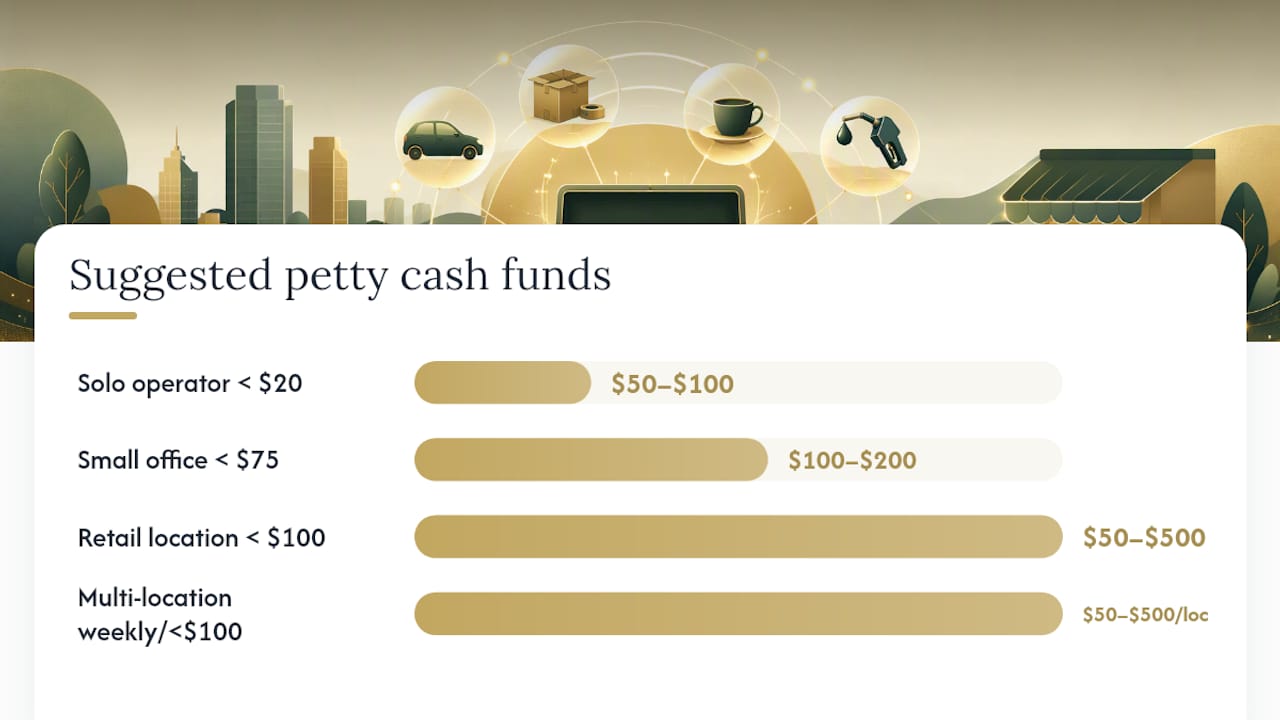
Start on the lower end and adjust after 60 days of actual use. If you’re replenishing more than once a week, the fund is too small. If cash sits untouched for three weeks, it may be too large, and the idle cash creates unnecessary risk.
Pro Tip: Adjust your fund size seasonally. A retail business that sees heavier foot traffic in November and December may need a temporarily larger fund to handle change and incidental supply runs.
Advantages and disadvantages of keeping a petty cash fund
Petty cash is genuinely useful for small businesses, but it carries real risks that grow as your team does. Here is a balanced look at both sides.
| Advantages | Disadvantages |
|---|---|
| Fast access to cash for minor purchases | Vulnerable to theft and misuse |
| No card or check required for small transactions | Requires consistent recordkeeping discipline |
| Reduces friction for staff running errands | Receipts get lost, creating documentation gaps |
| Useful for cash-only vendors or situations | Manual reconciliation takes time |
| Keeps small expenses off personal cards | Scales poorly as transaction volume grows |
| Easy to set up with minimal cost | Idle cash earns nothing and can be forgotten |
The core tradeoff is convenience versus control. For a business with one or two trusted employees and a modest fund, the convenience usually wins. For a growing team with multiple locations, the reconciliation burden and theft exposure tend to tip the balance toward digital alternatives.
How to set up a petty cash system from scratch
A solid petty cash setup takes less than an afternoon. Follow these steps in order, and you’ll have an audit-ready system before the end of the day.
-
Decide on your fund size. Use the sizing table above as a starting point. Pick a round number that covers one to two weeks of typical small purchases.
-
Write a check or transfer cash to establish the fund. Record the debit to “Petty Cash” and the credit to your checking account. This is the only time you touch the fund without a corresponding receipt.
-
Appoint a custodian. Choose one person who will manage disbursements, collect receipts, and request replenishment. This person should not also be the one who approves replenishment checks.
-
Secure the fund. A locked cash box or small safe is standard. Only the custodian should hold the key. Xero’s guidance specifically calls out secure storage as a core best practice.
-
Define approved uses and per-transaction limits. Write a short policy (even one page) that lists what petty cash can and cannot be used for, and sets a maximum per transaction (commonly $25–$50 for small businesses).
-
Create a petty cash voucher template. Every disbursement needs a voucher, even when a receipt exists.
Sample petty cash voucher fields
-
Set an approval matrix. For most small businesses, the custodian approves routine purchases up to the per-transaction limit. Anything above that limit, or any advance, requires the owner or manager to sign off.
-
Establish a replenishment trigger. Replenish when the cash balance falls to 20–25% of the imprest amount, not on a fixed calendar date. This keeps the fund functional without creating unnecessary replenishment cycles.
-
Document the policy and train your team. Anyone who might need to request petty cash should know the voucher process, the approved uses, and who to ask.
Good bookkeeping best practices treat petty cash as a real account, not a miscellaneous drawer. Setting it up correctly from day one saves hours of cleanup later.
How to reconcile and replenish petty cash correctly
Reconciliation is where most small businesses fall short. The process is straightforward, but it has to happen consistently to catch errors before they compound.

Reconciliation checklist
Before requesting replenishment, the custodian should complete each of these steps:
- Count all physical cash in the box
- Total all receipts and vouchers on hand
- Confirm that cash + receipts = original imprest balance
- Note any discrepancy (over or short) and investigate before proceeding
- Obtain approver signature on the replenishment request
- Attach all receipts to the replenishment request
Xero recommends reconciling petty cash regularly rather than waiting until the fund is nearly empty. For most small businesses, reconciling at least monthly, or whenever the fund drops to the replenishment trigger, keeps the ledger accurate.
Sample replenishment journal entries
| Scenario | Debit | Credit |
|---|---|---|
| Standard replenishment (typical receipts amount) | Various expense accounts | Cash (Checking) |
| Replenishment with $5 short | Various expense accounts, Cash Over/Short $5 | Cash (Checking) |
| Replenishment with $3 over | Various expense accounts | Cash Over/Short $3, Cash (Checking) |
Surprise counts add an important layer of verification. Periodically, someone other than the custodian counts the fund unannounced and compares the result to the expected balance. This is one of the most effective deterrents against slow, small-scale theft.
Replenishment frequency varies by transaction volume. A busy retail location may need weekly replenishment. A quiet professional office might go a full month between cycles. The trigger should be balance-based, not calendar-based, so the fund never runs dry mid-week.
Internal controls that reduce fraud and keep you audit-ready
A petty cash fund without controls is essentially an honor system with cash. These measures close the most common gaps.
Core controls every small business should have:
- Designate one custodian and document that appointment in writing
- Limit physical access to the locked box to the custodian only
- Require a signed voucher and receipt for every disbursement, no exceptions
- Require a second person (owner, manager, or bookkeeper) to approve replenishment
- Conduct unannounced spot counts at least quarterly
- Rotate oversight periodically, especially if the same person has managed the fund for years
- Reconcile to the general ledger at every replenishment, not just at month-end
A compact set of controls — custodian, vouchers, imprest model, and periodic spot audits — reduces theft risk and simplifies both replenishment and ledger posting.
Red flags to watch for:
- Missing receipts that appear repeatedly from the same employee
- Round-dollar disbursements with no supporting receipt (e.g., “$20 — miscellaneous”)
- Frequent small reimbursements to the same person
- Cash balance that never quite reconciles, even after adjustments
- Vouchers filled out after the fact rather than at the time of purchase
Audit-readiness tip: Structure your petty cash file so every replenishment cycle has its own folder or envelope containing the count sheet, all receipts, the signed voucher log, and the replenishment check stub. An IRS agent or external auditor should be able to pick up any folder and reconstruct every transaction without asking a single question.
Pro Tip: If a receipt goes missing, have the employee sign a brief written memo stating the date, amount, vendor, and business purpose. A signed memo is not as strong as a receipt, but it is far better than a blank line in your ledger.
Integrating petty cash controls into your broader bookkeeping cycle makes reconciliation faster and keeps your records consistent from month to month.
When should you replace petty cash with a digital alternative?
Physical petty cash made sense when cards were less common and expense software was expensive. Neither is true today. As teams grow, the manual administrative burden of reconciling physical petty cash often outweighs its convenience, and businesses should plan a migration path to digital controls.
Feature comparison: petty cash vs. digital options
| Feature | Physical petty cash | Corporate/prepaid card | Expense management platform |
|---|---|---|---|
| Speed of access | Immediate | Immediate | Immediate (digital receipt) |
| Audit trail | Manual (vouchers) | Automatic (card statement) | Automatic + categorized |
| Receipt capture | Paper, easily lost | Manual upload or none | Photo capture, auto-matched |
| Real-time reporting | None | Limited | Yes |
| Fraud controls | Custodian + spot counts | Card limits + alerts | Approval workflows + limits |
| Reconciliation effort | High (manual) | Medium | Low (automated) |
| Setup cost | Minimal | Low | Low to moderate |
Expense-tracking apps provide better documentation and budget visibility than a cash box, particularly for businesses where employees regularly make purchases on behalf of the company.
Signals that it’s time to transition:
- You’re reconciling petty cash more than once a week
- Lost receipts are a recurring problem at replenishment time
- Multiple employees need access to the fund simultaneously
- Your bookkeeper spends more than 30 minutes per replenishment cycle
- You’ve had a theft or unexplained shortage in the past year
Transition checklist:
- Audit your last three months of petty cash transactions to identify the most common expense types
- Choose a prepaid card or expense platform that covers those categories
- Set per-employee spending limits that mirror your current petty cash policy
- Run both systems in parallel for 30 days to catch gaps
- Close the petty cash fund by depositing remaining cash and recording a credit to the Petty Cash account
Pro Tip: Online accounting tools can improve cash-flow visibility significantly when you move away from manual petty cash tracking. The real-time data alone often justifies the switch.
Tax and audit readiness: what U.S. small businesses need to keep
Petty cash expenses are deductible, but only when you can substantiate them. The IRS expects documentation that shows the amount, date, vendor, and business purpose for every expense. A shoebox of crumpled receipts does not meet that standard.
Documentation checklist for petty cash tax substantiation
| Required element | Acceptable form |
|---|---|
| Amount | Receipt or signed voucher showing exact dollar amount |
| Date | Printed on receipt or written on voucher at time of purchase |
| Vendor / payee | Receipt header or written description (e.g., “USPS — stamps”) |
| Business purpose | Written on voucher or back of receipt by employee |
| Approver sign-off | Custodian or manager initials on voucher |
For tax and audit readiness, keeping contemporaneous records — vouchers signed by the custodian and requester plus itemized receipts — is the deciding factor in whether small-dollar expenses remain deductible.
Record retention: The IRS generally recommends keeping business records for at least three years from the date you file the return that includes those expenses. Keep petty cash logs, vouchers, and receipts for at least three years, stored in a way that lets you retrieve any specific transaction quickly.
Missing receipt procedure:
- Have the employee complete a signed written memo with: date, amount, vendor, and business purpose
- Manager or owner countersigns the memo
- Attach the memo to the voucher in place of the receipt
- Note “receipt unavailable” in your petty cash log
Pro Tip: Scan or photograph every receipt at the time of disbursement. Paper receipts fade, and a faded receipt is the same as no receipt when an auditor asks for documentation. A tax preparation partner can help you build a receipt-capture workflow that holds up under scrutiny.
Quick-reference scenarios: what to do in common petty cash situations
Even a well-run petty cash system runs into edge cases. Here is how to handle the most common ones on the spot.
Common scenarios and immediate responses:
- No receipt available: Have the employee sign a written memo (date, amount, vendor, business purpose) before leaving the office. Never disburse cash without either a receipt or a completed memo.
- Employee needs a petty cash advance: Record the advance as a receivable. Note the employee’s name, the amount, the date, and the expected return date. Require a receipt and change (if any) upon return.
- Purchase exceeds the per-transaction limit: Do not pay from petty cash. Route the purchase through a check, card, or purchase order per your normal approval process.
- Cash count comes up short at reconciliation: Document the shortage on the count sheet, note it in the ledger as Cash Over/Short, and investigate before replenishing. Do not simply absorb the shortage without a written explanation.
- Custodian is absent: Only a designated backup custodian (named in your policy) should access the fund. Do not allow ad hoc access.
Mini-template: missing receipt statement
Mini-template: petty cash advance memo
- Employee name and department
- Date of advance
- Amount advanced: $______
- Purpose of advance (specific, not “miscellaneous”)
- Expected return date for unused cash and receipt
- Custodian signature
When to escalate: Contact the owner or bookkeeper immediately if a shortage exceeds $20, if a receipt memo is refused, if the fund has been accessed without a voucher, or if the same employee has had two or more unexplained shortages in a single quarter. Good cash-flow management depends on catching small problems before they become patterns.
A perspective on petty cash management for small businesses
Petty cash is one of those areas where small businesses tend to be either too casual or too anxious. The casual approach — a drawer of bills with no log — creates real audit exposure and invites slow, undetected theft. The anxious approach — treating every $5 purchase like a capital expenditure — wastes time and frustrates staff.
The right answer sits in the middle, and it is simpler than most owners expect. A fixed imprest amount, one designated custodian, a signed voucher for every disbursement, and a monthly reconciliation that takes 20 minutes.
What I see most often with small businesses is not fraud, but drift. The policy exists on paper, but the voucher habit slips. Receipts pile up unmatched. Replenishment happens whenever someone remembers, not when the balance triggers it. Six months later, the ledger is a mess and no one is sure what was spent on what.
The fix is not a more complicated system. It is consistent execution of a simple one. Standardize the voucher, schedule the reconciliation, and make the custodian role a real responsibility with a named person attached to it. When those three things are in place, petty cash stops being a liability and becomes what it was always meant to be: a small, convenient tool that stays in its lane.
Kelliworks can help you build a petty cash system that holds up
Petty cash management is one of those tasks that looks simple until it isn’t. Missing receipts, unreconciled balances, and undocumented advances are among the most common bookkeeping issues we see when small businesses come to Kelliworks for the first time.

As your virtual accounting department, Kelliworks sets up your petty cash policy, voucher templates, and replenishment workflow so your fund is audit-ready from day one. We also handle the monthly reconciliation, categorize every expense correctly for tax purposes, and flag the moment your transaction volume suggests it’s time to move to a digital alternative. When that transition comes, we manage it alongside your broader bookkeeping so nothing falls through the cracks.
Ready to get your petty cash under control? Request a consultation with Kelliworks and we’ll review your current process, identify the gaps, and put a clean system in place.
Sources
- Understanding Petty Cash: Usage, Accounting, and Best Practices — Investopedia
- What Is Petty Cash? Examples & How to Manage It in 2026 | QuickBooks
- What Is an Imprest System of Petty Cash? — AccountingCoach
- Petty cash: what it is, how it works, and how to manage it | Xero US
- Petty Cash Management Guide | Billed