


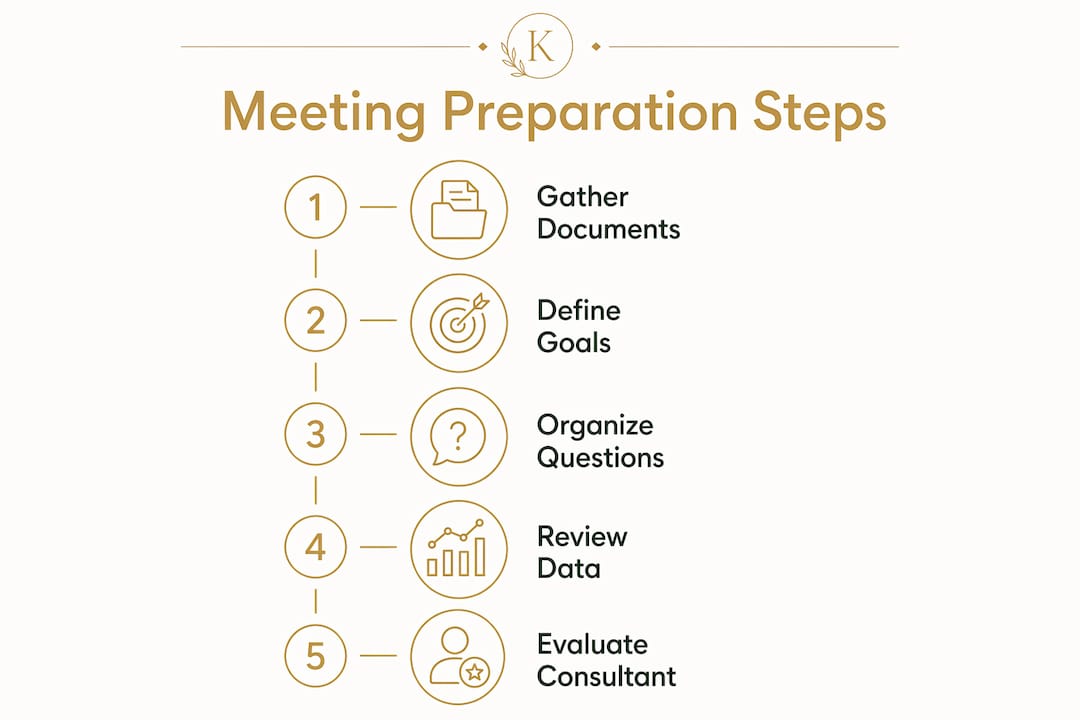
Financial meeting preparation is defined as the process of gathering key documents, clarifying your goals, and prioritizing your questions before sitting down with a financial consultant. Small business owners who walk in prepared get more from every minute of that session. The standard industry term for this process is “pre-consultation preparation,” and it covers everything from assembling tax returns to writing a focused agenda. This guide gives you a practical, step-by-step framework to prepare for a financial consulting meeting so you leave with clear, specific advice rather than a list of follow-up tasks.
How to prepare for a financial consulting meeting
The first thing to understand is what the meeting actually is. Initial consultations last 30–60 minutes and focus on fact gathering and goal setting, not final plans. That means your consultant is listening for your financial story, not grading your spreadsheets. Knowing this should relieve pressure and redirect your energy toward clarity rather than perfection.
Preparation works on two levels: practical and strategic. The practical level means having the right documents in hand. The strategic level means knowing what you want to accomplish before you walk in. Both matter equally. A business owner who brings three years of tax returns but cannot articulate a single financial goal will leave with generic advice. A business owner who arrives with a clear goal but no supporting data will leave with a plan built on assumptions.

The good news is that neither level requires weeks of work. Most small business owners can complete solid pre-consultation preparation in two to three focused hours. The sections below walk you through each step.
What documents should you bring to a financial meeting?
Essential documents include the last two years of tax returns, recent bank and credit card statements, investment summaries, a list of current debts, and insurance information. Bringing organized, recent documentation lets your consultant evaluate your full financial picture without wasting session time on data collection.
Here is a practical checklist of what to gather:
- Tax returns: Last two years of federal and state business returns
- Bank statements: Three to six months of business checking and savings statements
- Credit card statements: Three months of business card activity
- Debt summary: Outstanding loans, lines of credit, and payment terms
- Investment summaries: Retirement accounts, brokerage accounts, or business investment holdings
- Insurance overview: Current policies, premiums, and coverage amounts
- Revenue and expense summary: A simple profit and loss statement or even a rough monthly breakdown
One thing most business owners get wrong is waiting until they have “perfect” records. Formal, perfectly organized financial statements are not required for an initial meeting. A rough summary that honestly reflects your numbers creates productive dialogue. Financial professionals can gather additional detail over time. Your job is to show up with real, current data, not a polished report.
When you pull these documents together, organize them by category rather than by date. Use labeled folders or clearly named digital files. If you are sharing documents digitally, a simple naming convention like “2024 Tax Return Business” saves everyone time during the meeting.
Pro Tip: Create a one-page cover sheet that lists every document you are bringing and a brief note on anything unusual, such as a missed quarter or a one-time expense. This gives your consultant an instant orientation before diving into the details.
How do you define your financial goals before the meeting?
Clear goals are the single biggest factor in getting useful advice from a financial consulting session. Vague requests like “I want to grow my business” give your consultant nothing to work with. Specific goals like “I want to reduce my quarterly tax liability by restructuring owner compensation” give them a problem to solve.
Start by writing down your top financial concerns and objectives. Then sort them by urgency and importance. A useful framework for defining financial goals separates short-term needs (cash flow, upcoming tax deadlines) from long-term priorities (retirement planning, business expansion funding).
Common small business financial goals worth clarifying before your meeting include:
- Cash flow management: Identifying gaps between income and expenses across the calendar year
- Tax planning: Reducing liability through deductions, entity structure, or timing of income
- Funding growth: Understanding financing options for equipment, hiring, or expansion
- Debt reduction: Creating a payoff sequence that minimizes interest costs
- Retirement planning: Setting up or optimizing a SEP-IRA, Solo 401(k), or similar vehicle
Your personal values also shape your financial objectives. A business owner who prioritizes stability will set different goals than one focused on rapid growth. Be honest about what matters most to you, not just what sounds financially responsible.
Pro Tip: Limit your list to 5–8 prioritized questions before the meeting. Writing a one-sentence summary of your main financial problem and ranking your questions by importance keeps the conversation focused and gives your consultant a clear starting point.
How do you build an agenda and question list for the meeting?
A focused agenda is what separates a productive consulting session from a rambling conversation. Consulting works best with specific, well-defined asks rather than broad objectives. “What should I do about taxes?” is a broad ask. “Should I switch from an S-corp to a C-corp given my current revenue level?” is a specific ask that produces a specific answer.
Follow these steps to build your agenda:
- List every question you have. Write them all down without filtering. You will trim later.
- Group related questions. Tax questions together, cash flow questions together, and so on.
- Rank by priority. Put the question you most need answered at the top.
- Cut to your top 5–8. Anything beyond that is unlikely to get thorough attention in a single session.
- Add context to each question. One sentence explaining why you are asking helps your consultant give a relevant answer.
Before the meeting, also clarify your constraints. If you have a budget limit for implementing any recommendations, say so upfront. If you are working toward a specific deadline, like a tax filing date or a loan application, mention it early. Constraints help your consultant prioritize their advice.
Common mistakes to avoid during financial meeting preparation:
- Asking questions that are too broad to answer in one session
- Forgetting to bring a document that directly relates to your top question
- Spending the first half of the meeting explaining background instead of asking questions
- Leaving without confirming the next step or follow-up action
Pro Tip: After the meeting, evaluate whether the consultant listened carefully, asked clarifying questions, and gave specific rather than generic answers. This tells you whether the relationship is worth continuing. A good consulting meeting checklist includes a post-meeting review column for exactly this purpose.
How should you present your financial data during the meeting?
Presenting financial data effectively means telling a story, not reciting numbers. Presenting data as a cohesive story rather than isolated figures helps your consultant understand context and make faster, better decisions. A sequence like “Revenue grew 22% last year, but net profit dropped because labor costs increased faster than sales” communicates far more than handing over a spreadsheet.
Small business owners should know core business metrics including monthly recurring revenue (MRR), burn rate, and runway before walking into any financial advisory session. Being conversant in these numbers moves the meeting from a status update to a strategic conversation. You do not need to memorize every line of your financials. You need to know the numbers that define your business’s current health.
Key metrics to have ready before your session:
- Monthly recurring revenue (MRR): Your predictable monthly income
- Burn rate: How much cash you spend per month beyond what you earn
- Runway: How many months of operating cash you have at the current burn rate
- Gross margin: Revenue minus cost of goods sold, expressed as a percentage
- Accounts receivable aging: How long outstanding invoices have been unpaid
When a difficult question comes up during the meeting, answer it with data rather than estimates. If you do not know an exact number, say so and offer the closest figure you have. Consultants respect honesty far more than confident guesses.
“Clients who share their full financial story, including fears, habits, and goals, allow advisors to build a plan that goes beyond the numbers. Openness is the most valuable thing you can bring to a first meeting.”
Learning how to read financial statements before your session gives you the vocabulary to discuss your data confidently and understand the advice you receive.
Key Takeaways
Effective pre-consultation preparation requires organized documents, specific financial goals, and a prioritized question list to convert a 30–60 minute session into clear, actionable advice.
| Point | Details |
|---|---|
| Gather current documents | Bring two years of tax returns, recent bank statements, debt summaries, and insurance info. |
| Prioritize 5–8 questions | Rank questions by urgency and limit your list so every topic gets real attention. |
| Tell a financial story | Present metrics like MRR and burn rate in context, not as isolated numbers. |
| Rough data is acceptable | Conversational summaries work for initial meetings; perfection is not required to start. |
| Evaluate the consultant too | After the session, assess whether answers were specific and whether the advisor listened carefully. |
What I have learned from first financial consulting meetings
The first financial consulting meeting is a diagnostic conversation, not a sales pitch or a performance review. I have worked with dozens of small business owners who walked in expecting to be judged for their financial choices. That fear made them guarded, and guarded clients get generic advice. The owners who came in open, even about the messy parts, walked out with a real plan.
The most common preparation mistake I see is trying to cover everything in one session. A business owner will show up with questions about taxes, retirement, cash flow, hiring, and a potential acquisition, all for a 45-minute meeting. Narrowing focus to one or two core decisions produces far better outcomes than spreading the conversation thin. Pick your most pressing issue and go deep on it. Save the rest for the next session.
One thing that surprises people: your consultant is not expecting you to have all the answers. They are trained to ask the right questions. Your job is to show up with honest data and a clear sense of what is keeping you up at night. That combination, transparency plus preparation, is what turns a first meeting into a productive working relationship. If you want to understand how financial consulting differs from bookkeeping before your first session, that context helps you set the right expectations going in.
— Kelli
Kelliworks financial consulting for small business owners
Small business owners deserve financial guidance that fits their actual situation, not a generic checklist handed to every client.
Kelliworks offers full-service financial consulting tailored specifically to small businesses and entrepreneurs. We help you organize your documents, clarify your goals, and walk into your first session ready to have a real conversation. Our team also handles tax preparation and bookkeeping so your financial picture stays current between meetings. If you want expert support before, during, and after your consulting sessions, learn more about hiring a virtual accountant and what that partnership looks like for a business at your stage.
FAQ
What documents do I need for a financial consulting meeting?
Bring the last two years of tax returns, three to six months of bank and credit card statements, a debt summary, investment account overviews, and current insurance information. Recent, honest data matters more than perfectly formatted reports.
How long does a first financial consulting meeting last?
Initial consultations typically run 30–60 minutes and focus on understanding your situation and goals rather than delivering a finished financial plan.
How many questions should I bring to a financial advisor meeting?
Limit your list to 5–8 prioritized questions. A focused question list gives your consultant enough structure to provide specific, useful answers within a single session.
Do I need perfect financial records before my first meeting?
No. Transparent, conversational summaries are sufficient for an initial session. Financial professionals can collect additional detail over time as the relationship develops.
What financial metrics should a small business owner know before the meeting?
Know your monthly recurring revenue, burn rate, runway, gross margin, and accounts receivable aging. Fluency in these core metrics moves the conversation from basic status updates to strategic planning faster.