


Most businesses switch accounting firms when the relationship becomes purely reactive — compliance filings on deadline, silence in between, and no guidance when it actually matters. According to a TaxDome study reported by CPA Practice Advisor, According to a TaxDome study reported by CPA Practice Advisor, 85% of business clients rate responsiveness as very or extremely influential when choosing or staying with an accounting firm. If your firm only calls you in March, that number explains exactly why you’re reading this.
The short version: businesses change accountants because of poor responsiveness, compliance-only service, frequent errors, outdated technology, or simply outgrowing what the firm can offer. If two or more of those describe your situation right now, it’s worth starting a structured search.
Run this three-question check:
- Does your accountant contact you proactively at least once per quarter with advice, not just a request for documents?
- Has your firm missed a deadline, made a billing error, or produced a report you couldn’t act on in the past 12 months?
- Has your business changed significantly (new revenue stream, new hires, new state registrations) without a corresponding conversation from your accountant?
Two “yes” answers mean the relationship is likely costing you more than a transition would. Kelliworks operates as a full advisory partner — not a once-a-year tax preparer — and the sections below show you exactly how to diagnose the problem, choose a replacement, and make the switch without disruption.
Table of Contents
- Why businesses switch accounting firms: the full checklist
- How do you choose the right accounting firm?
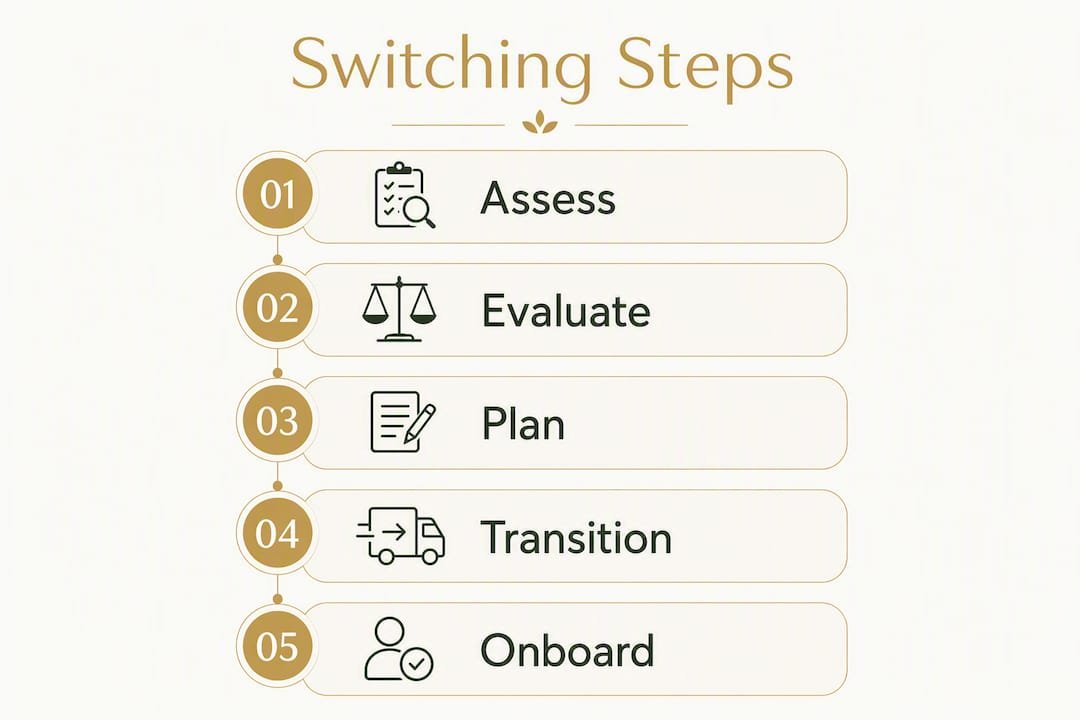
- How to switch accounting firms with minimal disruption
- How an advisory-led firm prevents these problems from recurring
- Key Takeaways
- The case for switching sooner rather than later
- Kelliworks makes the transition straightforward
- Useful sources and further reading
Why businesses switch accounting firms: the full checklist
The reasons businesses leave their accounting firm fall into two categories: surface irritants you can address with a direct conversation, and structural gaps that no conversation will fix. Knowing which you’re dealing with saves months of hesitation.
Common warning signs include poor communication, missed deadlines, lack of proactive advice, and inadequate industry knowledge. Here’s how to read the severity of each:
-
Poor responsiveness — emails go unanswered for days; calls aren’t returned before deadlines. Severity: Amber. One conversation may fix it. A pattern over two months means the firm is overloaded and you’re not a priority.
-
Contact only at tax time — your accountant surfaces in February, disappears until next January. Severity: Red. Advisory-led relationships are the standard that retains clients; compliance-only contact is a structural model mismatch, not a personality issue.
-
No proactive tax planning — you learn about a deduction or credit after the filing window closes. Severity: Red. The cost of missed tax planning compounds every year. This isn’t fixable by asking nicely.
-
Frequent errors or missed IRS deadlines — amended returns, penalty notices from the IRS, or reconciliations that never balance. Severity: Red. Start the search now.
-
Outdated technology — your firm still emails PDFs and asks you to mail documents. Among businesses spending $10,000 or more per year on accounting, 76–83% rank technology in the top-two importance factors. Manual workflows slow your close, introduce errors, and signal a firm that isn’t investing in its own operations.
-
Opaque or unexpected billing — invoices arrive with vague line items, or the bill jumps without explanation. Severity: Amber to Red. Transparent pricing and clear scopes of work are foundational to a functional relationship. If you can’t predict your accounting bill, you can’t budget accurately.
-
Business has outgrown the firm — you’ve added employees, opened a second location, or started selling in new states, and your accountant hasn’t mentioned nexus, payroll tax registration, or entity restructuring. Severity: Red. A firm that scales with your business is a different product than one built for a solo operator.
-
Insufficient industry expertise — your firm doesn’t understand your revenue model, your cost structure, or the credits specific to your industry. Severity: Amber to Red depending on complexity.
-
Reports without insights — you receive a P&L and a balance sheet with no commentary, no variance analysis, no forward-looking note. Severity: Amber. Ask once. If the next report looks identical, that’s the answer.
Pro Tip: When problems are costing you time or money every month, staying is usually more expensive than switching. The ongoing cost of missed planning, rework, and your own hours chasing responses adds up faster than a one-time transition.
How do you choose the right accounting firm?
Choosing a replacement firm is where most business owners make their second mistake: they pick based on price or proximity rather than fit. Use a structured framework.
Decision criteria
| Criteria | Why it matters |
|---|---|
| Responsiveness and SLAs | Defines how quickly you’ll get answers when a deadline or decision is urgent |
| Industry specialization | Determines whether the firm understands your revenue model, cost drivers, and applicable credits |
| Advisory services offered | Separates compliance-only firms from partners who help you plan, not just report |
| Technology stack | Affects how fast your close runs, what integrations are available, and how secure your data is |
| Pricing transparency | Lets you budget accurately and avoids surprise invoices |
| Scalability | Confirms the firm can handle your next stage, not just your current one |
| Data security and access | Clarifies who owns your records and how you retrieve them if you ever leave |
| Onboarding timeline | Sets realistic expectations for the familiarization period |

Modern firms use tools like QuickBooks Online, Xero, and cloud-based document portals. Some now integrate AI-assisted tax research tools to speed up research and reduce manual lookup time. Ask specifically what’s in the stack and what access you’ll retain.
For full-service accounting, the tradeoff between a large generalist firm and a smaller specialized provider often favors the smaller firm for businesses under $5 million in revenue — dedicated oversight and direct partner access matter more than brand name at that scale.
Interview questions to ask shortlisted firms
- “How do you handle month-end close for clients like mine, and what’s your typical turnaround?”
- “Walk me through your onboarding process and timeline.”
- “Who will be our primary contact, and how many clients do they manage?”
- “Which cloud tools do you use, and what access will we retain to our own data?”
- “Do you provide proactive tax planning? Give me a recent example from a similar client.”
- “How do you communicate between filings — scheduled check-ins, or on-demand only?”
Red flags to watch for
- Evasive or vague answers about timelines and who handles your account day-to-day
- No written service-level agreement or engagement letter
- Inability to produce a sample report or onboarding timeline on request
- Pricing described as “it depends” with no structure or range
- No references from businesses in your industry or at your revenue stage
Pricing model considerations
Fixed monthly fees work best when your transaction volume is predictable. Hourly billing suits project-based or occasional needs but creates budget uncertainty. A retainer model fits businesses that need ongoing advisory access. Understanding how accounting fees are structured before you sign prevents the exact billing opacity that drove you to switch in the first place.
How to switch accounting firms with minimal disruption
Timing and preparation determine whether a transition is smooth or chaotic. The single most avoidable mistake is starting a switch in January or February, when your outgoing firm is managing year-end filings and your incoming firm is onboarding new clients at peak capacity.

Timing calendar
| Period | Recommendation |
|---|---|
| January–April 15 | Avoid starting a switch; tax season creates deadline risk on both sides |
| May–June | Clean window; prior-year returns are filed, Q1 is closed |
| July–August | Good timing, especially after Q2 close |
| October–November | Workable if transition completes before year-end |
| December | Avoid; year-end close and planning season |
Step-by-step transition checklist
- Transfer IRS authorizations — file Form 2848 (Power of Attorney) or Form 8821 (Tax Information Authorization) to authorize your new firm with the IRS.
Records to transfer
- Most recent two to three years of filed federal and state tax returns
- Current-year general ledger export and chart of accounts
- Bank reconciliations for all accounts
- Payroll records and payroll tax filings
- Outstanding IRS or state tax notices
- Corporate filings and registered agent information
- Loan documents and lease agreements
- Access credentials for accounting software and bank feeds
Good bookkeeping practices make this pack straightforward to assemble. If your records are disorganized, that’s a cleanup task the new firm can scope during onboarding.
What to expect in the first 60–90 days
Experienced firms follow structured onboarding frameworks that limit owner time to roughly 10–15 hours over 4–6 weeks. Plan for a familiarization period of 2–3 weeks where reports may take slightly longer as the new team builds context, then speed and clarity improve markedly by month three. By day 90, you should have two or three completed reconciliations, a documented reporting cadence, and a written 30/60/90 action plan.
The total switching cost typically requires a moderate time investment and some overlapping fees for a limited period. For most businesses, that’s a one-time investment that pays back quickly when the new firm starts catching what the old one missed.
How an advisory-led firm prevents these problems from recurring
The firms businesses stay with longest aren’t the ones that file accurately — they’re the ones that call before a problem becomes expensive. Businesses that receive proactive, advisory-led support are less likely to churn and more likely to refer peers, and 92% of business clients say peer referrals are critical when choosing a firm. That retention loop starts with advisory depth, not just clean filings.
Kelliworks structures every new client engagement around a documented onboarding framework:
- Discovery call — understand the business model, current pain points, and outstanding compliance items
- Secure data access — transfer of software credentials, bank feeds, and historical records through encrypted channels
- Reconciliation and cleanup scope — identify any gaps or errors in prior-period records before moving forward
- Reporting templates — establish the specific reports the owner needs and the cadence for receiving them
- 30/60/90-day milestones — written plan delivered before work begins, reviewed at each checkpoint
That shift from reactive to proactive is what personalized financial strategies look like in practice: regular check-ins, forward-looking cash-flow notes, and tax planning that happens in October, not April.
Pro Tip: In the first two to three weeks with a new firm, set a brief weekly check-in — even 15 minutes. It shortens the familiarization period significantly and surfaces any data gaps before they affect a filing.
Key Takeaways
Businesses that switch to an advisory-led accounting firm consistently recover more in missed planning and time savings than the transition costs them.
| Point | Details |
|---|---|
| Run the three-question check | If two or more checks fail, the relationship is likely costing more than a switch would. |
| Time the transition carefully | Avoid January through April 15; May–June and July–August are the cleanest windows. |
| Prepare a records pack first | Gather filed returns, reconciliations, payroll records, and software access before notifying your outgoing firm. |
| Budget realistically for the switch | Expect 10–15 hours of your time and 1–2 months of overlapping fees as a normal, worthwhile cost. |
| Kelliworks as your next firm | Kelliworks provides documented onboarding, a named primary contact, and proactive advisory support from day one. |
The case for switching sooner rather than later
Most business owners I speak with waited longer than they should have. The hesitation is understandable — switching feels disruptive, and there’s a real concern about overlap fees, lost context, and a temporary slowdown in reporting. Those concerns are legitimate. They’re also shorter-lived than most people expect.
A structured transition with an experienced firm takes 4–6 weeks of active coordination and roughly 10–15 hours of your time. The disruption window is real but finite. What isn’t finite is the cost of staying with a firm that only contacts you at tax time, misses planning opportunities, or produces reports you can’t use to make decisions.
The businesses I see make the most progress financially are the ones that treat their accounting relationship as a strategic asset, not a compliance checkbox. That means expecting quarterly conversations, proactive tax planning, and reports that tell you something useful about next quarter, not just last quarter. If your current firm isn’t delivering that, the question isn’t whether to switch. It’s when.
Kelliworks makes the transition straightforward
Switching firms is easier when the incoming firm has done it hundreds of times. Kelliworks functions as a virtual accounting department for small businesses — not a generalist firm that handles your file once a year, but a dedicated team managing bookkeeping, tax preparation, payroll, and financial consulting on an ongoing basis.

What reduces transition friction specifically: a documented onboarding process with a fixed timeline, secure data transfer, a named primary contact who manages your account directly, and predictable flat-rate pricing so you know exactly what you’re paying before you sign. The first 30 days include a cleanup scope, reconciliation review, and a written 30/60/90 plan. No surprises.
If you’re ready to stop managing your accounting relationship and start benefiting from it, book a consultation with Kelliworks to discuss your current situation and what a structured transition would look like for your business.
Useful sources and further reading
- What Do Businesses Actually Value When Choosing or Staying with an Accounting Firm? — CPA Practice Advisor — TaxDome study data on responsiveness, technology, and advisory value as retention drivers.
- Dispelling Five Common Misconceptions About Switching Accounting Firms — Forbes — Addresses common fears about disruption and explains how structured onboarding frameworks minimize downtime.
- IRS Penalties — IRS.gov — Primary source for understanding penalty exposure when deadlines are missed during or before a transition.
- Virtual Accounting Department Explained for Small Business — Kelliworks — Explains how a virtual accounting department model works and what to expect from an ongoing advisory relationship.