


You are loan ready when a lender can see, in about ten minutes, that your business can repay what it borrows. That means clean books, separated finances, a credit history you can explain, current financial statements, and a clear reason for the loan. This checklist walks through each item, shows what lenders ask for, and tells you what to fix first.
TL;DR
- Lenders judge you on the Five C’s of Credit: character, capacity, capital, collateral and conditions. Prepare for all five, not just your business idea.
- Keep business and personal money in separate accounts before you apply. Mixed finances are a common reason for an early rejection.
- Have a current profit and loss statement, a balance sheet, a cash flow projection, tax returns and a personal financial statement ready.
- Expect phone calls and meetings. Most banks still run small business lending as a hands-on process.
- Start 60 to 90 days before you apply. Most gaps are bookkeeping gaps, and bookkeeping takes time to fix.
Table of Contents
- What loan readiness means
- The loan readiness checklist
- A quick readiness table
- What if the business is not yet profitable?
- Questions to ask about fees and compensation
- Our perspective: readiness is mostly a records problem
- How we can help you get ready
- A 90-day timeline
- FAQ
- Sources
What loan readiness means
Loan readiness is not a score you buy. It is the state of your records, credit and plans on the day a lender opens your file.
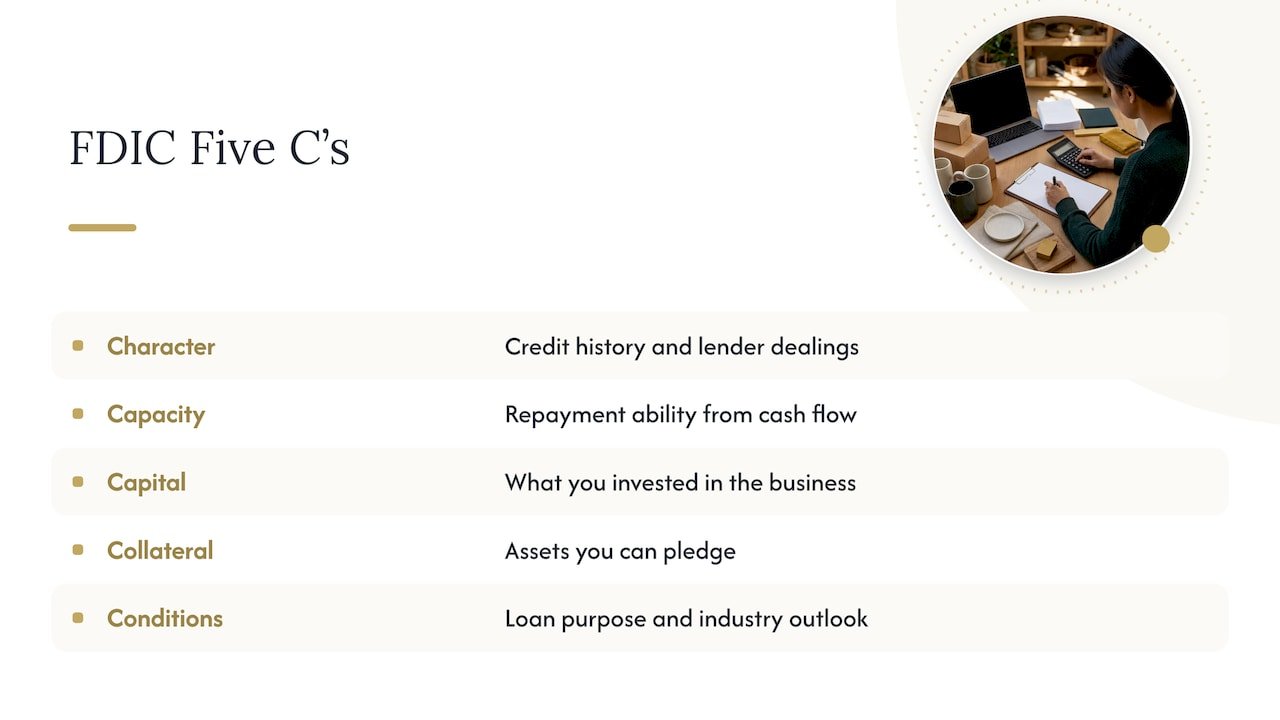
The FDIC’s small business financing training describes the Five C’s that underwriters use: character, capacity, capital, collateral and conditions. Character is your credit history and how you have dealt with lenders. Capacity is your ability to repay from cash flow. Capital is what you have invested in the business. Collateral is the assets you can pledge. Conditions cover the loan purpose and the industry outlook.
Most owners prepare for one of those, the business idea. The same FDIC guide notes that failing to clean up credit or mixing personal and business finances can end an application before a lender looks at your potential. A good checklist covers all five.
The loan readiness checklist
Work through these in order. Each step builds on the one before it.
- Define the purpose and the amount.
- Separate business and personal finances.
- Bring your bookkeeping up to date.
- Pull your personal and business credit reports.
- Produce current financial statements.
- Build a cash flow projection and a short business plan.
- Gather tax returns and entity documents.
- List collateral and debts.
- Match yourself to the right lender or program.
- Prepare for the conversation.
1. Define the purpose and the amount
Lenders want a specific answer to the question of why you need the money and how much. “Working capital” is a start. “$60,000 to buy a second delivery van and cover three months of fuel and insurance” is a request a lender can underwrite.
Write down three things:
- What the money will buy, with quotes or invoices where you have them.
- How the purchase produces revenue or savings.
- How you will repay, in monthly dollars, from which income.
If you cannot fill in the third line, you are not ready yet. That is useful to learn before a lender tells you.
2. Separate business and personal finances
The FDIC guide says to keep business and personal finances strictly separate, both for accurate records and for tax compliance. In practice:
- Open a business checking account and use it for every business deposit and expense.
- Stop paying business costs from a personal card, or if you must, reimburse yourself through a documented process.
- Pay yourself through a clear owner draw or payroll, not random transfers.
If you have not formed an entity yet, our business formation services cover incorporation, a registered agent, business banking setup and annual report filing.
3. Bring your bookkeeping up to date
This step is where most applications stall. A lender can only trust statements that tie back to reconciled records. Check that:
- Every bank and card account is reconciled through last month.
- Transactions are categorized consistently.
- Receivables and payables are current and accurate.
- Payroll and sales tax filings match what your books show.
If your books are behind, see our guides on bookkeeping best practices and a clear small business bookkeeping approach. Freelancers can start with what financial records to keep.
4. Pull your credit reports and prepare to explain them
The FDIC training treats character as more than a number: lenders assess whether you can be trusted to manage the loan responsibly, and being open about past credit problems helps build credibility. So do not hide a late payment or a collection. Know what is on your personal report, check your business credit file if one exists, and write a two-sentence explanation of anything negative.
For most small business loans, especially from a bank or an SBA lender, expect your personal credit to matter alongside the business’s.
5. Produce current financial statements
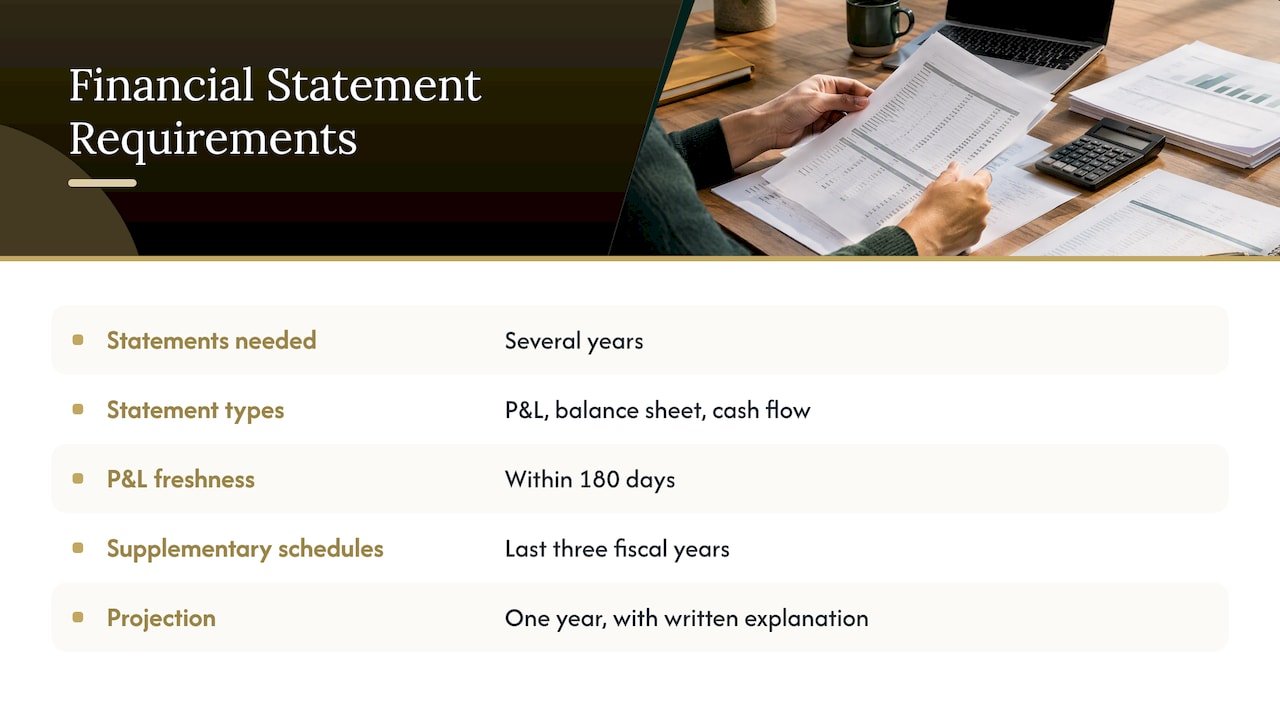
Lenders typically want several years of financial statements: a profit and loss statement, a balance sheet and a cash flow statement. For SBA 7(a) loans, the SBA’s 7(a) application checklist says the P&L must be current within 180 days of your application, with supplementary schedules from the last three fiscal years. It also asks for a one-year projection with a written explanation of how you expect to reach it.
If you do not read these statements comfortably, learn before the meeting. Our guide on how to read financial statements covers the basics. You will be asked about the numbers, and “my accountant handles that” is a weak answer.
6. Build a cash flow projection and a short business plan
The FDIC lists a detailed business plan with goals, strategies and financial projections among the standard parts of a loan package. Keep yours short. One to three pages is plenty for most small loans:
- What you sell and to whom.
- Who runs the business and their experience.
- How the loan changes revenue, costs or capacity.
- A monthly cash flow projection for the next 12 months, with your assumptions written out.
A projection with stated assumptions is more believable than one with round numbers and no explanation. If cash is tight at the moment, four moves to stabilize cash flow in 30 days can help the numbers look and work better before you apply.
7. Gather tax returns and entity documents
Plan on recent business and personal tax returns. The FDIC guide lists them among the standard documents, and requirements vary by loan size, entity structure and how mature the company is. Also collect:
- Articles of incorporation or organization, and your operating agreement.
- Business licenses and permits.
- Your EIN confirmation letter.
- Lease agreements and key contracts.
- Ownership details for anyone holding a significant share.
If you have unfiled returns, deal with them first. A lender who finds a missing return will stop. Our tax preparation and filing page covers catching up on outstanding returns, which starts with a $150 deposit.
8. List collateral and debts
Collateral means assets pledged to secure the loan, such as equipment, inventory or property. Make a simple schedule with each asset, its estimated value and whether it is already pledged elsewhere. Do the same for existing debts: lender, balance, monthly payment, rate and maturity.
For SBA loans, owners are also asked for a Personal Financial Statement on SBA Form 413, which the SBA uses to assess repayment ability and creditworthiness. Starting one early shows you where your personal balance sheet stands.
9. Match yourself to the right lender or program
Not every loan fits every business. The SBA describes 7(a) loans, 504 loans and Microloans: 7(a) is the flagship program for equipment, real estate and working capital, 504 is long-term fixed-rate financing for major fixed assets, and Microloans go up to $50,000 for early-stage businesses. The SBA reports it guaranteed 84,400 loans totaling $44.8 billion in fiscal year 2025.
If you do not know which lenders to approach, the SBA’s Lender Match tool asks a few questions about your business and connects you with lenders who express interest.
10. Prepare for the conversation
Don’t expect everything to happen in an online form. The FDIC’s 2024 small business lending survey found only about 13% of banks let you sign closing documents entirely online, and roughly a quarter accept formal applications through an online portal. Plan for meetings and calls.
Before you go, rehearse short answers to these questions:
- What will you use the money for, and why now?
- How much cash does the business generate each month after expenses?
- What happens if sales fall 20%?
- What assets can you pledge?
- What is the story behind any credit blemish?
A quick readiness table
Use this to see where you stand. Mark each row ready, nearly or not yet.
| Area | Lender question | What to have |
|---|---|---|
| Character | Can we trust you with credit? | Credit reports, short explanation of any negatives |
| Capacity | Can the business repay? | P&L, cash flow statement, 12-month projection |
| Capital | What have you put in? | Balance sheet, owner investment records |
| Collateral | What backs the loan? | Asset schedule with values, debt schedule |
| Conditions | Why this loan, and what is the market like? | Purpose statement, quotes, short business plan |
What if the business is not yet profitable?
A loss does not automatically rule you out. An FDIC training document on small business financing explains that lenders may add back certain non-cash expenses, such as depreciation, when assessing the ability to repay. You will want organized statements so you can explain these adjustments and show a realistic path to repayment.
The same document includes a small business financing checklist and encourages entrepreneurs to work with bankers, counselors or other advisors before making financing decisions. That is good advice at any stage.
Questions to ask about fees and compensation
Once you reach a loan officer or broker, ask how they are paid. According to the CFPB, mortgage loan officers and brokers are usually paid a loan-specific fee or commission, paid by you or by the lender, and federal law bars them from basing pay on the loan’s terms. That CFPB page covers mortgages. Commercial loans have their own rules, so apply the habit rather than assume the same protections.
Ask:
- Who pays any origination or broker fee, and when?
- Is the fee in the closing disclosure or term sheet in writing?
- Are there prepayment penalties, guarantee fees or packaging fees on top?
Before signing a large commercial loan, have a commercial lending attorney review the documents, especially personal guarantees and collateral terms.
Our perspective: readiness is mostly a records problem
We work with small business owners, freelancers and startups on bookkeeping, tax preparation and financial consulting. When an owner tells us a loan application went badly, the cause is rarely a weak business. It is usually records that were behind, personal and business spending that were mixed, or statements the owner could not explain.
That is good news, because those problems are fixable. Reconciled books, a clean separation of accounts and a realistic projection can be put in place in weeks, not years.
We also encourage owners to talk to us before they talk to a lender. A lender sees one snapshot. We can help you decide whether the amount is right, whether the payments fit your cash flow, and whether the timing makes sense. Our guide on business financial planning shows how we think about that.
If you are only a little short of ready, do not rush. A lender usually gives you one clear first impression.
— Kelli
How we can help you get ready
If your books are behind or your financial statements are not lender-ready, our full-service accounting and bookkeeping team can reconcile your accounts, prepare your statements and build the projections a lender asks for. We work virtually and in person, and we can book a free consultation to look at where you stand.
A 90-day timeline
| When | What to do |
|---|---|
| Days 1 to 30 | Separate accounts, catch up bookkeeping, pull credit reports, file any missing returns |
| Days 31 to 60 | Close the books monthly, produce a P&L and balance sheet, draft a projection and purpose statement |
| Days 61 to 90 | Build the asset and debt schedules, assemble the document folder, research lenders, schedule meetings |
If you want a view into how consulting fits this process, our financial consulting checklist for startups is a good companion.
FAQ
How long does it take to become loan ready?
If your books are current and your accounts are separate, a few weeks can be enough to assemble documents. If you are behind on bookkeeping or tax filings, plan on two to three months. The timeline depends mostly on how much cleanup your records need.
What documents do I need for a small business loan?
Plan on a loan application, a business plan, financial statements, recent business and personal tax returns, credit reports and collateral documentation, according to the FDIC. Exact requirements vary by lender, loan size and business structure, so ask your lender for its list early.
Can I get a loan if my business is not profitable?
Sometimes. Lenders may consider a path to repayment and adjust for non-cash expenses like depreciation. You will need organized statements and a clear explanation, and a smaller amount or added collateral may improve your chances.
Should I use an SBA loan?
It depends on your purpose and size. SBA programs cover working capital, equipment, real estate and small early-stage needs through Microloans of up to $50,000. Use the SBA’s Lender Match tool or talk to a local lender about which fits.
Sources
- FDIC Small Business Financing Participant Guide
- FDIC Banking Services Available for a Small Business
- FDIC Small Business Lending Survey 2024, Section 6
- SBA FY25 lending results
- SBA Form 413, Personal Financial Statement
- SBA Lender Match
- CFPB: How does a mortgage loan officer or broker get paid?