


Good bookkeeping directly enables predictable cash flow, clearer profitability, and faster growth decisions. It is the financial foundation every small business needs to move from reactive to strategic. Here are the primary ways accurate books drive real business outcomes:
- Cash flow visibility: Clean records show exactly when money arrives and leaves, so you can plan hiring and inventory without surprises.
- Profit clarity: Accurate categorization reveals true margins by product, service, or customer.
- Tax readiness: Organized records reduce audit risk and cut the time and cost of filing.
- Financing access: Lenders and investors require current, reconciled financials before approving credit or funding.
- Budget reliability: Historical bookkeeping data feeds forecasts that actually reflect your business.
- Cost control: Detailed expense records expose waste and margin leaks that are invisible in a bank balance.
- Compliance confidence: Payroll, sales tax, and contractor records stay accurate and defensible.
- Scalability: Systems built on solid bookkeeping grow with the business instead of breaking under volume.
The action checklist in Section 11 gives you a one-week plan to put these into practice.
Table of Contents
- Why bookkeeping affects business growth: the metrics that matter
- How does cash flow management protect your ability to grow?
- How does bookkeeping feed reliable budgets and forecasts?
- What bookkeeping problems block growth and how do you fix them?
- What does research say about bookkeeping and business growth?
- Key Takeaways
- What a virtual accounting partner actually changes
- Kelliworks turns your books into a growth tool
- Authoritative sources and further reading
Why bookkeeping affects business growth: the metrics that matter
Every transaction your business records becomes a data point. Enough data points, properly categorized, produce the metrics that tell you whether your business is actually healthy or just busy. That distinction shapes every major decision you make.
The three metrics most directly tied to growth decisions are gross margin (revenue minus direct costs), net profit (what remains after all expenses), and cash runway (how many months you can operate at current burn). A fourth metric, contribution margin, isolates how much each product or service line contributes to covering fixed costs. When your books are current and correctly coded, these numbers are available in minutes. When they are not, you are guessing.
| Metric | What it tells you | Growth decision it supports |
|---|---|---|
| Gross margin | Profitability before overhead | Pricing, product mix |
| Net profit | True bottom-line performance | Hiring, reinvestment timing |
| Cash runway | Months of operating capacity | Expansion, credit decisions |
| Contribution margin | Per-product/service profitability | Stop, scale, or reprice a line |
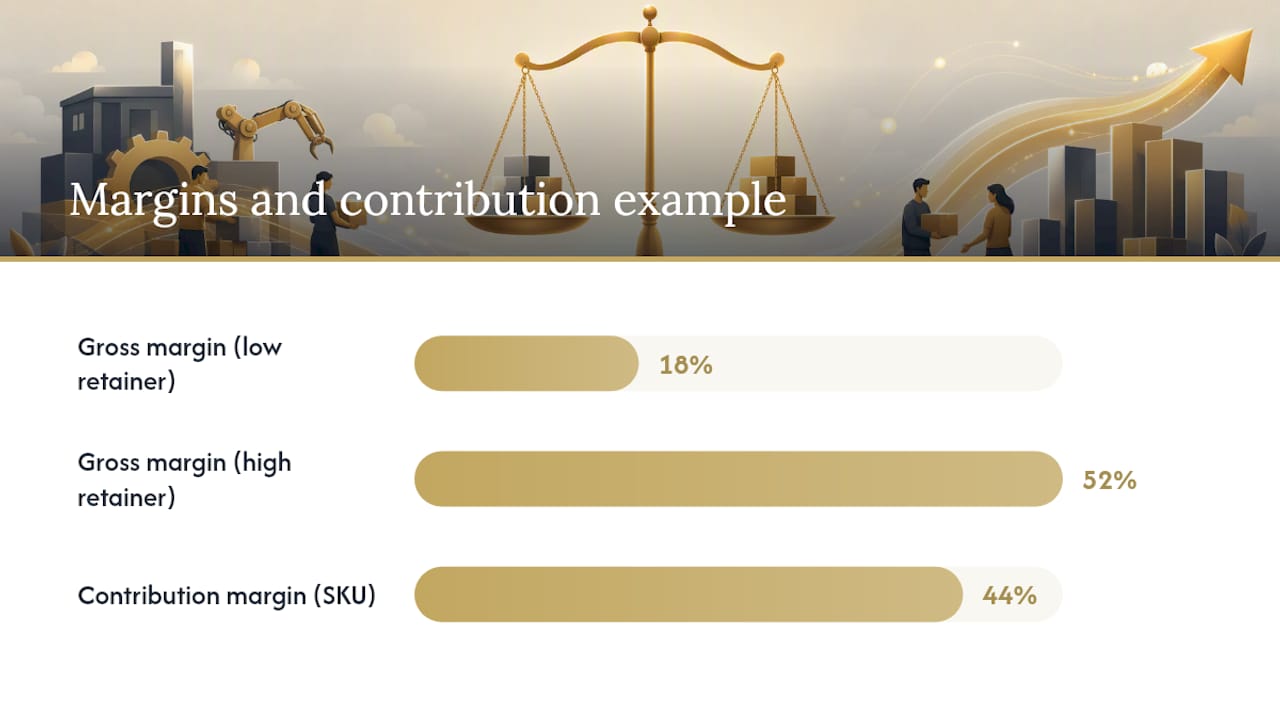
Consider two quick examples. A service business owner notices her gross margin on one retainer package is 18% while another runs at 52%. Without clean books, both look like revenue. With them, she can reprice the low-margin package or replace it. A product seller tracking contribution margin by SKU discovers that his top-selling item barely covers its direct costs once shipping and returns are included. He scales back promotion on that SKU and redirects budget to a line with a 44% contribution margin. Both decisions are only possible when financial data drives growth actions.
Bookkeeping combined with management accounts turns transactional data into decision-ready insight that supports forecasting, investor readiness, and cost control. — Gerald Edelman
How does cash flow management protect your ability to grow?
Profit and cash are not the same thing. A business can show a healthy net profit on its income statement while running out of cash to pay payroll. The gap lives in timing: a customer invoice issued in March but paid in May, a supplier requiring payment in 30 days while your clients take 60. That mismatch is where growth plans stall.
Bookkeeping is the earliest warning system for cash timing problems. When accounts receivable (AR) and accounts payable (AP) are recorded in real time, you can see a cash shortfall forming weeks before it hits your bank account. That lead time is the difference between arranging a short-term credit line calmly and scrambling for cash at the worst possible moment. Managing cash flow with bookkeeping is one of the highest-leverage habits a small business owner can build.
A five-point cash health check for owners:
- Reconcile your bank account at least weekly so your books match your actual balance.
- Review your AR aging report every two weeks and flag invoices over 30 days.
- Map your AP due dates against projected cash inflows for the next 45 days.
- Maintain a cash reserve target (typically 4–8 weeks of fixed operating expenses).
- Record all revenue and expenses on the day they occur, not when you have time.
Pro Tip: Set an automatic reminder in your accounting software to flag any invoice unpaid at 21 days. Catching late payments at three weeks instead of 60 days can recover weeks of cash runway over the course of a year.
How does bookkeeping feed reliable budgets and forecasts?
A budget built without historical bookkeeping data is a guess. One built on 12 months of clean, categorized actuals is a planning tool. The difference shows up when you need to make a growth commitment: hiring a new employee, signing a lease, or launching a product line.
The chain works like this: consistent bookkeeping produces accurate monthly financials, which become your management accounts, which feed a rolling forecast. Each step adds interpretive value. Management accounts amplify bookkeeping by adding monthly KPIs and forward-looking commentary that lenders and investors value.
A practical monthly budget and 3-month forecast cycle:
- Close your books by the 5th of each month (reconcile bank, categorize all transactions).
- Pull your actual P&L and compare it to last month’s budget. Note variances over 10%.
- Update your revenue forecast for the next 3 months using confirmed orders and pipeline.
- Reforecast your COGS and payroll based on current headcount and supplier pricing.
- Project your cash position week by week for the next 90 days using AR and AP data.
- Identify one budget line where actuals exceeded forecast and adjust the assumption going forward.
For this cycle to produce reliable outputs, four bookkeeping inputs must be accurate: recurring revenue recognized in the correct period, cost of goods sold separated from operating expenses, payroll recorded by pay date, and AR/AP recorded when invoiced or billed, not when cash moves.
What bookkeeping problems block growth and how do you fix them?
Most small business bookkeeping problems fall into a predictable set of categories. Recognizing them early makes remediation faster and less expensive.
Top bookkeeping problems small businesses face:
- Inconsistent expense coding (same vendor categorized differently each month)
- Unreconciled bank or credit card accounts (books do not match actual balances)
- Mixed personal and business transactions in the same account
- Late or missing invoices (AR not recorded until payment arrives)
- Payroll recorded incorrectly (gross wages only, taxes not separated)
- Missing receipts for deductible expenses
- Duplicate transactions from manual entry alongside bank feeds
- No chart of accounts, or one that has grown inconsistently over time
- Sales tax collected but not tracked as a liability
- Books not closed monthly, so errors compound across quarters
A prioritized remediation plan:
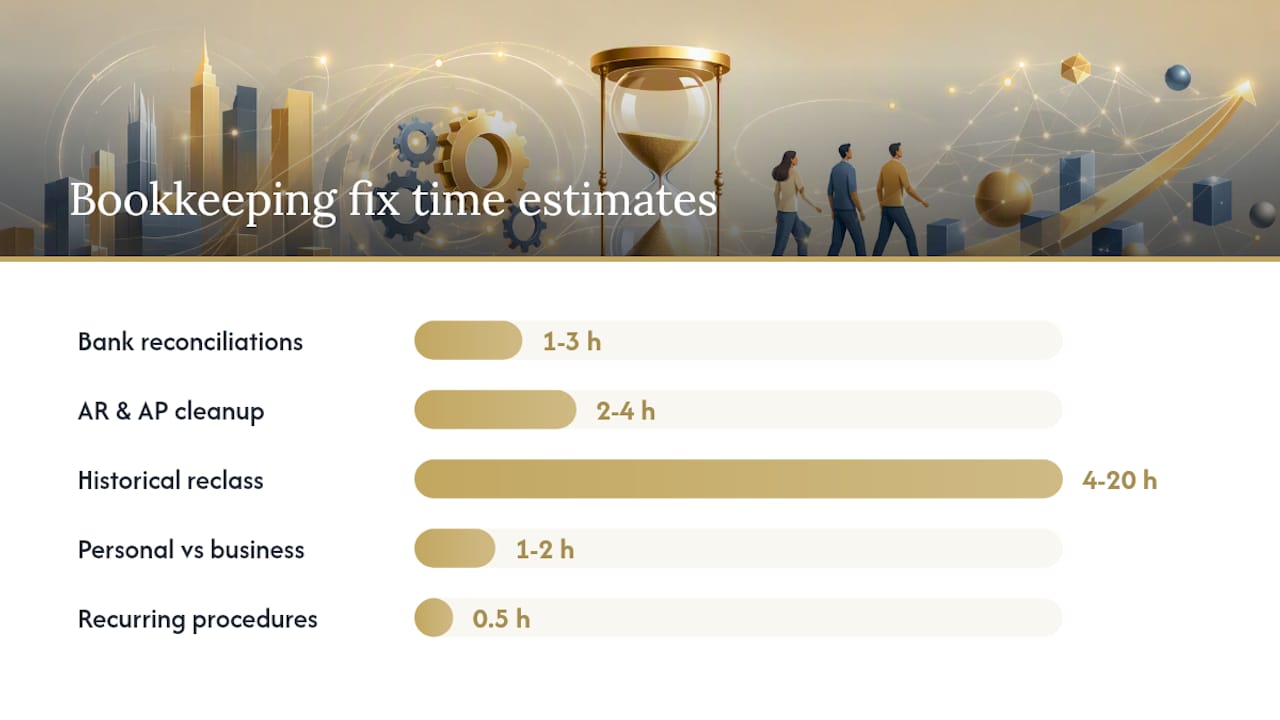
- Stabilize bank reconciliations first (1–3 hours DIY or 2–4 hours with a bookkeeper). Match every account to its statement for the most recent month. This gives you a reliable starting point.
- Clean AR and AP (2–4 hours). Confirm every open invoice is recorded and every outstanding bill is entered. Resolve any amounts that do not match vendor statements.
- Correct historical miscoding (variable: 4–20 hours depending on volume). Work backward through the current year, reclassifying transactions to the correct accounts. This is the step most worth hiring a professional for.
- Separate personal and business transactions (1–2 hours). Move any personal charges to an owner’s draw account and open a dedicated business card if you have not already.
- Set recurring procedures (30 minutes to document). Write down the weekly and monthly tasks, assign them to a person or a calendar reminder, and commit to the cadence.
For steps 1 and 2, most owners can manage DIY in a weekend. Step 3, historical reclassification, is where a certified bookkeeper or CPA pays for itself quickly. A professional can typically complete a full-year clean-up in a fraction of the time it would take an owner unfamiliar with accounting software.
What does research say about bookkeeping and business growth?
The connection between bookkeeping and business performance is not just intuitive. It is supported by field research. An empirical study of micro and small enterprises using Spearman’s Rank Correlation found a significant positive relationship between bookkeeping implementation and business growth has been found. The study noted that bookkeeping practices were moderately implemented across the sample, suggesting that most small businesses are leaving growth on the table by not fully committing to consistent recordkeeping.
A separate ScienceDirect study on bookkeeping practices and SME performance found that owner accounting literacy mediates the relationship between bookkeeping and business outcomes. In plain terms: bookkeeping produces better results when the owner understands the numbers. This has a direct implication for small business owners. Either build your own accounting literacy or work with a partner who translates the numbers into decisions for you.
Field research confirms a significant positive relationship between bookkeeping implementation and small business growth, with owner accounting literacy strengthening that effect. — IJRIS study
Key sources that support the guidance in this article:
- ScienceDirect: Bookkeeping practices and SME performance: owner accounting skills as a mediating factor
- IRS recordkeeping guidance: documentation and retention expectations
- AICPA: professional standards for transactional accounting and reporting
- First Utah Bank: Why every growing business needs a bookkeeper: practical case for consistent bookkeeping
Key Takeaways
Consistent, accurate bookkeeping is the single most accessible lever small business owners have for improving cash visibility, profitability, and financing readiness.
| Point | Details |
|---|---|
| Cash flow is not profit | Reconcile AR and AP weekly to catch timing gaps before they become cash shortfalls. |
| Metrics require clean data | Gross margin, net profit, and cash runway are only reliable when books are current and correctly coded. |
| Compliance depends on records | Keep income, expense, payroll, and contractor records for 3–7 years per IRS guidance. |
| Lenders read book quality | Produce a current P&L, balance sheet, cash flow statement, and AR/AP aging before applying for credit. |
| Kelliworks as your partner | Kelliworks provides virtual bookkeeping and accounting support that keeps your books current, your forecasts reliable, and your growth decisions grounded in real data. |
One-week action checklist:
- Day 1: Reconcile last month’s bank and credit card accounts.
- Day 2: Pull your AR aging report and follow up on any invoice over 21 days.
- Day 3: Review your top 10 expense categories and confirm they are coded correctly.
- Day 4: Map your AP due dates against projected cash inflows for the next 45 days.
- Day 5: Set a recurring monthly close date and block it in your calendar.
- Day 6–7: If any of the above took more than 4 hours or revealed significant errors, contact a professional bookkeeper.
When bookkeeping consistently takes more than 5 hours per week or your books are more than 30 days behind, a virtual accounting partner typically recovers that time and improves accuracy within the first month.
What a virtual accounting partner actually changes
The most common pattern we see at Kelliworks is an owner who has been managing books in a spreadsheet or a loosely configured accounting tool, and whose records are 60–90 days behind by the time they reach out. The books are not wrong, exactly. They are just incomplete and inconsistent enough that no reliable metric can be extracted from them.
After a structured clean-up and a consistent monthly close process, the same owner can answer questions like “Which of my service lines is most profitable?” and “Can I afford to hire in Q3?” with confidence rather than instinct. That shift, from instinct to informed decision-making, is what the research on owner accounting literacy points to. Bookkeeping does not automatically produce growth. It produces the data that makes growth decisions defensible.
The conventional wisdom says bookkeeping is a compliance task. File your taxes, stay out of trouble, move on. That framing undersells it significantly. The owners who grow fastest are not necessarily the ones with the best products or the most aggressive sales strategies. They are often the ones who know their numbers well enough to act quickly when an opportunity appears and to stop investing in what is not working. Clean books are what make that possible.
A virtual accounting department operationalizes the entire checklist above: monthly close, AR follow-up, payroll reconciliation, and management reporting, without the overhead of a full-time hire.
Kelliworks turns your books into a growth tool
Kelliworks is the alternative to piecing together your finances alone. Where most small business owners spend hours chasing receipts and reconciling accounts, Kelliworks handles the full bookkeeping cycle, monthly close, and financial reporting so your numbers are always current and decision-ready.

The Kelliworks virtual accounting department bundles bookkeeping, tax preparation, payroll processing, and financial consulting into one personalized engagement. You get accurate monthly financials, a clear picture of your cash position, and a partner who can explain what the numbers mean for your next hire, your next investment, or your next financing conversation.
Ready to stop guessing and start growing with reliable financial data? Schedule a free consultation with Kelliworks today.
Authoritative sources and further reading
The following sources were used in building this guide. Each one offers reliable, actionable information for small business owners who want to go deeper.
- Bookkeeping practices and SME performance: The intervening role of owners’ accounting skills – ScienceDirect
- Tangible Property Final Regulations — IRS
- American Institute of CPAs (AICPA)
- 10 ways bookkeeping and management accounts support business growth | Gerald Edelman
- Bookkeeping Matters as Your Business Grows – HireEffect
- How Professional Bookkeeping Helps Your Business Grow – BKEEP Inc.
- Bookkeeping practices and business growth study (IJRIS)
- Why Every Growing Business Needs a Bookkeeper | First Utah Bank