


A clear financial strategy is the single most important operational tool a startup has for surviving and scaling. Without it, you are making hiring, pricing, and investment decisions on instinct rather than data, and the consequences show up fast: missed payroll, a funding round that stalls, or a runway that disappears six weeks before you expected it to.
Here is where to start right now:
- Check your runway. Calculate exactly how many months of operating expenses your current cash covers at today’s burn rate.
- Set one rolling forecast. Build a 13-week cash forecast this week, even if it lives in a Google Sheet. Update it every month. This rolling forecast is the minimum viable financial tool for any startup, and updating it monthly ensures your data stays accurate for decision-making.
- Identify one investor readiness gap. Pick the single weakest item in your financial story — no forecast, inconsistent actuals, or a messy cap table — and commit to fixing it in the next 30 days.
Founders benefit most from acting on these steps immediately. Product leads and early operations hires should be looped in too, because financial decisions touch headcount, pricing, and go-to-market timing all at once.
Key Takeaways
A clear financial strategy gives startups the runway visibility, investor credibility, and decision-making data they need to survive and scale at every stage.
| Point | Details |
|---|---|
| Start with runway | Calculate months of cash remaining at current burn before any other financial work. |
| Match priorities to stage | Early-stage focus belongs on unit economics and cash; growth-stage focus shifts to scalable reporting. |
| Build a rolling forecast | A driver-based 13-week cash forecast, updated monthly, is the minimum viable financial tool for any startup. Stage-based priorities matter: early-stage focus is on runway and unit economics, while reporting and capital structure become priorities during growth and scale-up stages. |
| Investor readiness is built, not pitched | Clean actuals, a credible model, and a clear use-of-funds schedule answer investor questions before they are asked. |
| Kelliworks accelerates the process | Kelliworks provides bookkeeping, tax prep, and financial consulting as a virtual accounting department, so founders can build a finance function without a full-time hire. |
Table of Contents
- Why financial strategy matters for startups more than any other tool
- What does a financial strategy look like at each stage?
- What are the core components every startup financial strategy needs?
- How does financial strategy make you investor-ready?
- When should you hire a CFO, use a fractional CFO, or outsource finance?
- What U.S. tax and compliance basics should every startup handle early?
- How do you build a single source of truth for startup finances?
- Your 8-step checklist to build a startup financial strategy
- How Kelliworks operationalizes a startup financial strategy
- How scenario planning and sensitivity analysis protect your startup
- The part of financial strategy most founders underestimate
- Kelliworks gives startups a full finance function without the overhead
- Sources
Why financial strategy matters for startups more than any other tool
Finance does far more than track what you have already spent. As Andreessen Horowitz explains, finance should be built early and treated as a strategic function that ties together people, product, and cash. That framing shifts the job from bookkeeping to decision-making infrastructure.
In practice, finance balances vision with realistic goals, determines what is actually profitable, and forces trade-offs before cash runs out rather than after. Five concrete functions stand out:
- Protecting runway and liquidity. Knowing your burn rate and cash position lets you make proactive decisions, not reactive ones.
- Testing initiatives against financial reality. A founder who wants to hire ten people immediately will find that a simple model often reveals the same growth outcome is achievable with four hires phased over two quarters, preserving six months of runway.
- Measuring unit economics. Gross margin, customer acquisition cost (CAC), and lifetime value (LTV) tell you whether the business model works before you pour more capital into it.
- Enabling prioritized hiring. Finance shows you which role generates the highest return per dollar, so you hire the right person at the right time.
- Informing pricing and go-to-market investments. A driver-based model reveals which pricing lever moves the needle on contribution margin fastest.
Investopedia’s definition of strategic financial management captures the underlying principle well: managing resources to reach long-term objectives often requires making short-term trade-offs. That is the discipline startups need most, because every dollar spent in year one is a dollar that cannot fund growth in year two.
Pro Tip: Treat financial data the way you treat product metrics. Instrument it, automate the ingestion of actuals, and run a monthly review cycle. A finance function that only reports history is a lagging indicator; one that forecasts and flags variance is a real decision tool.
What does a financial strategy look like at each stage?
Stage-driven priorities are the clearest signal that a founder understands why financial strategy matters for startups. Early focus belongs on runway and unit economics. Later, the priority shifts to scalable reporting and capital structure. Trying to build investor-grade reporting at the idea stage wastes time; ignoring it at Series A costs you the round.
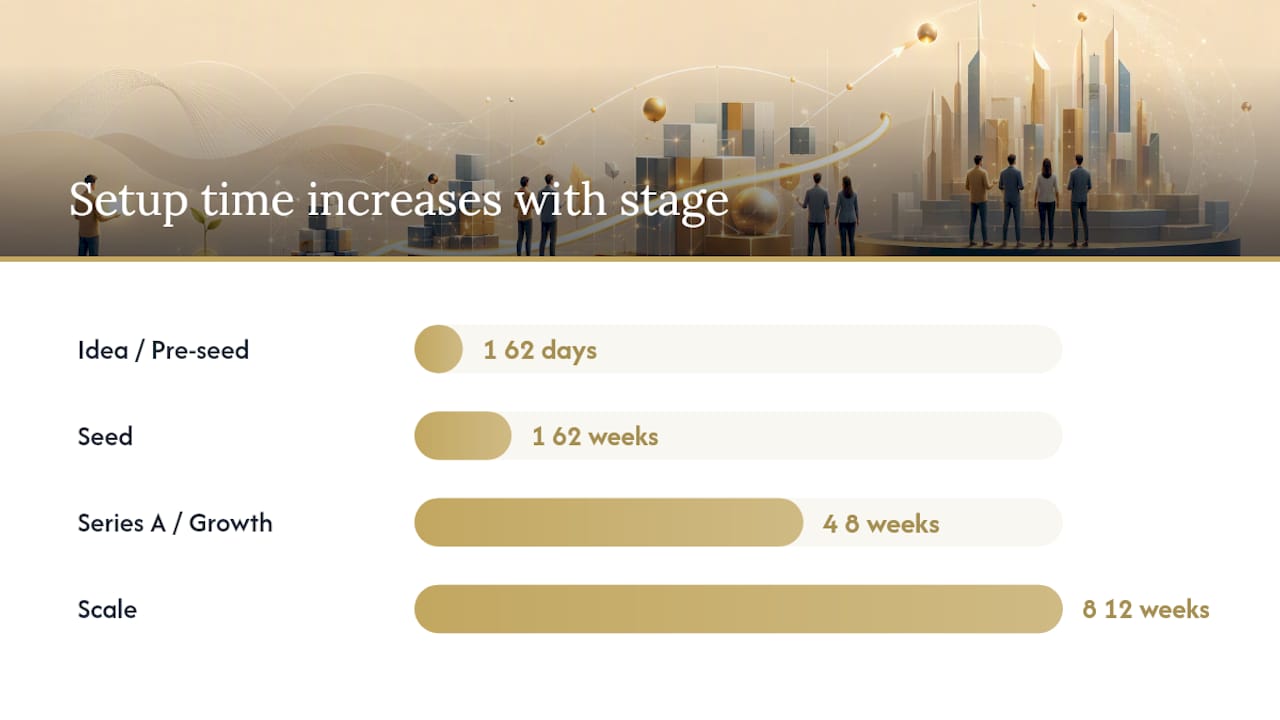
| Stage | Primary Measurement | Top Objectives | Typical Setup Time |
|---|---|---|---|
| Idea / Pre-seed | Runway (months of cash) | Validate cost structure, set break-even target, open business bank account | 1–2 days |
| Seed | Unit economics (CAC, LTV, gross margin) | Build rolling forecast, track burn weekly, prepare basic investor materials | 1–2 weeks |
| Series A / Growth | CAC/LTV ratio, revenue growth rate | Automate actuals, hire or engage fractional CFO, build board-ready reporting | 4–8 weeks |
| Scale | Cash conversion cycle, EBITDA | Implement FP&A software, establish variance review cadence, optimize capital structure | 8–12 weeks |
Quick actions by stage:
- Idea / Pre-seed: Open a dedicated business account, log every expense, and build a simple 12-month cash projection in a spreadsheet.
- Seed: Set up a driver-based rolling forecast (revenue drivers, headcount plan, cash roll-forward). A minimal version takes about one week to build.
- Series A / Growth: Automate actuals from your accounting software, produce monthly board packages, and close your books within five business days of month-end.
- Scale: Evaluate FP&A platforms, formalize a budget-versus-actuals review, and align your capital structure with your three-year plan.
Aligning your funding type to your strategic goals is equally stage-dependent. A seed-stage company raising a convertible note has different financial reporting obligations than a growth-stage company on a priced round, and your financial strategy needs to reflect that difference. You can explore a practical financial growth strategy framework for small businesses to see how these stage priorities translate into a working plan.
What are the core components every startup financial strategy needs?
The non-negotiable components are: a cash forecast, a driver-based financial model, a defined KPI set, a budget-versus-actuals process, and at least two risk scenarios. Gartner’s guidance on finance strategy reinforces this: measurable KPIs, a clear roadmap, and a balance of technology and talent are what separate a finance function that delivers insights from one that only produces reports.
KPIs every startup should track
- Runway: Months of cash remaining at current burn. The most important number in your business.
- Burn rate: Net cash consumed per month (gross burn minus revenue).
- Gross margin: Revenue minus cost of goods sold, expressed as a percentage. Below 40% in a SaaS business is a red flag.
- CAC: Total sales and marketing spend divided by new customers acquired in the same period.
- LTV: Average revenue per customer multiplied by average customer lifespan.
- AR days: How long it takes to collect receivables. High AR days signal a cash flow problem waiting to happen.
- Churn rate: Monthly or annual percentage of customers or revenue lost.
How to build a minimal rolling forecast in five steps
- Define your revenue drivers. List the two or three inputs that actually move revenue: number of deals closed, average contract value, conversion rate.
- Map your cost assumptions. Headcount is usually a majority of operating expenses for early-stage startups. Model it by role and start date.
- Build a cash roll-forward. Start with opening cash, add collections, subtract disbursements, and land on closing cash for each month.
- Add two scenarios. A base case and a downside case (20–30% lower revenue, same costs) show you the floor on runway.
- Reforecast monthly. Replace the oldest month’s assumptions with actual results and extend the horizon by one month. This is the “rolling” part.
| Benchmark | Insight |
|---|---|
| Cash-flow failure is a principal driver of business collapse | A rolling cash forecast is the earliest warning system you have. |
| FP&A at startups can run on a driver-based model with automated actuals until a dedicated hire is justified | Founders can run lightweight FP&A themselves through seed stage without specialized software. |
Setting measurable financial goals alongside these components keeps the KPIs connected to outcomes rather than floating as abstract numbers.
How does financial strategy make you investor-ready?
Investors look for credible forecasts, defensible unit economics, a clear use-of-funds breakdown, and repeatable growth levers. The financial strategy you build for operational purposes doubles as your investor narrative, which is why the two should never be built separately.
Investor due-diligence checklist:
- A three-year financial model with monthly detail for year one
- Historical actuals reconciled to bank statements
- Cap table showing ownership percentages and any outstanding SAFEs or convertible notes
- Burn rate and runway calculation with clear assumptions
- Unit economics summary (CAC, LTV, payback period, gross margin by cohort)
- Use-of-funds schedule tied to specific milestones
- Clean bookkeeping with no unexplained transactions
Common red flags that kill deals:
- No financial model, or a model that cannot be explained line by line
- Actuals that do not match the story told in the pitch deck
- Unexplained churn spikes with no retention analysis
- Gross margins that compress as revenue grows (a unit economics problem, not a scale problem)
- A cap table with errors, missing signatures, or undocumented option grants
A strong forecast addresses investor concerns before they are raised. If your model shows runway extending 18 months post-raise with a clear path to break-even, an investor’s first concern — “will they run out of money before hitting the milestone?” — is answered on page one. Lack of a clear financial strategy is one of the biggest reasons funding rounds stall, and the fix is almost always the same: build the model, clean the books, and align the numbers to the narrative.
When should you hire a CFO, use a fractional CFO, or outsource finance?
Choose the model that solves for your current constraint: time, trust, or speed. A two-founder bootstrapped startup does not need a full-time CFO. A VC-backed company preparing for a Series B does.
Decision flow:
- Full-time CFO: Justified when you have raised a Series B or later, have a finance team to manage, and need someone in the room for board meetings and M&A conversations. Annual cost typically exceeds $200,000 in total compensation.
- Fractional CFO: The right fit for Series A companies that need strategic guidance, investor-ready reporting, and board support but cannot yet justify a full-time hire. Engagements typically run 10–20 hours per month.
- Virtual accounting partner: Best for pre-seed through seed-stage companies that need clean books, tax compliance, basic forecasting support, and someone to own the month-end close. Lower cost, faster to engage, and no long-term hiring commitment.
Pros and cons at a glance:
Full-time CFO
- Pros: Deep institutional knowledge, full availability, strong board presence
- Cons: High cost, long hiring timeline, often over-qualified for early-stage needs
Fractional CFO
- Pros: Senior expertise at a fraction of the cost, flexible scope, fast to engage
- Cons: Limited availability, may not be available during a fundraising crunch
Virtual accounting partner
- Pros: Immediate start, broad service coverage (bookkeeping, tax, reporting), consistent and cost-effective
- Cons: Less strategic depth than a CFO, best paired with founder-led forecasting at early stages
A two-founder bootstrapped startup running on $500,000 in seed funding gets the most value from a virtual accounting partner that handles bookkeeping, tax prep, and monthly reporting while the founders focus on product and sales. A VC-backed growth company at Series A needs a fractional CFO to own the financial model and investor relations, supported by a clean accounting foundation. You can review the types of financial consulting services available to founders to map the right model to your current stage.
What U.S. tax and compliance basics should every startup handle early?
Your tax posture directly affects cash, entity structure, and your ability to raise funding. Getting this wrong early creates expensive cleanup work later, and some mistakes — like misclassifying contractors or missing payroll tax deposits — carry IRS penalties that compound quickly.
U.S. startup tax and compliance priorities:
- Entity selection: An LLC, S-Corp, or C-Corp each carries different tax treatment. C-Corps are generally preferred by VC investors because of how equity and losses are handled under the tax code.
- Payroll tax deposits: Federal payroll taxes must be deposited on a schedule set by the IRS based on your lookback period. Missing a deposit triggers penalties.
- Sales tax nexus: If you sell into multiple states, you may have sales tax obligations in states where you have no physical presence. The South Dakota v. Wayfair Supreme Court decision (2018) established economic nexus thresholds that most states have since adopted.
- Federal filings: File your annual return with the IRS on time. S-Corps and partnerships file on March 15; C-Corps file on April 15 (or the extended deadline).
- State obligations: Register in every state where you have employees or meet economic nexus thresholds. Failure to register creates back-tax liability.
- Bookkeeping practices: Maintain separate business and personal accounts from day one. Clean, categorized records are the foundation of every tax filing and audit defense.
Proactive tax planning checklist:
- Document all startup costs (legal fees, incorporation, early R&D) — many are deductible under IRC Section 195
- Ask your tax advisor about the R&D tax credit (IRC Section 41), which applies to qualifying software development and product work
- Track equity-based compensation carefully; 83(b) elections must be filed within 30 days of a restricted stock grant
- Review your accounting method (cash vs. accrual) with a tax advisor before your first full fiscal year
Escalate to a specialist when you have cross-state sales, R&D credit claims, or equity-heavy compensation packages. These areas carry enough complexity and dollar value to justify professional guidance. A startup-focused tax planning guide covers the early-stage decisions in detail.
How do you build a single source of truth for startup finances?
The goal is one reliable cash number and one place where actuals and plan live together. Without that, you are reconciling spreadsheets instead of making decisions.
A practical minimal tech stack:
- Accounting: QuickBooks Online or Xero for bookkeeping, invoicing, and tax-ready reporting
- Payments and billing: Stripe for revenue; sync it directly to your accounting software via native integration
- Bank sync: Connect your business bank account to your accounting software so transactions flow in automatically
- FP&A / spreadsheet layer: Google Sheets or Excel for your rolling forecast until you reach Series A; Mosaic, Jirav, or Causal for dedicated FP&A after that
- Dashboards: A simple Google Looker Studio dashboard pulling from your accounting software covers most early-stage reporting needs
When to stay in spreadsheets vs. when to buy dedicated tools:
Spreadsheets work well through seed stage when one person owns the model and scenarios are simple. The trigger points for upgrading to dedicated FP&A software are: the monthly model rebuild takes more than a day, someone is managing the spreadsheet full-time, or you need to run multi-scenario rebuilds quickly for a board meeting. That threshold typically arrives around Series A.
Pro Tip: Automate actuals ingestion before you do anything else. A forecast that requires manual data entry every month will not get updated consistently. Connect your accounting software to your forecast layer first, then build the model around it.
Gate financial write access to one or two people from the start. A shared spreadsheet that anyone can edit is not a source of truth; it is a liability. Establish a monthly close rhythm: books closed by day five, actuals loaded by day seven, variance review by day ten.
Your 8-step checklist to build a startup financial strategy
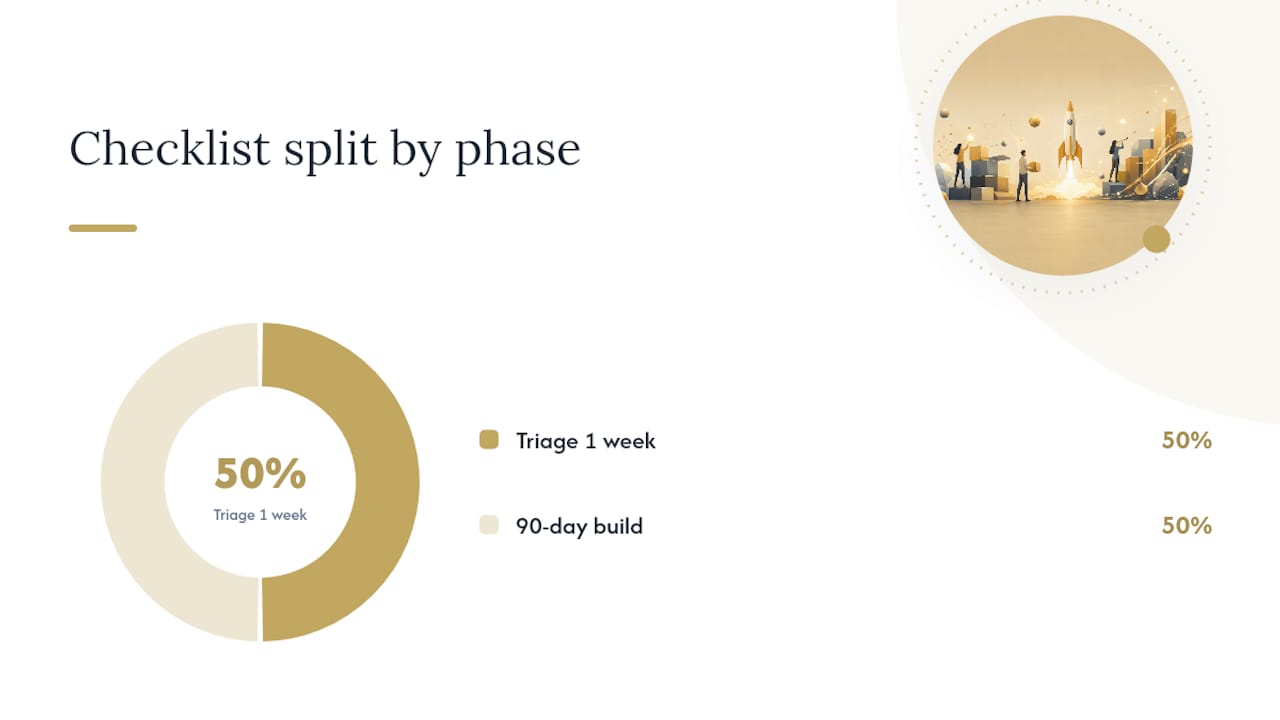
Work through these steps in order. The first four belong in a one-week triage sprint. Steps five through eight form your 90-day build.
One-week triage sprint:
- Calculate your runway today. Divide current cash by average monthly burn. Write the number down. This is your most important metric.
- Open or audit your business bank account. Confirm that all business transactions flow through a dedicated account with no personal expenses mixed in.
- Clean up your books. Categorize the last three months of transactions in QuickBooks or Xero. This is the foundation for everything else.
- Build a 13-week cash forecast. List expected cash inflows and outflows week by week. It does not need to be perfect; it needs to exist.
90-day build:
- Build a driver-based annual model. Add revenue drivers, headcount plan, and a downside scenario. Use the five-step process from the core components section above.
- Automate actuals ingestion. Connect your bank and accounting software so actuals flow into your model without manual entry.
- Engage a finance partner or fractional CFO. Decide which model fits your stage (see the finance leadership section) and engage within 30 days. A financial consulting checklist can help you prepare for that first engagement.
- Build your investor materials. Assemble your financial model, cap table, use-of-funds schedule, and KPI summary into a single folder. Update it monthly.
Ownership and success metrics:
The founder or co-founder with the most operational context should own steps one through four. Step five onward can be shared with an operations hire or finance partner. Success looks like: runway calculated weekly, books closed within five business days of month-end, and a financial model that gets updated every month without a scramble.
For additional cost-management tactics that complement this checklist, the cost-saving accounting strategies guide covers practical bookkeeping efficiencies worth reviewing alongside your setup.
How Kelliworks operationalizes a startup financial strategy
Kelliworks functions as a full-service virtual accounting department for startups that need clean books, tax compliance, and financial reporting without the overhead of an in-house team. For founders working through the checklist above, Kelliworks handles the execution so you can stay focused on building.
The services map directly to the checklist:
- Bookkeeping and cleanups: Monthly transaction categorization, reconciliation, and historical cleanup for founders who have fallen behind
- Monthly actuals automation: QuickBooks setup and bank sync so actuals flow in without manual work
- Rolling forecast support: Financial consulting to build and maintain a driver-based model tied to your business drivers
- Tax preparation and filing: Federal and state filings, payroll tax compliance, and proactive planning for credits and deductions
- Compliance and incorporation support: Entity setup, registration in new states, and ongoing compliance monitoring
- Financial consulting: Strategic guidance on unit economics, pricing, and investor readiness
Expected client outcomes include improved runway visibility, faster responses to investor due-diligence questions, and a significant reduction in time spent on month-end close. Founders who previously spent two to three days closing the books each month typically see that compressed to a single review session once Kelliworks owns the process.
When to choose a virtual partner over an in-house hire: If your annual revenue is below $2 million and you do not yet have a dedicated finance role, a virtual accounting partner delivers more coverage at lower cost and can be up and running within days rather than the weeks a hiring process requires. For financing options that complement your financial strategy, Surge Financial offers business loan solutions for professional services firms worth evaluating alongside your capital planning.
How scenario planning and sensitivity analysis protect your startup
Scenario planning is the practice of building multiple versions of your financial model to test how the business performs under different conditions. Sensitivity analysis goes one level deeper: it isolates a single variable (price, churn, CAC) and measures how much a change in that variable moves your key outputs.
Most early-stage founders build one forecast and treat it as the plan. That is a fragile approach. A single unexpected event — a key customer churning, a hiring delay, or a slower sales cycle — can make the entire model obsolete in a month.
A practical scenario framework uses three cases:
- Base case: Your most realistic projection, built on current conversion rates, average deal size, and planned headcount.
- Upside case: What happens if revenue comes in 20–30% above plan? Does your cost structure scale efficiently, or do margins compress?
- Downside case: What happens if revenue misses by 20–30%? How many months of runway remain, and what is the first cost you cut?
Sensitivity analysis adds precision to the downside case. Run it on your two or three highest-impact variables. For a SaaS startup, those are typically monthly churn rate, CAC, and average contract value. A one-percentage-point increase in monthly churn, for example, often has a larger impact on LTV than a 10% increase in CAC. Knowing that tells you where to focus retention investment.
The output of scenario planning is not a prediction. It is a set of decision triggers. If revenue falls 15% below plan for two consecutive months, you know in advance that you will reduce discretionary spend and pause one open headcount. That decision is made calmly in a planning session, not in a panic when cash is already tight.
The part of financial strategy most founders underestimate
The founders we work with most often arrive with a strong product instinct and a weak financial instinct. That is not a character flaw; it is a natural consequence of how most founders spend their early months. But the gap between “we have a great product” and “we have a business that can scale” is almost always a financial strategy gap.
What surprises many founders is how quickly financial clarity changes their decision-making confidence. Once you know your runway to the week, your CAC payback period to the month, and your gross margin by product line, you stop making decisions by feel. You start making them by data. That shift is not just reassuring; it changes the quality of every conversation you have with investors, employees, and co-founders.
The other thing worth saying plainly: financial strategy does not require a finance background. It requires discipline, a clean set of numbers, and a willingness to look at the data honestly, even when it is uncomfortable. The founders who build strong financial foundations early are not the ones who love spreadsheets. They are the ones who understand that financial clarity is a competitive advantage, and they treat it accordingly.
Kelliworks gives startups a full finance function without the overhead
Startups that need clean books, investor-ready reporting, and proactive tax planning often face the same choice: hire too early and strain the budget, or wait too long and scramble before a funding round. Kelliworks is the alternative. As a virtual accounting department built specifically for small businesses and startups, Kelliworks delivers bookkeeping, tax preparation, financial consulting, and compliance support under one engagement, without the cost or timeline of a full-time hire.

Founders who work with Kelliworks get clean monthly financials, a tax strategy aligned to their entity structure, and a finance partner who understands the pressures of early-stage growth. The initial consultation covers your current financial position, the gaps in your reporting, and a clear plan for what gets fixed first. Most clients are up and running within one to two weeks. To get started, schedule a consultation and come prepared with your last three months of bank statements and your current burn rate.
Sources
- Finance as Strategy: When and How Startups Should Build a Finance Function | Andreessen Horowitz
- How to create a better finance strategy | Gartner
- The Role of Finance in Business Strategy | EDHEC Online
- 4 Key Areas of a Startup’s Financial Strategy – Midven – Part of Future Planet Capital
- What is business finance and how create strategies for it? | IMD
- Why Financial Strategy Matters At Every Stage Of Business Growth | Forbes
- Strategic financial management definition | Investopedia
This article is general information, not a substitute for advice from a qualified financial advisor. Consult a qualified financial professional about your own circumstances before acting on anything here.