


Scenario financial planning is a structured method that models multiple plausible futures to test your cash position, margins, and capital needs, then produces ready contingency plans you can act on immediately. Gartner defines it as evaluating multiple potential future states so finance leaders can prepare alternative action plans to enact depending on how events unfold. Run it before any major strategic decision, during periods of market volatility, or whenever a single-point forecast feels dangerously optimistic. Success looks like this: clear financial triggers, pre-approved contingency actions, and measurably better cash visibility across your organization.
Key Takeaways
Scenario financial planning is most valuable when it produces pre-approved contingency actions tied to measurable triggers, not just a range of financial forecasts.
| Point | Details |
|---|---|
| Start with the decision, not the model | Define the specific question and scope before building any scenario. |
| Limit to three scenarios | Base, downside, and stress test cover most planning needs without creating confusion. |
| Cash visibility comes first | Reliable cash forecasting is the foundation; scenario models built on bad data produce bad outputs. |
| Triggers make scenarios actionable | Every scenario needs a measurable threshold and a pre-approved action assigned to a named owner. |
| Kelliworks accelerates SMB adoption | Kelliworks handles data cleanup, model build, and recurring reporting so small businesses can run scenario planning without a full FP&A team. |
Table of Contents
- What scenario financial planning actually means for your finance team
- Why scenario financial planning matters for resilience and better decisions
- Common types of financial planning scenarios and how to choose the right one
- A practical step-by-step process for running scenario financial planning
- How to convert scenarios into financial model changes
- How to choose modeling tools and testing engines
- How to convert scenario outputs into contingency plans and decision triggers
- Governance, cadence, and documentation to make scenario planning repeatable
- Three practical examples that show how scenarios changed real decisions
- Typical timeline and main cost drivers for scenario planning adoption
- Common pitfalls in scenario planning and how to avoid them
- How scenario planning differs from business-continuity planning
- A reusable methodology and checklist for your first scenario planning run
- Applying scenario planning in small businesses with an outsourced accounting partner
- What finance leaders actually get wrong when they start scenario planning
- Kelliworks helps small businesses run scenario planning without the overhead
- Sources
What scenario financial planning actually means for your finance team
Single-point forecasting gives you one number. Scenario planning in finance gives you a range of plausible futures and a decision for each one. That distinction is not cosmetic. Financial Professionals notes that a single-point estimate fails to capture all possible outcomes, and that scenario planning should run as a structured, continuous cycle rather than a one-time annual event.
In practical terms, scenario financial planning has six core components:
- Scope: The specific decision or planning horizon you are testing (e.g., a 12-month cash runway, a market entry, a major capital project).
- Drivers and uncertainties: The two or three variables most likely to swing your financial outcomes (revenue growth rate, a key customer concentration, input costs).
- Scenario narratives: Short, internally consistent stories that describe how each future unfolds, grounding the numbers in business logic.
- Modeling assumptions: The specific input values assigned to each driver in each scenario.
- Outputs: Financial statements, cash runway curves, EBITDA margin ranges, and liquidity ratios produced by the model.
- Decision triggers: Measurable thresholds that tell you which scenario is materializing and which contingency plan to activate.
The difference from sensitivity analysis is worth stating plainly. Sensitivity analysis moves one variable at a time to see how the output changes. Scenario planning moves several related variables together, because in the real world a revenue shock rarely arrives alone. It typically brings margin compression, working capital stress, and a credit covenant conversation at the same time.
Each scenario produces a distinct cash runway curve and a distinct set of actions.
Why scenario financial planning matters for resilience and better decisions
The core value is preparation, not prediction. Workday frames it well: scenario planning is a strategic foresight tool that shifts leadership from reactive to proactive decision-making by defining plausible boundaries before a crisis forces a choice.
The practical benefits finance leaders consistently report include:
- Cash visibility: Knowing your cash runway under each scenario before a downturn hits, not after.
- Faster response time: Pre-approved contingency plans mean your team executes rather than deliberates when a trigger fires.
- Better capital allocation: Scenario outputs show which investments survive even the downside case, making capital decisions defensible to boards and investors.
- Stronger stakeholder conversations: A CFO who walks into a board meeting with three scenarios and a trigger matrix commands a different level of credibility than one presenting a single forecast.
- Reduced overcommitment risk: Single-point forecasts create a false sense of security. Scenario planning removes that illusion by forcing the team to model what happens when the base case does not materialize.
J.P. Morgan’s guidance on scenario planning emphasizes that practitioners prioritize cash-flow visibility above all else during volatility, often using operational measures like payment-term negotiations and consolidated cash management to protect liquidity before complex modeling even begins. That sequencing matters: secure reliable cash forecasting first, then layer in scenario models.
Stat to know: NetSuite reports that scenario planning helps decision-makers identify ranges of potential outcomes and manage both positive and negative possibilities, making it an integrated approach to uncertainty rather than a simple forecasting upgrade.
Common types of financial planning scenarios and how to choose the right one
CFI’s scenario analysis framework identifies four standard cases: base, upside, downside, and stress test. In practice, FP&A teams also use operational and normative scenarios for different planning problems.
Base case: Your most likely outcome given current trends. Used as the anchor for budgets, board presentations, and investor guidance. Not the optimistic case.
Upside case: A favorable but plausible outcome, often driven by faster-than-expected revenue growth or margin expansion. Useful for sizing opportunity and avoiding under-investment.
Downside case: A realistic adverse outcome. Typically the most important scenario for cash and covenant management.
Used to find the breaking point in your financial structure.
Operational scenarios: Test specific business decisions rather than macro conditions, such as the financial impact of a new pricing model, a headcount reduction, or a supply-chain disruption.
Normative/strategic scenarios: Ask “what would need to be true for us to reach a target state?” and work backward. Useful for long-range planning and capital strategy.
Grove FP’s FP&A guidance recommends modeling three primary scenarios (base, upside, downside) with an optional stress test. More than five distinct scenarios typically creates confusion rather than clarity.
| Business question | Scenario type to run | Primary output |
|---|---|---|
| Will we hit covenant thresholds in a downturn? | Downside + stress test | Liquidity ratio, debt service coverage |
| Should we enter a new market this year? | Upside + base + downside | Cash runway, payback period |
| What if our top customer churns? | Operational scenario | Revenue impact, cash runway change |
| Where should we be in five years? | Normative/strategic | Capital requirements, target margin |
| How do we present risk to the board? | Base + downside + stress | Scenario fan chart, trigger matrix |
A practical step-by-step process for running scenario financial planning
Workday’s scenario modeling framework describes the cycle as: define the decision, identify uncertainties, construct scenarios, analyze financial impact, and develop contingency plans. Here is how that translates into a working FP&A process.
-
Define the decision and scope. State the specific question the scenarios must answer and the time horizon. “What is our 12-month cash position under three demand environments?” is a usable scope. “Model everything” is not. Owner: CFO or FP&A lead. Deliverable: one-page scope document.
-
Identify key uncertainties and drivers. Limit initial models to two or three key uncertainties to avoid analysis paralysis and keep scenarios actionable. Interview business-unit owners to surface the variables they are most uncertain about. Owner: FP&A lead with business-unit input. Deliverable: ranked driver list.
-
Build scenario narratives. Write a short, internally consistent story for each scenario that explains why the drivers move the way they do. This step keeps the numbers grounded in business logic and makes scenarios credible to non-finance stakeholders. Owner: FP&A lead. Deliverable: one-paragraph narrative per scenario.
-
Set modeling assumptions. Translate each narrative into specific input values for every driver. Document the rationale for each assumption. Owner: Financial modeler. Deliverable: assumptions sheet with source and rationale.
-
Run models and analyze financial impacts. Produce income statement, balance sheet, and cash flow outputs for each scenario. Calculate cash runway, EBITDA margin, free cash flow, and any relevant covenant ratios. Owner: Financial modeler. Deliverable: scenario model outputs and comparison dashboard.
-
Develop contingency plans and triggers. For each scenario, define the measurable threshold that signals it is materializing and the pre-approved action that fires when it does. Owner: CFO with business-unit owners. Deliverable: trigger matrix and action playbook.
-
Validate with stakeholders. Present scenarios and triggers to the board or leadership team with design and UX guidance from Project Pixel’s professional services to ensure clarity and impact. Incorporate feedback and get sign-off on the contingency actions before they are needed. Owner: CFO. Deliverable: approved scenario deck and signed-off playbook.
Roles at a glance:
- FP&A lead: Owns scope, driver identification, narratives, and process coordination.
- Financial modeler: Builds and maintains the model, documents assumptions.
- Business-unit owners: Provide driver estimates and validate operational feasibility of contingency actions.
- CFO: Approves scope, owns stakeholder communication, signs off on triggers.
- Board/investors: Review and approve major contingency actions (financing, restructuring).
How to convert scenarios into financial model changes
The quality of a scenario model depends on choosing the right input levers and tracking the metrics that actually drive decisions.
High-impact input drivers to vary:
- Revenue growth rate and mix by product or segment
- Pricing changes and volume assumptions
- Customer churn or retention rate
- Cost of goods sold as a percentage of revenue
- SG&A as a percentage of revenue or as a fixed cost base
- Working capital assumptions: days sales outstanding, days payable outstanding, inventory turns
- Capital expenditure timing and amount
- Interest rates and debt service costs
Financial metrics to track across scenarios:
- Cash runway (months of operating cash at current burn)
- Free cash flow
- EBITDA margin
- Liquidity ratios (current ratio, quick ratio)
- Debt service coverage ratio
- Covenant thresholds (if applicable)
Visualization that works for non-technical stakeholders:
- Waterfall charts showing the step-by-step impact of each driver on EBITDA or cash.
- Scenario fan charts displaying cash runway curves for each scenario on a single timeline.
- Cash runway curves that plot months of runway against time for base, downside, and stress cases.
Modeling approach: A single model with scenario switches (a dropdown or named range that changes all assumptions at once) is easier to maintain and audit than separate workbook versions. Use separate workbooks only when scenarios require fundamentally different model structures, such as a pre-acquisition model versus a post-acquisition model.
Pro Tip: Build your assumptions sheet as a standalone tab with every input value, its source, and the date it was last updated. When a stakeholder challenges a number, you can point to the source in seconds rather than reconstructing the logic from memory.
How to choose modeling tools and testing engines
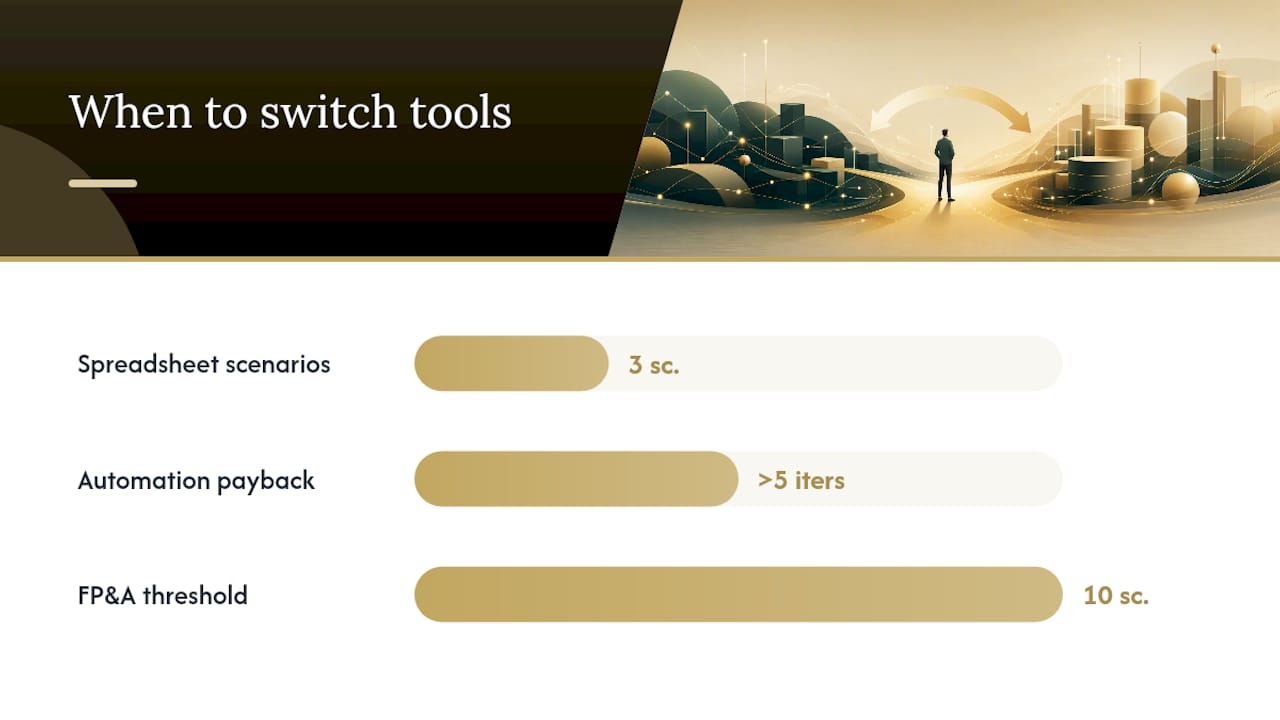
The right tool depends on four factors: the complexity of your scenarios, how often you reforecast, your data integration needs, and your team’s collaboration and auditability requirements.
Tool choice checklist:
- How many scenarios do you run per cycle? (Three is manageable in a spreadsheet; ten or more argues for an FP&A platform.)
- How often does the model need to refresh? (Monthly reforecasting with live data connections favors FP&A/EPM tools.)
- How many people need to edit or review the model simultaneously? (Collaboration at scale is where spreadsheets break down.)
- Do you need an audit trail for board or investor review? (FP&A platforms log changes automatically; spreadsheets require manual version control.)
Spreadsheet best practices (Excel or Google Sheets):
- One source of truth: a single master workbook, not copies floating in email.
- Version control: date-stamped file names or a shared drive with version history.
- Modular assumptions sheet: all inputs in one tab, all formulas referencing that tab.
- Scenario switches: a single cell or dropdown that changes all scenario-specific inputs at once.
- Documented assumptions: a comment or adjacent column explaining every non-obvious input.
FP&A/EPM platform benefits and trade-offs:
- Benefits: Faster scenario generation, centralized data, automatic audit trails, and the ability to run more scenario iterations without rebuilding models from scratch. Published client examples show organizations reducing model build times from weeks to days after adopting enterprise performance management software.
- Trade-offs: Higher upfront cost, implementation time measured in weeks to months, and a learning curve for the team.
When automation pays back: If you reforecast more than once a month, run more than five scenario iterations per cycle, or need to pull actuals from multiple systems automatically, the time savings from an FP&A platform typically justify the investment within the first year.
How to convert scenario outputs into contingency plans and decision triggers
A scenario model that sits in a spreadsheet without a trigger matrix is an academic exercise. The goal is a playbook your team can execute the day a threshold is crossed, without waiting for a leadership meeting to decide what to do.
How to define measurable triggers:
- Choose a financial metric that is observable in near-real time (weekly cash balance, monthly revenue vs. plan, rolling 13-week cash forecast).
- Set a specific threshold for each scenario (e.g., cash balance falls below 90 days of operating expenses, or monthly revenue misses plan by more than 15% for two consecutive months).
- Assign a single owner responsible for monitoring each trigger.
- Pre-approve the immediate action so execution does not require a new decision.
Sample trigger framework:
| Trigger | Threshold | Immediate action | Owner |
|---|---|---|---|
| Cash runway decline | Below 90 days | Freeze discretionary spend, notify CFO | CFO |
| Revenue miss vs. plan | Greater than 15% for two months | Activate cost reduction playbook | FP&A lead |
| Covenant proximity | Within 10% of threshold | Engage lender, prepare waiver request | CFO |
| Key customer churn | Single customer over 20% of revenue | Accelerate pipeline, review headcount plan | Sales lead + CFO |
Playbook elements for each trigger:
- Communications: who notifies whom, within what timeframe, and with what information.
- Cost actions: specific line items to freeze, reduce, or eliminate, with dollar amounts where possible.
- Financing steps: pre-identified credit facilities, equity options, or asset sales to pursue.
- Stakeholder notification: board, investors, lenders, and key employees who need to know and when.
Governance, cadence, and documentation to make scenario planning repeatable
Scenario planning that runs once a year is better than nothing. Scenario planning that runs on a defined cadence with clear ownership is what actually builds organizational resilience. Financial Professionals makes the point directly: build triggers that automatically mandate strategic changes when thresholds are crossed, and make the process continuous.
Recommended cadence options:
- Monthly reforecast: Update assumptions and rerun scenarios with the latest actuals. Best for businesses with high revenue volatility or tight cash positions.
- Quarterly strategic refresh: Rebuild scenario narratives and reassess key drivers. Best for stable businesses or as the standard cadence for most mid-market companies.
- Event-driven ad hoc: Triggered by a major external event (rate change, regulatory shift, M&A opportunity) or an internal trigger firing. Runs outside the regular cycle.
Documentation and governance essentials:
- A version-controlled assumptions log with dates and change rationale.
- A named model owner responsible for accuracy and updates.
- An approval gate before scenarios are presented to the board (CFO sign-off minimum).
- A post-cycle review: what changed, which triggers fired, and what the model got right or wrong.
| Activity | Frequency | Owner | Primary deliverable |
|---|---|---|---|
| Assumptions update | Monthly | Financial modeler | Updated assumptions sheet |
| Scenario model refresh | Monthly or quarterly | FP&A lead | Revised scenario outputs |
| Trigger monitoring | Weekly | FP&A lead | Trigger status dashboard |
| Strategic scenario rebuild | Quarterly | CFO + FP&A lead | New scenario narratives and model |
| Board/stakeholder review | Quarterly | CFO | Scenario deck with trigger matrix |
Three practical examples that show how scenarios changed real decisions
Enterprise example: Capital allocation under demand uncertainty. A manufacturing company facing uncertain demand for a new product line ran three scenarios before committing to a $12 million capacity expansion. The board approved a phased expansion instead, with a trigger tied to order volume that would release the second phase of capital. The scenario work did not stop the investment. It structured it so the company could survive the downside.
Lesson: Scenario planning does not prevent investment. It prevents overcommitment.
The company implemented a selective price increase targeting only the product categories with the lowest competitive substitution risk, protecting margin without triggering the downside.
Lesson: Scenario outputs make partial or phased decisions visible as options, not just all-or-nothing choices.
The downside scenario showed cash dropping below 60 days of operating expenses by February. The owner negotiated extended payment terms with two vendors and drew down a small line of credit in December, before the slow period hit. Cash never dropped below 75 days. For SMBs, this kind of scenario work is often where an outsourced accounting partner adds the most immediate value: cleaning up the books so the cash forecast is reliable, and building the model so the owner can run it monthly without starting from scratch.

Lesson: For small businesses, a two-scenario cash model built on clean books is worth more than a sophisticated five-scenario model built on unreliable data.
Typical timeline and main cost drivers for scenario planning adoption
Timeline by organization size:
- Rapid prototype (any size): A two-to-three scenario cash model built in a spreadsheet can be ready in two to five business days if the underlying financial data is clean and organized.
- SMB full program: A repeatable monthly scenario process with a trigger matrix and governance cadence typically takes four to eight weeks to set up from scratch, including data cleanup.
- Mid-market rollout: Integrating scenario planning into an existing FP&A cycle with an EPM tool takes two to four months, depending on data integration complexity.
- Enterprise implementation: A full EPM deployment with scenario modeling, automated data feeds, and board-ready reporting can take six to twelve months.
Primary cost drivers:
- Tooling: Spreadsheets are free but labor-intensive. FP&A/EPM platforms carry licensing costs that vary by vendor and seat count.
- Data integration: Connecting your accounting system, CRM, and operational data to a central model is often the largest hidden cost.
- Modeling effort: Building a well-structured, auditable model takes 20–80 hours depending on complexity.
- Governance and training: Documenting the process, training the team, and running the first governance cycle adds time and cost.
- Ongoing maintenance: Monthly updates, assumption reviews, and trigger monitoring require dedicated FP&A capacity.
When outsourcing is cost-effective: For small businesses without a dedicated FP&A function, outsourcing the model build, data cleanup, and recurring reporting to a virtual accounting partner is almost always faster and less expensive than hiring internally. You get a working model and a governance cadence without the overhead of a full-time hire.
Common pitfalls in scenario planning and how to avoid them
Even well-intentioned scenario programs fail. The most common failure modes are predictable and preventable.
- Modeling too many variables. When every input becomes a scenario driver, the model becomes impossible to explain and the outputs lose credibility. Limit key uncertainties to two or three per scenario cycle.
- No clear decision triggers. Scenarios without triggers are stories, not plans. Every scenario needs a measurable threshold and a pre-approved action.
- Infrequent cadence. An annual scenario exercise captures the world as it was, not as it is. Monthly or quarterly refreshes keep the model relevant.
- Stakeholder disbelief. If the business-unit owners do not trust the assumptions, they will not act on the triggers. Involve them in the driver identification step, not just the output review.
- Overfitting to unlikely extremes. A stress test that models a 90% revenue decline is technically a scenario, but it is not useful for operational planning. Keep stress tests severe but plausible.
| Pitfall | Consequence | Mitigation |
|---|---|---|
| Too many variables | Model paralysis, no clear outputs | Limit to 2–3 key drivers per cycle |
| No decision triggers | Scenarios never drive action | Define measurable thresholds before presenting |
| Annual-only cadence | Model is stale when needed | Set monthly or quarterly refresh schedule |
| Stakeholder disbelief | Contingency plans ignored | Co-develop assumptions with business-unit owners |
| Extreme-only scenarios | Plans are not operationally feasible | Keep stress tests severe but plausible |
How scenario planning differs from business-continuity planning
Finance teams sometimes conflate scenario planning with business-continuity planning (BCP). They serve different purposes and should not be merged.
Direct comparison:
- Scope: Scenario planning covers strategic and financial decisions over a 12-to-36-month horizon. BCP covers operational recovery from a specific disruptive event (a cyberattack, a facility outage, a key-person loss) over days to weeks.
- Time horizon: Scenario planning is medium-to-long-term. BCP is short-term and event-specific.
- Outputs: Scenario planning produces financial models, trigger matrices, and capital allocation decisions. BCP produces recovery procedures, communication trees, and operational checklists.
- Ownership: Scenario planning is owned by the CFO and FP&A team. BCP is typically owned by operations, IT, or risk management.
- Typical triggers: Scenario planning is triggered by strategic decisions or market shifts. BCP is triggered by an operational disruption.
When to use each:
- Use scenario planning when you are deciding whether to expand, raise capital, enter a new market, or prepare for a macro downturn.
- Use BCP when you need to know how the business keeps running if a critical system fails or a key team member is unavailable.
A brief example: a retailer facing a potential supply-chain disruption would use BCP to plan how to keep stores stocked for the next 30 days. The same retailer would use scenario planning to model the 12-month revenue and margin impact of a sustained sourcing disruption and decide whether to diversify suppliers or build inventory reserves.
A reusable methodology and checklist for your first scenario planning run
Minimum deliverables for a complete scenario planning cycle:
- Assumptions sheet (all inputs, sources, and rationale)
- Scenario narratives (one paragraph per scenario)
- Model outputs (income statement, cash flow, key metrics for each scenario)
- Trigger matrix (trigger, threshold, action, owner)
- Contingency playbook (communications, cost actions, financing steps)
- Executive summary slide (one page: scenarios, key metrics, triggers, recommended actions)
Checklist by phase:
Define phase:
- Write a one-sentence scope statement.
- Identify two to three key uncertainties.
- Name the scenario types you will run (base, downside, stress).
- Assign a model owner and a process owner.
Model phase:
5. Build or update the assumptions sheet.
6. Write scenario narratives.
7. Set input values for each scenario.
8. Run the model and produce outputs.
9. Validate outputs with business-unit owners.
Act phase:
10. Define measurable triggers for each scenario.
11. Write contingency playbook bullets for each trigger.
12. Get CFO or leadership sign-off on contingency actions.
Govern phase:
13. Schedule the next model refresh.
14. Assign trigger monitoring to a named owner.
15. Document version history and assumption changes.
Suggested executive presentation outline:
- Slide 1: Decision context and scope (one sentence)
- Slide 2: Key uncertainties and scenario descriptions
- Slide 3: Financial outputs by scenario (cash runway, EBITDA, key metrics)
- Slide 4: Trigger matrix (threshold, action, owner)
- Slide 5: Recommended action and next review date
Applying scenario planning in small businesses with an outsourced accounting partner
Small businesses can run a minimal viable scenario program with three scenarios, a weekly cash forecast, and one owner-assigned trigger matrix. The barrier is almost never the concept. It is clean, reliable financial data and the time to build the model.
SMB minimal viable scenario checklist:
- Clean, up-to-date books (monthly reconciliation at minimum).
- A 13-week rolling cash forecast updated weekly.
- Two to three scenarios: base, downside, and one operational scenario tied to your biggest risk.
- One trigger matrix with no more than three triggers and three pre-approved actions.
- A named owner who reviews the trigger status weekly.
- A quarterly refresh scheduled on the calendar.
Roles split: what you handle vs. what an outsourced partner provides:
| Activity | Business owner | Outsourced accounting partner |
|---|---|---|
| Providing business context and driver estimates | Yes | Supports with data |
| Bookkeeping and data cleanup | No | Yes |
| Building and maintaining the scenario model | No | Yes |
| Weekly cash forecast update | Reviews | Prepares |
| Trigger monitoring and alerts | Decides | Monitors and flags |
| Recurring scenario reporting | Reviews | Produces |
| Governance documentation | Approves | Drafts |
A virtual accounting partner like Kelliworks can compress the setup timeline from weeks to days by handling the data cleanup, model build, and recurring reporting that most small business owners do not have time for. The owner focuses on the business decisions. The partner handles the financial infrastructure that makes those decisions reliable. For SMBs considering this path, reviewing what a virtual accounting department actually covers is a practical first step before scoping an engagement. You can also use Kelliworks’s financial consulting checklist for startups to prepare for your first scenario planning session.
What finance leaders actually get wrong when they start scenario planning
Most finance teams approach scenario planning as a modeling problem. It is not. It is a decision-making problem that happens to require a model.
The teams that get the most value from scenario planning are not the ones with the most sophisticated models. They are the ones who defined the decision first, kept the scenarios to three, and got leadership to pre-approve the contingency actions before a trigger ever fired. When a threshold is crossed, they execute. Everyone else calls a meeting.
The second mistake is treating cash flow as an output of the scenario rather than the foundation of it. J.P. Morgan’s guidance is clear: secure reliable cash forecasting first. A scenario model built on unreliable actuals produces unreliable outputs, and unreliable outputs produce inaction. For small businesses especially, the single highest-return investment before building any scenario model is getting the cash flow management fundamentals right.
The third mistake is running scenarios once. Financial Professionals is explicit that scenario planning should be a continuous cycle. The world changes. Your model should too. A quarterly refresh is the minimum. Monthly is better if your business has meaningful revenue volatility.
One organizational reality worth naming: the biggest resistance to scenario planning is not technical. It is cultural. Business-unit leaders who built the original forecast do not always welcome a process that formally acknowledges it might be wrong. Address that directly. Frame scenario planning as preparation, not criticism. The base case stays. You are just building the contingency plans that protect it.
Kelliworks helps small businesses run scenario planning without the overhead
Scenario planning does not require a full FP&A department. What it requires is clean data, a well-structured model, and a recurring process someone actually maintains. That is exactly where Kelliworks fits.
Kelliworks functions as your virtual accounting department, handling the bookkeeping cleanup, model setup, and recurring financial reporting that make scenario planning reliable and repeatable for small businesses. Rather than spending weeks organizing data before you can even start modeling, you work with a partner who has your books current, your cash forecast running weekly, and your scenario outputs ready for your review on a defined schedule. The result is a working scenario program without the cost of a full-time hire.
If you are ready to build a scenario planning process that actually drives decisions, schedule a financial consulting session with Kelliworks to map out your first scenario cycle. You can also explore why small businesses hire a virtual accountant to understand the full scope of what an outsourced partner can handle.
Sources
- Scenario Modeling 101: A Framework for Strategic Financial Planning | Workday
- Scenario planning’s role in business strategy | J.P. Morgan
- Scenario Planning | Financial Professionals Glossary
- Financial scenario planning | Gartner
- What Is Scenario Planning? Strategy, Steps, and Practical Examples | NetSuite
This article is general information, not a substitute for advice from a qualified financial advisor. Consult a qualified financial professional about your own circumstances before acting on anything here.