


Fix three systems first: tidy bookkeeping, simple cash-flow controls, and basic automation such as bank feeds and receipt capture. Start a weekly cash check today and capture transactions daily or weekly so nothing surprises you at month end. If you would rather not run these tasks yourself, a virtual accounting partner can handle the recurring work for you.
TL;DR:
- Update a one page cash projection every Friday, time bills after expected collections, and add regularly to a reserve to spot shortfalls early.
- Reconcile bank and credit card accounts weekly, investigate unusual items the same day, and block invoices lacking purchase orders or approval.
- Compare actual results with the budget each month, investigate gaps, and adjust the next forecast using sales, margins, fixed costs, and seasonal timing.
- Run every business deposit and payment through dedicated accounts, and record any business expense paid personally as a reimbursement in your ledger.
- Automate bank feeds and receipt capture first, then assess software by its connections to banking, payments, and payroll, plus support and weekly usability.
Table of Contents
- Core financial systems every small business needs
- Bookkeeping and recordkeeping best practices that cut errors
- Cash-flow controls: simple tactics to keep cash stable
- Budgeting and forecasting made practical
- Automation and software workflows that actually save time
- Reconciliation and internal controls that reduce month-end work
- Weekly and monthly checklist you can follow today
- Separating personal and business finances
- Integrating payroll and HR management into financial workflows
- Tax planning strategies to optimize cash flow and compliance
- Leveraging business consulting to align finances with growth goals
- Workflow design and operational support to enhance financial processes
- Setting up professional business banking and merchant services
- Using financial dashboards and key performance indicators for monitoring
- Why more owners should hand off the books earlier
- Our help for small businesses that want finances handled
- FAQ
- Sources
Core financial systems every small business needs
Most small businesses do not need complicated finance operations. They need a few systems that talk to each other and give you a clear view of your cash. The U.S. Small Business Administration recommends starting with a balance sheet, choosing an accounting method (cash or accrual), keeping proper books, and getting accounting help where you need it.
- Bookkeeping ledger: the single record of income and expenses that feeds every report you read.
- Business bank account: a dedicated account so every deposit and payment is business activity.
- Invoicing and accounts receivable: a process that bills on time and tracks who owes you.
- Accounts payable and payments: a schedule for bills so you pay on time without draining cash early.
- Payroll: a reliable way to pay people and taxes, even if it is only you at first.
Data should flow in one direction: bank feeds into the ledger, and the ledger into your profit and loss statement and balance sheet. When every transaction enters at one point, your reports stay trustworthy.
A short setup checklist gets you covered: get your EIN, open a business bank account, build a chart of accounts, and write down your basic payment policies, such as invoice terms and who approves bills.
Bookkeeping and recordkeeping best practices that cut errors
Good bookkeeping is mostly habit. Capture transactions daily or weekly, and keep the paperwork behind them organized. The IRS says you may use any recordkeeping system that clearly shows income and expenses, but you must keep supporting documents such as invoices, receipts, deposit slips and canceled checks, because they back up your entries and your tax return. It also says electronic records must provide a complete, accurate record that is accessible to the IRS.
- Record transactions on a fixed day each week, not “when you get to it.”
- Store receipts and invoices digitally, filed by month.
- Use one chart of accounts that lines up with your tax return, so categories do not drift.
- Review uncategorized items weekly, before they pile up.
Pro Tip: Name digital files with the date, vendor and amount. Organized files make receipts easier to find.
Consider hiring a bookkeeper when the work eats more hours each month than you can spare, when you miss deadlines, or when finances cause you stress. Our guide to bookkeeping best practices goes deeper on daily and weekly routines.
Cash-flow controls: simple tactics to keep cash stable
Cash and profit are different things, and mixing them up catches many owners off guard. The SBA points out that confusing cash with profitability is a classic failure: inventory purchases, debt principal repayments and asset acquisitions can drain cash even when your profit and loss statement looks healthy.
Put these controls in place:
- Set clear payment terms on every invoice and enforce them.
- Automate invoice reminders so you never rely on memory to chase a late payment.
- Offer a fast-pay option, such as card or bank transfer, so customers can pay the day they receive the bill.
- Time your bill payments to land after the money you expect to collect, without paying late.
- Build a short-term cash reserve, even a small one, and add to it on a schedule.
- Keep a one-page cash projection that shows expected money in and out over the next several weeks.
The projection does not need to be fancy. A simple sheet that you update every Friday will warn you about a shortfall while you still have time to act. Practical guidance from U.S. Bank agrees: know your break-even point, put cash flow ahead of profit, and improve how you handle accounts payable.
Budgeting and forecasting made practical
A forecast only helps if you actually use it. Start from last year’s numbers, set a plan for each month, and compare plan against actual every month. That is the same approach the SBA describes when it walks through the common budgeting and forecasting mistakes owners make.
Keep the model small and focus on the drivers that move your results:
- Revenue: expected sales by month, with seasonal highs and lows marked.
- Gross margin: what you keep after the direct costs of delivering your product or service.
- Major fixed costs: rent, payroll, insurance and loan payments.
- Seasonal peaks: the months when cash goes out before it comes in.
When actual numbers drift from plan, ask why, then adjust next month. Update the forecast monthly, and assign an owner for the process. In a small team that is often you or a bookkeeper. If you outsource, your accounting partner can prepare the variance report and walk you through it. For a deeper process walkthrough, see our small business bookkeeping guide.
Automation and software workflows that actually save time
Automation should remove repeated typing, not add new tools to babysit. Prioritize these features:
- Bank feeds that pull transactions into your ledger automatically.
- Receipt capture from your phone or email.
- Automated invoicing and payment reminders.
- Payment processing that matches deposits to invoices.
- Payroll that connects to your books.
Use one workflow pattern: capture, categorize, reconcile. Automate capture first, because that is where most manual work and most missed transactions live. APQC reports that reconciliation is the most common bottleneck in the financial close, and that continuous processing and faster reconciliation resolve exceptions sooner and shorten close time.
When you choose software, judge it on practical criteria instead of brand names:
- Integration: does it connect to your bank, payment processor and payroll?
- Support: can you reach a person when something breaks?
- Ease of use: will you or your team actually open it every week?
Pro Tip: Turn on bank feeds and receipt capture early. These features can reduce manual entry.
Capturing paperwork is easier with a one-minute habit. This repair receipts walkthrough shows how property owners snap receipts across multiple properties, and the same idea works for any business with scattered paper.
Reconciliation and internal controls that reduce month-end work
Reconciling your accounts weekly turns a month-end scramble into a quick check. Match your bank and credit card activity to your ledger, and resolve exceptions right away while the details are fresh. APQC notes that reconciliation is a frequent bottleneck and that continuous reconciliation shortens close time.
Add a few simple controls:
- Reconcile bank and credit card accounts every week.
- Block payment of any invoice that has no matching purchase order or approval. APQC recommends this kind of preventative control and fixing input errors at the source to reduce rework.
- Limit who can enter and approve payments, so one person does not do both.
- Investigate unusual items the same day you spot them.
These steps catch mistakes early, keep your cash figures accurate, and make the monthly close short and predictable.
Weekly and monthly checklist you can follow today
Use this routine as written, then adjust it to your business.
- Weekly: import bank transactions, match receipts, run a quick cash check, and send reminders on overdue invoices.
- Monthly: reconcile every account, run the profit and loss statement and balance sheet, compare budget to actual, and prepare next month’s cash projection.
- Quarterly: review your forecast, update your reserve target, and check your estimated tax payments.
- Annually: meet with your tax advisor or accounting partner to plan the year ahead.
Put the weekly items on your calendar as a recurring block. A short session on the same day each week is easier to keep than a long session that you keep postponing.
Separating personal and business finances
Mixing personal and business money is the fastest way to make your books messy. Open a business checking account and, if you use one, a separate business credit card. Run every business deposit and payment through them, and pay yourself on a regular schedule through an owner draw or payroll, depending on how your business is set up.
The payoff shows up in several places. Your ledger reflects only business activity, so your profit and loss statement is accurate. Tax time is faster, because you are not sorting personal groceries from supplies. And if you ever need a loan, a lender can read clean statements without questions.
The IRS says that whether an activity counts as a business depends in part on carrying it on in a businesslike manner and keeping complete, accurate books and records. A separate bank account is one of the plainest ways to show that.
If you have already mixed funds, do not panic. Pick a start date, open the new accounts, and move forward cleanly. Then categorize the older mixed transactions once, mark personal items as owner draws or contributions, and keep a short note explaining what you did. Our team can help clean up older records so that your starting point is solid.
A few habits keep the line clear:
- Never pay a personal bill from the business account, and never the reverse.
- If you must cover a business expense personally, record it as a reimbursement.
- Reconcile the business account weekly so a stray charge shows up fast.
Integrating payroll and HR management into financial workflows
Payroll is where finance and people management meet, and it is easy to let it live in its own silo. When payroll connects to your ledger, every pay run posts wages, taxes and benefits automatically, so your books and your cash forecast stay current without re-keying numbers.
Treat HR records as part of the same workflow. Keep new-hire paperwork, pay rates, time-off balances and classification decisions in one place that your payroll and bookkeeping both rely on. When someone changes pay or leaves, the update flows to payroll first, then to your books.
The SBA lists payroll setup steps and the need to meet federal, state and local tax obligations as part of managing your business. Build those into your calendar: payroll tax deposits, quarterly filings and year-end forms all have deadlines, and missing them costs money.
Practical ways to tighten the process:
- Run payroll on the same schedule every period so your cash plan can count on it.
- Reserve payroll taxes in a separate account the day you run payroll.
- Review a payroll summary against your ledger each month.
- Document who approves hires, raises and bonuses.
If you hire across state lines, the rules multiply quickly. Our guides on setting up small business payroll and payroll compliance lay out the steps. We also handle payroll and HR solutions for clients who would rather not track every deadline themselves.
Tax planning strategies to optimize cash flow and compliance
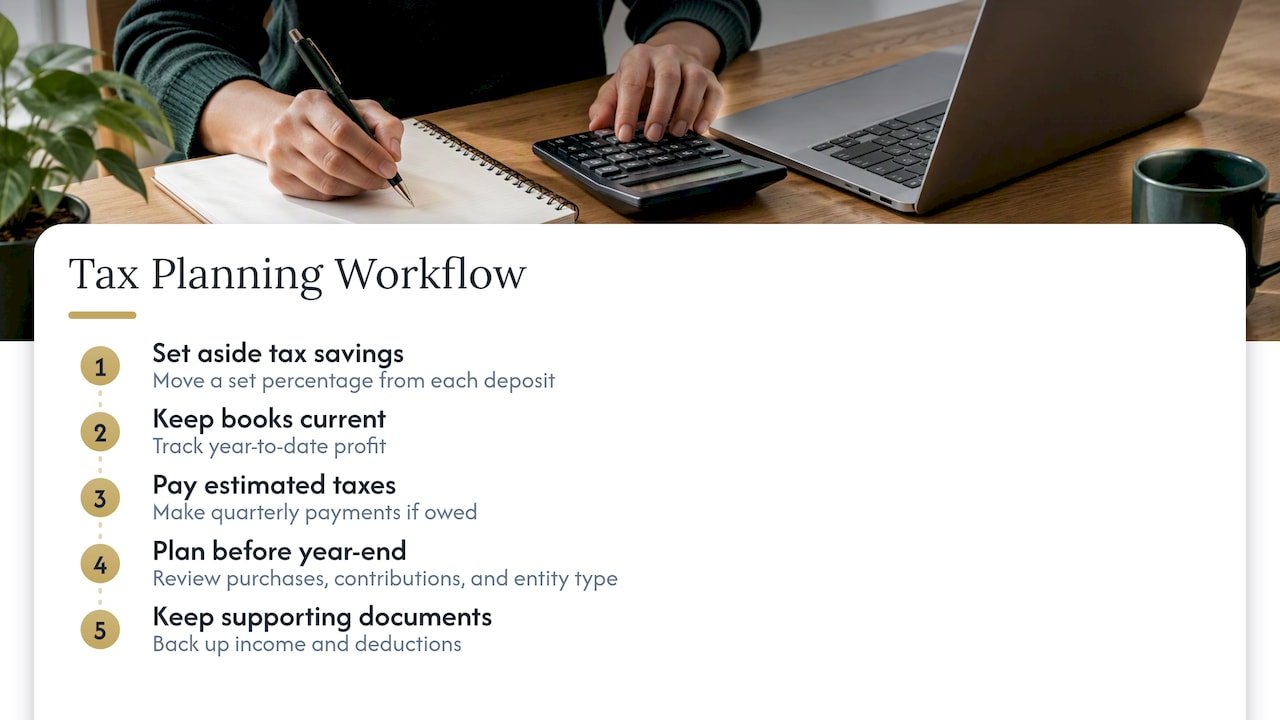
Tax planning works best when it happens all year, not in March. The goal is to avoid surprises: know roughly what you will owe, set the money aside as you earn it, and pay on time.
Start with a simple habit. Move a set percentage of each deposit into a separate tax savings account, and ask your tax advisor what percentage fits your situation. Keep your books current so you can see year-to-date profit at any time, because that number tells you whether your estimated payments are on track.
Next, understand your payment schedule. If you owe estimated taxes, missing quarterly payments can lead to penalties, and the rules for safe harbor payments depend on your income and prior-year tax. Our explainer on the estimated tax safe harbor walks through how it works, and your advisor can confirm what applies to you.
Then look at timing and structure. Decisions about equipment purchases, retirement contributions and your entity type can change both your tax bill and your cash. These are choices to make with a professional before year end, not after. Our overview of a tax savings strategy covers the questions worth asking, and our early-stage tax planning guide helps new founders get started.
Good records make all of this easier. The IRS expects you to keep supporting documents that back up your income and deductions, so a clean filing system pays off at tax time. If you have outstanding returns, we can help you catch up.
Leveraging business consulting to align finances with growth goals
Bookkeeping tells you what happened. Consulting helps you decide what to do next. When you are planning to hire, raise prices, open a second location or take on debt, a financial consultant turns your numbers into a plan.
A useful consulting engagement starts with your goals and works backward. How much revenue do you want next year? What margin do you need to hit it? How much cash will it take to get there, and when? Your books supply the starting point, and the consultant builds the forecast, the budget and the milestones around it.
The SBA recommends getting accounting help from a CPA, bookkeeper or online service for functions such as receivables, payables, reconciliation and payroll. Consulting sits on top of that foundation and focuses on decisions rather than data entry. For free guidance, SCORE offers mentoring and resources for small business finance, and Small Business Development Centers provide local help.
Signs it may be time to bring in a consultant include missing growth targets with no clear reason, uncertainty about pricing or margins, or a big decision ahead that depends on cash you do not yet have. Our post on signs your business needs financial consulting lists more, and we explain how consulting differs from bookkeeping for owners weighing the two. Before your first meeting, our preparation guide helps you bring the right documents.
Workflow design and operational support to enhance financial processes
Even with good software, finances slow down when the steps are unclear. Workflow design means writing down who does what, in what order, and by when. It sounds simple, and it removes most of the “who was supposed to send that invoice?” moments.
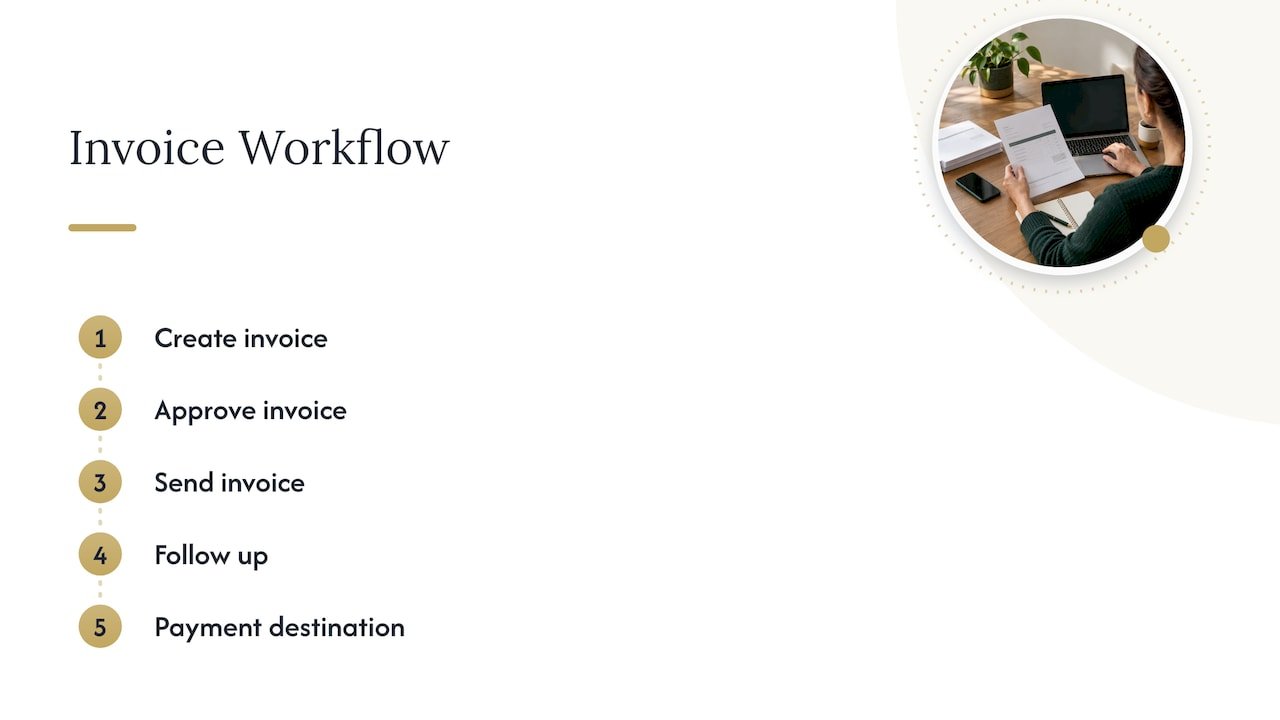
Map one process at a time. Take invoicing: who creates the invoice, who approves it, when does it go out, who follows up, and where does the payment land? Once the steps are on a single page, you can spot gaps and decide which ones to automate.
The same approach works for paying bills, handling expense reports and closing the month. For each, define the trigger, the owner, the deadline and the check that confirms it is done. APQC advises fixing problems at the source rather than correcting them downstream, and good workflow design puts that advice into practice.
Contracts and payment terms belong in the workflow too. When terms are captured clearly at signing, invoicing goes smoothly later. This contract management post shows one way solo professionals keep agreements and billing details in one place.
If building these processes feels like a second job, operational support can take it off your plate. We design workflows, document them and run them alongside you, so your finance routine keeps working when you are busy.
Setting up professional business banking and merchant services
Your bank is the foundation of your cash visibility, so set it up deliberately. Open a business checking account in your business’s legal name, and consider a savings account for taxes and reserves. Ask about fees, transaction limits, cash deposit rules and whether the account connects cleanly to your accounting software through bank feeds.
Merchant services are how you accept card payments. Compare processing fees, how quickly funds reach your account and whether the processor integrates with your invoicing and books. Matching deposits to invoices is much easier when the processor sends clear, itemized payout reports.
A few setup tips:
- Separate accounts for operating cash, taxes and reserves make your cash position easy to read.
- Turn on alerts for large withdrawals and low balances.
- Give each person only the access they need.
- Keep your business address and contact details consistent across accounts.
For new businesses, banking setup often goes hand in hand with forming the entity. We help with business formation and incorporation, including banking setup, a registered agent and annual compliance filings. If you need a professional business address or mail handling, our virtual mailbox services can help with that too.
Using financial dashboards and key performance indicators for monitoring
A dashboard is a one-page view of the numbers that tell you whether your business is healthy. Most accounting software can produce one, and a spreadsheet works fine to start. The point is to look at the same few figures on a regular schedule.
Choose a handful of indicators and resist the urge to track everything. These cover most small businesses:
- Cash balance and projected cash: how much you have and how long it will last.
- Receivables aging: how much is owed to you and how late it is.
- Gross margin: whether your pricing covers direct costs.
- Budget versus actual: where results are drifting from plan.
- Reconciliation status: whether your books are current.
That last one matters more than it sounds. APQC treats bank reconciliation cycle time as a signal of how smoothly your close is running, and it publishes a benchmark for the average cycle time to reconcile the general ledger if you want a point of comparison.
Review the dashboard weekly for cash and receivables, and monthly for margin and budget variance. When a number moves in the wrong direction, you have time to respond. Custom financial reporting is part of what we build for clients, so the dashboard shows what matters to your business.
Why more owners should hand off the books earlier
Most owners wait too long to outsource. They treat accounting as a cost to avoid until a tax notice, a missed payroll or a cash crunch forces the issue. We see it differently. Your time is the scarcest resource in the business, and every hour spent fighting a ledger is an hour not spent selling, serving or planning.
Outsourcing makes sense when your time is limited, when payroll or multi-state rules add complexity, when you have growth goals, or when you need predictable cash and forecasting. A virtual accounting partner typically handles recurring bookkeeping, payroll, tax preparation coordination and cash-flow forecasting. Our article on the benefits of outsourced bookkeeping explains how this keeps you ready for the IRS all year. As the founder of KelliWorks, I have built our department around that kind of steady, recurring support.
— Kelli
Our help for small businesses that want finances handled
If you want a done-for-you routine, we run it with you. Our team provides full-service bookkeeping, payroll processing, cash-flow management, budgets and forecasting, and tax planning and preparation. The result is cleaner books, fewer late invoices, steadier cash and more of your time back for growth.
We tailor each engagement to your business, virtually or in person. Pricing depends on your needs and is available on request, and our post on accounting service pricing explains what shapes it. Ready for a next step? Book a free consultation and tell us where your finances feel hardest to manage.
This article is general information, not a substitute for advice from a qualified financial advisor. Consult a qualified financial professional about your own circumstances before acting on anything here.
FAQ
How can I improve cash flow in a small business?
Set clear payment terms, send invoice reminders automatically and offer fast ways to pay. Keep a one-page cash projection and a small reserve so you see shortfalls early. The SBA warns that cash and profit are not the same, so track both.
Is QuickBooks worth it for a small business?
It can be, if it connects to your bank, payroll and payment processor and you will actually use it weekly. Judge any accounting software on integration, support and ease of use rather than the brand. We set up QuickBooks for clients who want a clean start.
What is the best finance software for small businesses?
The best choice is the one that automates bank feeds, receipt capture, invoicing and reminders, and fits your team’s comfort level. Compare integration, support and ease of use before you commit. APQC finds that automation and continuous processing help resolve exceptions earlier.
Do most small businesses really fail because of cash flow?
Cash problems are a common and serious risk, but a precise failure rate depends on the study and how it counts. Widely repeated percentages are hard to verify, so focus on what you can control: visibility, payment terms and a reserve. The SBA describes confusing cash with profit as a classic mistake.
Sources
- What kind of records should I keep | Internal Revenue Service
- Manage your finances | U.S. Small Business Administration
- Metric of the Month: What Bank Reconciliation Cycle Time Really Tells You